



'Inadequate safety culture' to blame for Uber's automated vehicle crash
The pedestrian’s impairment at the time of the crash, coupled with crossing outside a crosswalk, contributed to the crash.


NTSB investigators on-scene in Tempe, Arizona, examining the Uber automated test vehicle involved in the collision.
Photo by NTSB
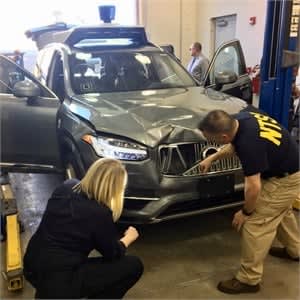
NTSB investigators on-scene in Tempe, Arizona, examining the Uber automated test vehicle involved in the collision.
Photo by NTSB
The National Transportation Safety Board (NTSB) called upon federal regulators to create a review process before allowing automated test vehicles to operate on public roads, based upon the agency’s investigation of a fatal collision between an Uber automated test vehicle and a pedestrian.
During a board meeting held to determine the probable cause of the March 2018 crash in Tempe, Ariz., the NTSB said an Uber Technologies Inc. division’s “inadequate safety culture” contributed to the fatal collision between an Uber automated test vehicle and a pedestrian. The vehicle operator was uninjured in the crash, the pedestrian died.
Uber’s Advanced Technologies Group had modified the striking vehicle, a 2017 Volvo XC90, with a proprietary developmental automated driving system. The vehicle’s factory-installed forward collision warning and automatic emergency braking systems were deactivated during the operation of the automated system. An Uber ATG operator was in the driver’s seat, but the automated system was controlling the vehicle when it struck the pedestrian at 39 mph.
The NTSB determined the immediate cause of the collision was the failure of the Uber ATG operator to closely monitor the road and the operation of the automated driving system because the operator was visually distracted throughout the trip by a personal cell phone. Contributing to the crash was Uber ATG’s inadequate safety risk assessment procedures, ineffective oversight of the vehicle operators, and a lack of adequate mechanisms for addressing operators’ automation complacency — all consequences of the division’s inadequate safety culture.
The pedestrian’s impairment at the time of the crash, coupled with crossing outside a crosswalk, contributed to the crash, as did the Arizona Department of Transportation’s insufficient oversight of automated vehicle testing, the NTSB found.
Among the investigation’s findings:
The Uber ATG automated driving system detected the pedestrian 5.6 seconds before impact. Although the system continued to track the pedestrian until the crash, it never accurately identified the object crossing the road as a pedestrian — or predicted its path.
Had the vehicle operator been attentive, the operator would likely have had enough time to detect and react to the crossing pedestrian to avoid the crash or mitigate the impact.
While Uber ATG managers had the ability to retroactively monitor the behavior of vehicle operators, they rarely did so. The company’s ineffective oversight was exacerbated by its decision to remove a second operator from the vehicle during testing of the automated driving system.
Uber ATG made several changes to address the deficiencies identified, including implementation of a safety management system.
The NTSB issued a total of six recommendations to the National Highway Traffic Safety Administration, the state of Arizona, the American Association of Motor Vehicle Administrators, and Uber ATG.
The NTSB recommended that NHTSA require entities wishing to test a developmental automated driving system on public roads to submit safety self-assessment plans before being allowed to begin or continue testing and that NHTSA should review the plans to ensure they include appropriate safeguards.
More Security and Safety

Transit Agencies Highlight Safety Gains at National Summit
Leaders from 15 major transit systems shared crime-reduction results and safety initiatives while discussing the role of continued federal support.
Read More →
DART Launches Major Security, Fare Enforcement Initiative
The 90-day demonstration will deploy coordinated security teams at five light rail stations while testing controlled access and gathering data to guide future investments.
Read More →
RTD Launches NextRide App to Consolidate Trip Planning, Fares, Security Reporting
The app expands on RTD’s existing NextRide web application and allows customers to view real-time vehicle locations and service alerts, purchase and store digital fares, and access customer support.
Read More →

TAPTCO Updates OSHA Compliance Training for Transit Maintenance Operations
The revamped program addresses 26 OSHA standards for maintenance facilities, with TAPTCO pointing to training, documentation, and everyday shop hazards as continuing challenges for transit operations.
Read More →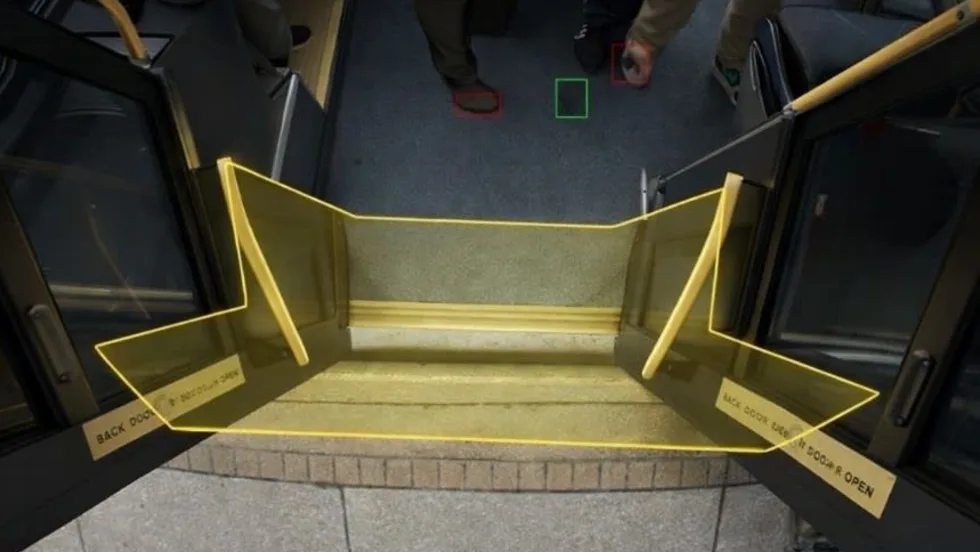
How VaporVision Adds Value to Transit Door Systems
Wabtec engineers explain how the system improves doorway detection, strengthens diagnostics and gives transit agencies and OEMs greater operating flexibility.
Read More →
FRA Announces $5.3B in Rail Investments, Including $2B for Amtrak
Funding will support grade-crossing improvements, infrastructure upgrades, and new Amtrak equipment in 23 states.
Read More →
Chicago, Maryland Expand Non-Law-Enforcement Safety, Rider Support
The CTA and MTA are launching new programs aimed at de-escalation, crisis response, rider assistance, and greater transparency.
Read More →
LA Metro, City of West Hollywood, and Partners Advance Smarter Bus Lane Enforcement
The award-winning partnership combines AI-powered detection with human oversight to improve bus reliability, accessibility, and enforcement efficiency.
Read More →
LA Metro Reports 57% Decline in Homelessness on Transit System Since 2024
The agency's latest homelessness count offers new data on how care-based services and cross-sector partnerships can complement traditional transit security strategies.
Read More →
FTA Launches 'Transit Moves America' Dashboard to Highlight Agency Safety and Performance
The online dashboard transforms National Transit Database information into a public-facing resource that allows users to compare transit agencies on key operational and safety metrics.
Read More →