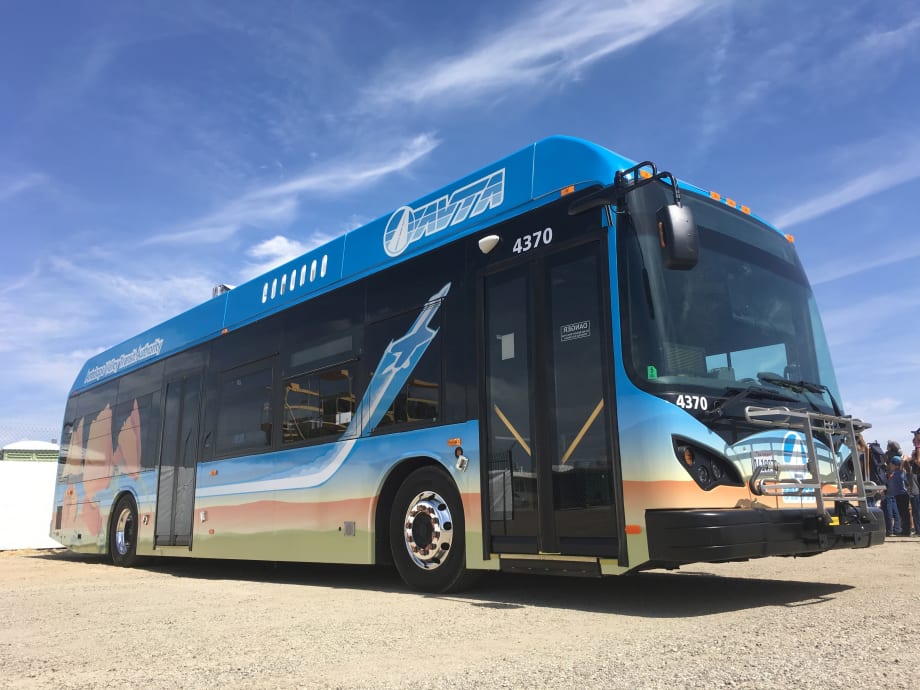
With a theme to be “100% Green in 2018,” the California-based agency recently awarded BYD a contract to supply up to 85 electric buses over a five-year period, with the first 29 set to be delivered over the next year.
by Alex Roman, Managing Editor
May 2, 2016Following the City of Lancaster, Calif.’s growing usage of solar energy — part of its plan to become one of the first “Net Zero Cities” in the world by achieving zero carbon emissions — the Antelope Valley Transit Authority (AVTA) recently took a huge step in making that goal a reality. In February, the agency awarded a contract to BYD to manufacture up to 85 electric buses over a five-year period, in a quest to become the nation's first all-electric bus fleet.
“This is a historic day for AVTA, which has been working diligently to secure grant funding to purchase these state-of-the-art zero-emissions vehicles,” Len Engel, executive director of AVTA, said at the press event announcing the contract. “We are proud to be the first transit system to adopt a goal of ‘100% Green in 2018,’ and we look forward to leading the nation toward a new alternative in public transportation.”
Under the order from AVTA, BYD will build and deliver a mix of 40- and 60-foot low-floor buses as well as 45-foot commuter coaches, as funding permits, to replace its current fleet of diesel buses. The initial-funded order will consist of 13 60-foot articulated buses and 16 commuters, which will be built at BYD’s Lancaster, Calif., plant that is mere minutes away from AVTA’s facility.
Initial Usage
AVTA’s path toward going electric began with a $1.9 million grant from Los Angeles County Supervisor Michael D. Antonovich to purchase two electric buses from BYD that would use inductive charging, which is currently being installed by Salt Lake City’s WAVE Technologies Inc.
Since receiving the first of those vehicles in the spring of 2014, AVTA has experienced positive results, including a 90% in-service rate and $1.20 cost-per-mile savings versus its older diesel buses.
“If you multiply the per-mile savings by the 500,000 miles you can do over 12 years, that is a significant savings over the life of the bus,” says Engel.
Depending on the operator, Engel adds that the agency is recording an average range of 185 miles per charge since putting the vehicles in service, with their more experienced operators getting as much as 220 miles per charge.
Aside from the overall cost per mile to run the electric vehicles, Engel adds that the agency has also experienced some unexpected benefits as well.
“One of the things we’ve been surprised about is that the tire and brake wear on the BYDs is significantly lower than on our diesel buses — we have one bus right now that has over 46,000 miles and we haven’t touched the brakes or the tires yet,” he says. “Also, since there is no transmission, we won’t have to overhaul them at mid-life and the motor costs about half of what a diesel engine would. That savings, will again, go back into the long-term savings of owning these electric buses.”
“What we said about the performance of our buses has not only proven true, but has actually been better than what we presented,” says Macy Neshati, BYD’s VP, coach and bus sales. “We have undercommitted and over-delivered, which is a great way to do things from a business perspective.”
100% Green in 2018
“Our thought was that the faster we get this thing going, the better our chances of getting funding,” says Engel on why the AVTA has taken such an aggressive approach with going electric. “At the time we started, there weren’t many agencies going after the money that was available, however, that is not necessarily the case now…there are a lot of people getting on the electric bus bandwagon now.”
The initial order includes 29 electric buses — 13 60-foot articulated and 16 commuter coaches — that will be delivered over the next 12 months, as well as the equipment for 11 200-kilovolt-amp (kVA) inductive chargers and the secondary pads that will be installed on the buses. Funding for the $39.4 million project comes from a significant $24.4 million Transit and Intercity Rail Capital Program (TIRCP) grant from the California Department of Transportation, with the rest coming through Federal 5307 funding and local match.
Engel says the AVTA’s plan to create a bus rapid transit route down one of its major corridors where there are often standees was a major factor in the agency’s ability to secure the TIRCP funding.
“The story we told to the California State Transportation Agency last year was that with articulated buses we will connect to the Palmdale Transportation Center where folks could catch a Metrolink commuter train, which will also be the Antelope Valley depot for high-speed rail when it eventually comes through,” he says. “We were able to argue that the route would be serving what the state calls ‘disadvantaged communities,’ based on the CalEnviroScreen 2.0 scale for air pollution. And because it was a transit and intercity rail capital program, the articulated buses fit well with their idea for connecting rail.”
Obstacles
Engel says that funding will be the biggest obstacle for the agency in trying to reach its aggressive 2018 goal, with the agency focusing more on California-based funding sources versus the oversubscribed federal programs, where there is currently only $55 million available nationwide through the FTA’s Low or No Emission Vehicle Deployment Program (Low-No).
Another challenge the AVTA faces, will be building the infrastructure to be able to charge up to 85 electric buses. The agency is currently in the final phases of design on the infrastructure necessary, with construction set to begin this summer at an estimated cost of $5 million. AVTA is also looking into the possibility of attaining a grant to acquire some additional property for solar panels and battery storage.
“The facility will also include an I/O Controls software system that will control how each bus draws power from the grid so that we can keep the balance,” says Engel.
Another hurdle for AVTA has been negotiating power and bringing enough power into its facility to actually charge the buses. The agency has negotiated with the city’s power utility to gain a favorable price on electricity and reached an agreement to avoid demand charges. The agency will also be able to allocate energy generated at its facility via solar panels to the inductive charging stations that will be onsite at a local city park.
Engle says that getting out in front of setting up the charging infrastructure would be the biggest takeaway for an agency looking to take on a similar project.
“You really have to start the engineering early. The infrastructure necessary to charge the buses is something that we didn’t get on nearly fast enough,” says Engel. “For instance, when we bring the new cabling into our facility, we will have open trenches. They will need to stay open to allow for heat dissipation, but we also had to figure out a way to keep them covered for safety reasons because you’re dealing with 12,500 volts.”
Engel adds that to combat the possible loss of power in the instance of a blackout, the agency will also invest in a $1 million generator.
He also says that while challenging, he is excited at what’s ahead for the agency in reaching its goal.
“It’s exciting because we are looking at some really significant savings in the future,” Engel says. “Yes, it is cutting edge, but we’re willing to be there and willing to share any of our experiences with transit agencies around the nation.”