



How to solve 3 common problems facing corporate commuter shuttles?
Addressing where the buses should park in the middle of the day and other common corporate shuttle challenges.
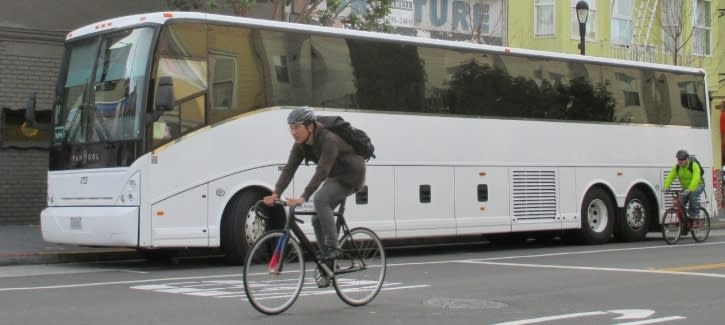
Corporate commuter shuttles have specific challenges other transit operations may not have to face
Metropolitan Transportation Commission
Corporate commuter shuttles have specific challenges other transit operations may not have to face
Metropolitan Transportation Commission
Corporate commuter shuttles have specific challenges other transit operations may not have to face, as we found out when improving the efficiency of commuter shuttle operations in Silicon Valley.
These shuttles are provided by large companies — companies whose core business is generally not transportation — to ferry their employees twice a day: from home to office at the beginning of the day and from office to home at the end of the day. This basic setup creates difficulties that are specific to commuter shuttles.
Here are three of those challenges, as well as ways they could be possibly be resolved:
1. Where should buses park in the middle of the day?
The challenge: While public transit may have peak times at rush hours, most buses and trains still operate in the middle of the day. That’s not the case for commuter shuttles, though — and that can make for some rather packed mid-day depots.
To make up for all that daytime down time, companies that operate shuttles tend to use more depots than regular transit operators for the same number of vehicles. But, they still must face the question of where to put which vehicles in a way that would minimize deadhead time and maximize efficiency, while still accounting for the capacity of each depot.
Depot locations, as well as break locations, may also change more regularly for commuter shuttles than for public transit. Since transportation isn’t a core business for the workplaces offering shuttles, they may well not have their own locations but need to rent them, or use depots or parking lots that may not be conveniently located and may only be able to hold a small amount of vehicles at certain times of day.
The solution: Algorithms that distribute the vehicles to depots in the most efficient way cut costs by allocating as many vehicles as possible to the depots that are closest to the workplace, making their deadhead trips the shortest on the end-of-day rides. Then, the buses are distributed to the next closest depot until it’s filled to its maximum capacity and so on until all the buses are parked.
For breaks, it’s important that the workplace scouts out spots that are suitable for break locations and determines how many buses can fit there at a given time. And if a workplace is using multiple bus operators that control specific depots or break locations, the drivers can be split into different groups so that each driver group is assigned to a depot or break location they’re allowed to use.
Planners and schedulers using a high-speed optimization process can easily assign different groups of drivers to different depots and break locations and make shifts both more efficient and easier for drivers by ensuring that most split breaks start and end at the same location.
2. How should you balance heavy traffic with top-notch service?
The challenge: Commuter shuttles are particularly sensitive to traffic because when all your trips are long-distance rush hour commutes — a particular problem if the company is located in a high-traffic region like the Bay area — then trip and deadhead duration can be highly unpredictable.
This can cause delays and makes planning difficult, a problem exacerbated by the levels of on-time performance expected for commuter shuttles: around 95% — far higher than the levels typically expected for public transit operators. After all, workplaces have a vested interest in getting their employees to work on time.
By the same token, leaving too much buffer time without trying to make up for it in other ways can significantly reduce operational efficiency.
The solution: To compensate for traffic variability, leave a big buffer for deadheads and trip times so that extra traffic delays don’t trigger delays in start time. Leaving enough buffer time also allows the same vehicle to be used for subsequent trips rather than needing to assign an extra vehicle, at greater expense, in a bid to adhere to a high level of on-time performance.
To improve operational efficiency without sacrificing on-time performance, it’s helpful to have good visibility into all the trips in the schedule — not just new trips being added, but also preexisting trips — as a way to see where connections between trips might be possible in a way that doesn’t infringe on necessary buffer time.
For instance, if a vehicle arrives at the office at 8 a.m., you might be able to use the same vehicle for a trip that starts near the office at 8:30, instead of sending in another vehicle from a further location that requires an hour-long deadhead.
Trip connections maximize the value of any given trip by reducing both the number of vehicles and the paid time required.
3. How can you comply with complicated break rules?
The challenge: Different regions have different break regulations they need to comply with, and California’s wage order 9 is particularly complex. Its rules mandate a break of at least 10 minutes before the fourth hour of work ends for any driver working over two hours and a break of at least 30 minutes before the fifth hour ends.
Although these labor laws don’t just apply to shuttle operations, the commuter shuttles’ long trips and deadheads at high-traffic times, and the challenge of finding suitable break locations, make it particularly difficult for workplaces to comply with these regulations for their shuttle services.
The solution: One simple but highly inefficient way to comply with these regulations is to schedule duties of up to four hours, as a way of circumventing the need for the required breaks. The problem with this is that it limits operational capabilities, dramatically, and increases the need for additional drivers and vehicles, ultimately bloating operations in a way that wouldn’t be necessary if it were easier to comply with the break rules.
Scheduling optimization that supports custom break rules enables companies running commuter shuttles to have longer, more efficient driver shifts while complying with complex regulations. Since break locations for shuttle trips are not necessarily on the driver’s route, this may include preferences allowing drivers to drive the bus to a specified location to take the required break.
Visibility of the entire schedule at once, combined with support for complicated break rules, mid-day parking, and trip connections, enables shuttle services that can be not only compliant and on time but also streamlined, efficient, and cost-effective.
Amos Haggiag is the co-founder and CEO of Optibus, a high-tech mobility platform provider that improves mass transit performance.
More Technology

From Hardware to Digital Partner: Luminator Charts Its Next Chapter
CEO Magnus Friberg discusses Luminator’s shift toward becoming a digital partner, the growing importance of software and interoperability, and how AI can help agencies improve operations and passenger experience.
Read More →
Beyond the Checklist: A Structured Approach to Transit Maintenance
Reliability-Centered Maintenance helps transit agencies move beyond routine checklists to focus limited resources on the assets and failures that have the greatest impact on safety, reliability, and service.
Read More →
NJ TRANSIT Advances Bus Technology Upgrades Across Statewide Fleet
More than 1,500 buses now feature upgraded technology designed to improve arrival predictions and provide free Wi-Fi, with deployment expected to reach nearly 2,000 buses by the end of 2026.
Read More →

Building a Flexible Path to Transit Electrification
John Hroncich discusses BAE Systems’ modular and scalable approach, lessons learned from decades of real-world operations, and how agencies can identify electrification strategies that fit their fleets.
Read More →
Biz Briefs: Alstom Lands Canadian Contract, LYT to Supply California TSP, and More
In METRO's latest installment, we take a look at recent news from Complete Coach Works, Beep, FlixBus, and more partnerships making headlines across the transportation sector.
Read More →
From Legacy Silos to Conversational Intelligence
What if transit leaders could ask any operational question and get a trusted answer in seconds? Conversational AI is transforming how agencies use their data.
Read More →
USDOT Announces Rail Vehicle Replacement Grants, Chattanooga AV Shuttle Funding
More than $191 million in federal funding will help three transit agencies replace aging rail vehicles and support a new autonomous shuttle service in Chattanooga.
Read More →
Bus Tech Talk: Keeping Transit Technicians Ahead of the Technology Curve
LA Metro’s Obed Mejia discusses technician training, evolving maintenance technology, fleet replacement, and strategies for getting the most out of today’s transit fleets.
Read More →
Biz Briefs: RIPTA Unveils New Frontrunners, Clevland RTA Adds New Siemens, and More
In METRO's latest installment, we take a look at recent news from Siemens, Prevost, Dodge, and more partnerships making headlines across the transportation sector.
Read More →
Why Simulating Pedestrian Movement Has Become Essential for Modern Rail Stations
Pedestrian microsimulation is helping rail planners identify bottlenecks, test station designs, and prepare complex transit hubs for growing passenger volumes.
Read More →