



DTNA CEO says future of commercial transport is battery-electric
Speaking to a crowd assembled in Long Beach, Nielsen said, “The road to emissions-free transportation is going to be driven with battery-electric vehicles. I believe the future is electric.”

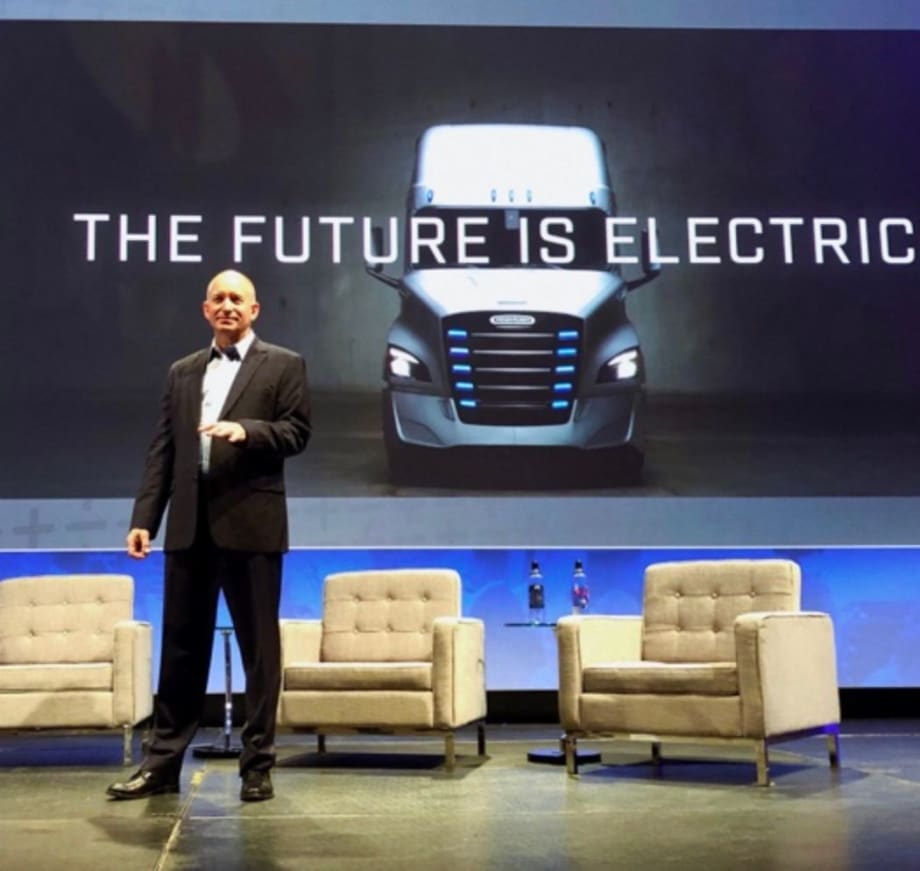
During his keynote speech at the 2019 ACT Expo in Long Beach, California, Roger Nielsen stated the future of commercial vehicles is battery-electric.
During his keynote speech at the 2019 ACT Expo in Long Beach, California, Roger Nielsen stated the future of commercial vehicles is battery-electric.
Roger Nielsen, president/CEO of Daimler Trucks North America (DTNA), the largest commercial vehicle manufacturer in North America, declared battery-electric vehicles as the solution to achieve emissions-free commercial transportation in North America.
Speaking to a crowd assembled in Long Beach, Nielsen said, “The road to emissions-free transportation is going to be driven with battery-electric vehicles. I believe the future is electric.”
The road to emissions-free driving, he continued, does not include plug-in hybrids for DTNA. Near-zero-emissions natural gas medium- and heavy-duty vehicles are currently available and will continue from Freightliner as an interim solution until full commercialization of the battery-electric Freightliner eM2 and eCascadia. The company sees potential for hydrogen fuel cells to extend battery-electric truck range, but does not see it as viable in the near term.
The vision of electric vehicles does not exclude fuel cells: “I can see glimpse of it over the horizon, but it will not be this generation of engineers who will be delivering it,” continued Nielsen.
To hasten the arrival of zero-emission commercial transport, three goals must first be achieved:
First, the industry must work together to establish a common battery-electric vehicle charging infrastructure. Daimler AG is a founding member of CharIN, an organization whose aim is to standardize charging requirements for electric vehicles, including commercial vehicles.
Second, batteries must become cheaper, lighter, and more powerful. DTNA is leveraging its global network to develop proprietary batteries for its commercial vehicles that meet the standards of quality, durability, and integration that customers demand.
Finally, the real cost of ownership for customers must be strengthened through increased incentives, decreased maintenance costs, and cheaper energy costs. Organizations like the South Coast Air Quality Management District (SCAQMD) will be instrumental in creating a viable business case for electric trucks. A $16M grant from SCAQMD partially funds the Freightliner Electric Innovation Fleet.
To enable rapid scale-up of thoroughly tested and validated electric vehicles, DTNA announced today that they will begin converting the Portland manufacturing plant to produce electric Freightliners. The plant lies just blocks from DTNA’s LEED Platinum headquarters. The plant renovations begin next year with series production scheduled to begin in 2021.
DTNA’s school bus division, Thomas Built Buses (TBB), is nearly ready to begin producing Proterra-powered Saf-T-Liner eC2s. The buses will be assembled at TBB’s school bus manufacturing plant in High Point, N.C.
Last year DTNA formed the Freightliner Electric Vehicle Council composed of 30 customers with strong use-cases for electric trucks to further drive its sustainable transportation program. The company is working with the council members to ensure a holistic approach to launching electric trucks. Members of the customer council benefit from co-development of deployment strategies for battery electric vehicles including applicable use cases, current legislation and requirements for facilities, charging infrastructure, and service support.
More Technology

Public Transit Conference Returning to GFX in 2027, Call for Papers Now Open
The Call for Papers is now open, allowing transit agency professionals and industry experts to help shape the PTC educational program by submitting session ideas for consideration.
Read More →
ENC Lands MATA Contract and More in Biz Briefs
In this edition of Biz Briefs, we spotlight the latest developments shaping the future of mobility.
Read More →
Strada360’s Steve Lassey on Turning Transit Data Into Better Decisions
From breaking down data silos to preparing for AI, Strada360 CEO Steve Lassey discusses how transit agencies can use technology to improve operations, customer information, and long-term decision-making.
Read More →
Almaviva Looks to Open Architecture to Advance Transit Technology
Eric Reese discusses how interoperability, open architecture, and modular design can help transit agencies control costs, reduce vendor lock-in, and upgrade technology without starting over.
Read More →
Driving Smarter Paratransit
John Hanlon shares how AlphaRoute is leveraging AI-powered technology to help paratransit providers optimize operations, support frontline staff, and enhance the rider experience.
Read More →
From Hardware to Digital Partner: Luminator Charts Its Next Chapter
CEO Magnus Friberg discusses Luminator’s shift toward becoming a digital partner, the growing importance of software and interoperability, and how AI can help agencies improve operations and passenger experience.
Read More →
Beyond the Checklist: A Structured Approach to Transit Maintenance
Reliability-Centered Maintenance helps transit agencies move beyond routine checklists to focus limited resources on the assets and failures that have the greatest impact on safety, reliability, and service.
Read More →
NJ TRANSIT Advances Bus Technology Upgrades Across Statewide Fleet
More than 1,500 buses now feature upgraded technology designed to improve arrival predictions and provide free Wi-Fi, with deployment expected to reach nearly 2,000 buses by the end of 2026.
Read More →
Building a Flexible Path to Transit Electrification
John Hroncich discusses BAE Systems’ modular and scalable approach, lessons learned from decades of real-world operations, and how agencies can identify electrification strategies that fit their fleets.
Read More →
Biz Briefs: Alstom Lands Canadian Contract, LYT to Supply California TSP, and More
In METRO's latest installment, we take a look at recent news from Complete Coach Works, Beep, FlixBus, and more partnerships making headlines across the transportation sector.
Read More →