



Brampton, Ontario 'Züms' toward boosting ridership with BRT service
The Züm service will be completely integrated into Brampton's existing transit system. Passengers will be able to ride the buses at no extra cost and transfer quickly and easily between lines.
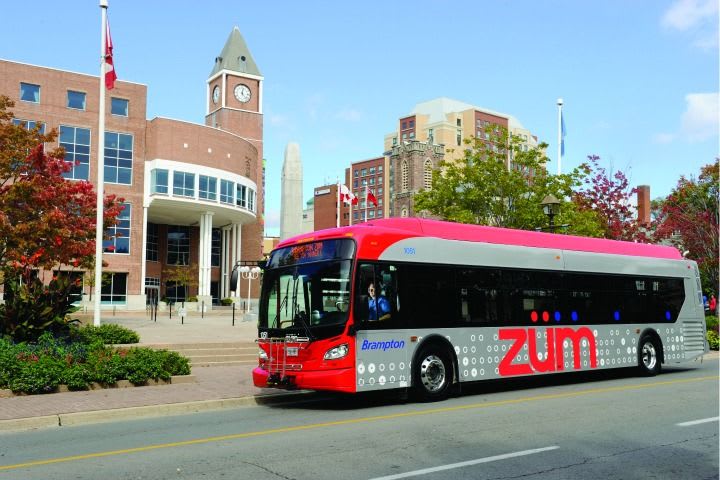
Phase one of the project will introduce 61 new buses to Brampton's transit system. These will serve the three Züm lines opening over the course of the project's first phase, including the now operational Queen St. corridor.
[IMAGE]MET11news-zum-2.jpg[/IMAGE]The City of Brampton in Ontario, Canada, has seen its transit ridership grow at approximately three times the national average since 2005. For 2010, the ridership increase stands at 12 percent to date. Since the passing of the Transportation and Transit Master Plan in 2004, the city has been striving to better streamline its public transit by introducing a grid-based system and, most recently, a bus rapid transit (BRT) service called Züm (pronounced "zoom").
The first Züm line opened in September on Queen St., one of Brampton's major transit corridors, coinciding with the highest ridership of the city's public transportation in history. The remainder of the Züm service will be introduced over the project's two phases.
"Our city is growing rapidly — it's one of the fastest growing cities in Canada," said Sue Connor, director of transportation for Brampton Transit. "We've compared our ridership to the growth of the city. Up to this point, we've been gaining about 25 percent new riders, and we think that's going to increase now that this new Züm service is in place."
Phase one of the project will introduce 61 new buses to Brampton's transit system. These will serve the three Züm lines opening over the course of the project's first phase, including the now operational Queen St. corridor. In 2011, Züm will begin serving Main St.; phase one will be completed in 2012 with the addition of a Züm line on Steeles Avenue.
In 2012, when Züm begins serving Steeles Ave., the city will begin to employ 60-foot articulated vehicles.
"After we get through the first phase, because of passenger volumes, we'll be needing 60-foot buses," Connor explained. At completion, the Züm service will include 65 articulated buses that are 60 feet in length and 41 conventional buses 40 feet in length.
"And on top of that, we have 238 buses in our conventional fleet as well," Connor adds.
The Züm service will be completely integrated into Brampton's existing transit system. Passengers will be able to ride Züm buses at no extra cost and transfer quickly and easily between lines.
"The Züm BRT lines will run in the major corridors throughout the city — east, west, north, south — and then on the major arterial roads feeding into those lines. We have conventional service, which is upgraded to a 10-minute frequency," Connor said.
Brampton's entire transit system has also been updated to include real-time information for passengers. GPS in each bus helps the city to track any delays and make service adjustments accordingly.
Each Züm bus is equipped with a security camera, LED headlights and a visual and audible stop announcement system. The interiors have been branded with the Züm logo and according to third-party testing, the buses have the lowest interior noise ever recorded.
The New Flyer-manufactured Züm vehicle is a hybrid-diesel and "the first bus in North America to have an electronic instrumental panel," Connor says. Brampton is the first city in North America to employ this vehicle model, which has "10 percent less weight than a normal, conventional bus on the market right now." Connor said the city is expecting an 8 to 10 percent drop in fuel consumption due to the vehicle's efficiency boosting features.
The $285 million Züm project will include the construction of transit infrastructure at major intersections for BRT use that will include queue jump lanes, bus bays, station stops and major technology upgrades. A Züm route on Bovaird — part of phase two - is due to be completed in 2014.
"The buses get really positive feedback," Connor continued. "Our challenge now is convincing people to move out of cars, out of that congestion and get on our buses. We're doing that by selling the control, the comfort and the convenience that the Züm service provides."
More Bus
Biz Briefs: New Flyer Delivers in Columbus, Houston, Beep and Freebee Merge, and More
In this edition of Biz Briefs, we spotlight the latest developments shaping the future of mobility.
Read More →
People Movement: Dan Dipert Coaches Adds Third-Generation Leader, Keolis Names New Valley Metro VP/GM, and More
In this edition, we also cover recent appointments and announcements at the Wabtec, SilverRide, HNTB, and more, showcasing the individuals helping to shape the future of transportation.
Read More →
New York MTA Plans Largest Bus Fleet Upgrade in More Than a Decade
The agency is seeking manufacturers for 650 new CNG buses to replace aging vehicles, improve reliability, and advance its broader fleet modernization strategy.
Read More →
Building a Flexible Path to Transit Electrification
John Hroncich discusses BAE Systems’ modular and scalable approach, lessons learned from decades of real-world operations, and how agencies can identify electrification strategies that fit their fleets.
Read More →
Bus Tech Talk: Keeping Transit Technicians Ahead of the Technology Curve
LA Metro’s Obed Mejia discusses technician training, evolving maintenance technology, fleet replacement, and strategies for getting the most out of today’s transit fleets.
Read More →
Biz Briefs: RIPTA Unveils New Frontrunners, Clevland RTA Adds New Siemens, and More
In METRO's latest installment, we take a look at recent news from Siemens, Prevost, Dodge, and more partnerships making headlines across the transportation sector.
Read More →
People Movement: Holly Arnold Joins Transdev and More
In this edition, we also cover recent appointments and announcements at Pace, CamTran, MCI, and more, showcasing the individuals helping to shape the future of transportation.
Read More →
The High Cost of Transit Buses: Industry Leaders Look to Procurement Reform
Transit leaders and policymakers examine how standardized bus designs, streamlined procurement, and predictable funding could help agencies stretch budgets and deliver better service.
Read More →
The Business Voice Behind Public Transportation
As chair of APTA’s Business Members Board of Governors, Ray Melleady explains how more than 850 business members are partnering with transit agencies to advance funding, innovation, and industry-wide collaboration.
Read More →
From Surviving to Thriving: Building Stronger Transportation Organizations
Bus Business Consultants founder Brian Dickson shares lessons on leadership, organizational health, and creating options for long-term success in a changing transportation industry.
Read More →