



Nashville MTA restores services following rains, flooding
With the rain beginning on Saturday, May 1, and continuing "almost non-stop," MTA was forced to suspend service by mid-morning on Sunday and began focusing on getting all of its equipment to higher ground.
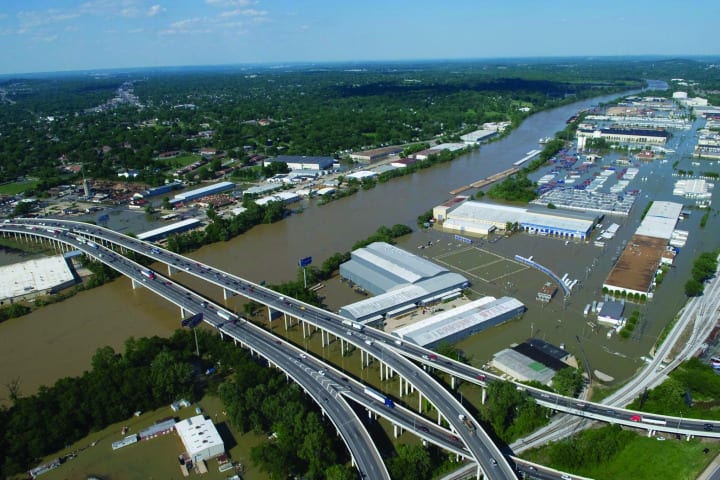
This aerial view of the MTA property along the Cumberland River shows the extent of the flooding. The transit operation's light yellow building is seen on the middle right side with blue bay doors and train cars in front to the right of the river and interstates.
[IMAGE]Nashville.jpg[/IMAGE]In May, the rain from powerful thunderstorms swelled the Cumberland River, which then flooded the streets of Nashville, Tenn., forcing the Metropolitan Transit Authority (MTA) to suspend services and begin trying to salvage its vehicles and equipment.
"Our offices and garage is close to the Cumberland River. The rain came down so heavily, it actually flooded us from the front of the building before the river even came up," said MTA's CEO Paul J. Ballard. "Then, the river came up and the two combined and that's why the water rose so quickly."
With the rain beginning on Saturday, May 1, and continuing "almost non-stop," MTA was forced to suspend service by mid-morning on Sunday and began focusing on getting all of its equipment to higher ground.
"It was pretty rough. Nashville was just devastated. There were people in town drowning in their own cars at some point," Ballard said. "We were completely out of service Monday, Tuesday and Wednesday because the water stayed high and a lot of the streets were damaged so we couldn't even really get around Nashville."
MTA was able to save most of its valuable equipment, according to Ballard, losing 75 of its 201-vehicle fleet - 36 buses and 39 paratransit vans - as well as several supervisor vehicles and miscellaneous support equipment. The estimated damage MTA reported to the Federal Emergency Management Agency (FEMA) totaled $30 million - $20 million in vehicles and $10 million in property. Ballard explained that the vehicle damage amount was based on replacement value instead of book value, and that it was unclear which amount FEMA would use in considering reimbursement.
FEMA could possibly cover 75 percent of the agency's losses and promised MTA a decision within seven to 10 days; however, as of press time no announcement had been made.
MTA slowly began providing services on holiday and weekend schedules, before finally resuming full services on May 24, using borrowed vehicles from operators throughout Tennessee as well as 25 buses from the Southwest Ohio Regional Transit Authority in Cincinnati.
With the flooding from the Cumberland River receding rather quickly, Ballard explained that the biggest hurdle in getting services restored to normal was not the damage to Nashville's streets, but its ability to service vehicles.
"Following the first week, we were really back to full strength with vehicles," Ballard said. "Because our garage was ruined, we had to move our normal functions to a local school bus garage and our paratransit maintenance was moved over to a Ford dealer, which limited the number of vehicles we could service and fuel."
Ballard added that it looked as if the damaged vehicles will be replaced quickly, with the MTA already placing an order for 35 paratransit vehicles scheduled to be delivered around July for its AccessRide services, and an additional 35 40-foot buses from Gillig that could be delivered by January. He also said that most of the agencies loaning their vehicles have not made any requests to get them back soon.
Although MTA employees lost about 79 personal vehicles during the flood and several had to be rescued via boat during the evacuation procedures, Ballard reported zero were injured in the field, at the facility or throughout the evacuations. He cited MTA's plan to deal with such an incident as a major factor for the accomplishment, as well being able to salvage so many of the agency's vehicles.
"We have an evacuation plan, which we followed, and that's really why we were able to get so many of the buses to safety and report zero injuries," Ballard said. "All in all, it's a nasty thing to have to go through, but I think we're actually better for it."
More Bus
LA Metro September Ridership Climbs 3.9%, Led by Rail Growth
The agency recorded more than 27.2 million boardings, with rail ridership increasing 12.4% year over year and the D Line posting the largest gains.
Read More →
Frontrunner Bus Group Introduces XF Low-Floor Bus with Enhanced Accessibility
The new mid-sized bus features a full flat-floor design, eight-inch curbside step-in height, and zero-entry rear ramp to improve passenger access and operational flexibility.
Read More →
Scenes from APTA TRANSform & EXPO 2026
Transit leaders, manufacturers, and industry professionals gathered in Chicago to explore new technologies, share ideas, and discuss the future of public transportation.
Read More →
More Than a Summer Job: Building the Next Generation of Transit Talent
The Delaware River Port Authority and PATCO have transformed their internship program into a hands-on professional development experience that introduces students to the breadth of transportation careers — and creates a pipeline for future employees.
Read More →
LA Metro Board Awards 220 Battery-Electric Bus Contract to ENC
The contract, which is the largest base award of battery-electric buses by a U.S. transit agency, will be built in Southern California, sustaining good jobs as LA prepares to welcome the world in 2028
Read More →
Public Transit Conference Returning to GFX in 2027, Call for Papers Now Open
The Call for Papers is now open, allowing transit agency professionals and industry experts to help shape the PTC educational program by submitting session ideas for consideration.
Read More →
Indian River Transit’s Community-Focused Approach Earns National Recognition
Named APTA’s 2026 Outstanding Public Transportation System in its size category, Florida’s Indian River County transit system continues to grow ridership through fare-free service and a focus on evolving community needs.
Read More →
ENC Lands MATA Contract and More in Biz Briefs
In this edition of Biz Briefs, we spotlight the latest developments shaping the future of mobility.
Read More →
From Surviving to Thriving: Building Stronger Transportation Organizations
Bus Business Consultants founder Brian Dickson shares lessons on leadership, organizational health, and creating options for long-term success in a changing transportation industry.
Read More →
Everett Transit, Community Transit Outline Consolidation Agreement
The proposed agreement calls for a 50% increase in bus service in Everett, a new microtransit zone, continued paratransit service, and the transfer of Everett Transit operations to Community Transit.
Read More →