




RELATED: New financing tools make electric bus buying easier
BYD produces 300th battery-electric bus at California plant
Also celebrated impending Antelope Valley Transportation Authority milestone of one million miles of zero-emission bus operations.
April 4, 2019
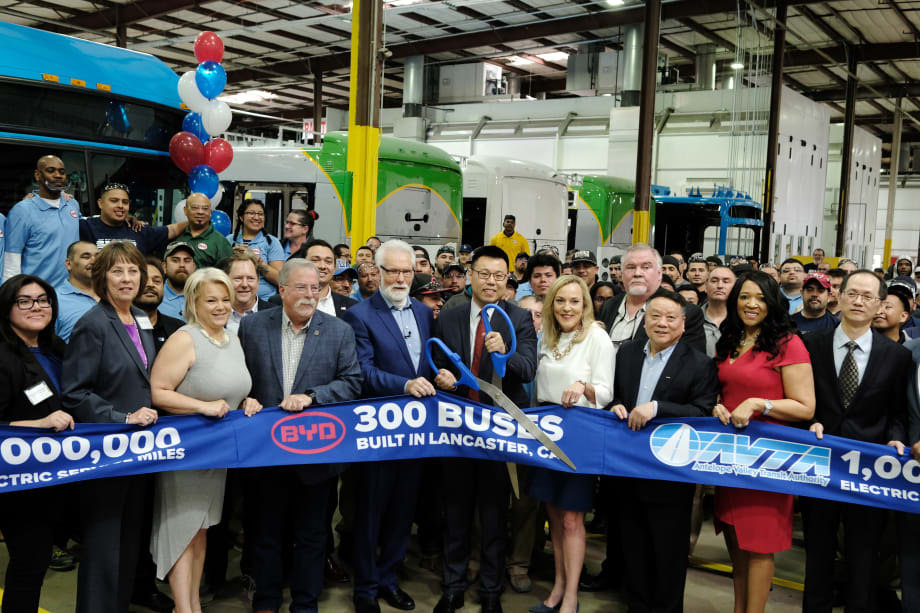
BYD officials were joined by local dignitaries and more to celebrate its 300th battery-electric bus.
Photos courtesy BYD
2 min to read
BYD officials were joined by local dignitaries and more to celebrate its 300th battery-electric bus.
Photos courtesy BYD
BYD (Build Your Dreams) produced its 300th bus at its Lancaster, California manufacturing plant.
BYD is celebrating the milestone with its highly valued customer and neighbor Antelope Valley Transit Authority (AVTA), which is closing in on a landmark of its own — one million miles of zero-emission bus operations. AVTA expects to make that breakthrough in early May.
The 300th bus is a 35-foot BYD K9S model transit bus. The vehicle is one of three built for Baton Rouge, Louisiana’s Capital Area Transit System (CATS). The agency will field test the use of electric buses in Baton Rouge and study how these battery-electric buses could be used on routes in Louisiana’s capital.
“We are very proud of this 300th American bus milestone. We are passionate about our mission to create a cleaner environment here in North America and across the globe,” said Stella Li, BYD President.
AVTA was one of BYD’s first customers. In 2016, the AVTA board set a goal of becoming the nation’s first all-electric fleet and vowed to convert all of its aging diesel buses. AVTA will achieve that conversion milestone later this year.
When BYD opened its Lancaster manufacturing plant in 2013, it had a handful of employees working on 10 buses in a 106,000-square-foot building that once housed a motorhome manufacturing facility.
In just six years, BYD has grown to become the largest battery-electric bus manufacturer in North America, with more than 750 employees. Since acquiring the facility, BYD has increased its manufacturing plant to over a half million square feet, with the capacity to produce as many as 1,500 buses a year.
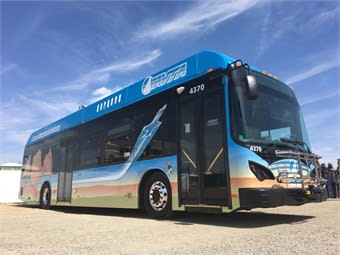
AVTA was one of BYD’s first customers.
In all, BYD has invested more than $250 million in North America, and in 2018 alone, has spent $70 million on components and services from American vendors — many from Southern California.
Since delivery of its first U.S. battery-electric bus in 2014, BYD has provided buses to customers in 13 states and four Canadian provinces.
From one bus model under production in 2013, BYD’s product line has expanded to include 12 models, the most of any e-bus manufacturer in the market. The transit bus line ranges from 30-foot K7 to the 60-foot K11, and the coach line ranges from 23-foot C6 to the double-deck, 45-foot C10MS.
At any given time, more than 80 buses on the factory floor are in various stages of assembly.
More Technology

From Hardware to Digital Partner: Luminator Charts Its Next Chapter
CEO Magnus Friberg discusses Luminator’s shift toward becoming a digital partner, the growing importance of software and interoperability, and how AI can help agencies improve operations and passenger experience.
Read More →
Beyond the Checklist: A Structured Approach to Transit Maintenance
Reliability-Centered Maintenance helps transit agencies move beyond routine checklists to focus limited resources on the assets and failures that have the greatest impact on safety, reliability, and service.
Read More →
NJ TRANSIT Advances Bus Technology Upgrades Across Statewide Fleet
More than 1,500 buses now feature upgraded technology designed to improve arrival predictions and provide free Wi-Fi, with deployment expected to reach nearly 2,000 buses by the end of 2026.
Read More →

Building a Flexible Path to Transit Electrification
John Hroncich discusses BAE Systems’ modular and scalable approach, lessons learned from decades of real-world operations, and how agencies can identify electrification strategies that fit their fleets.
Read More →
Biz Briefs: Alstom Lands Canadian Contract, LYT to Supply California TSP, and More
In METRO's latest installment, we take a look at recent news from Complete Coach Works, Beep, FlixBus, and more partnerships making headlines across the transportation sector.
Read More →
Sponsored•September 8, 2026
From Legacy Silos to Conversational Intelligence
What if transit leaders could ask any operational question and get a trusted answer in seconds? Conversational AI is transforming how agencies use their data.
Read More →
USDOT Announces Rail Vehicle Replacement Grants, Chattanooga AV Shuttle Funding
More than $191 million in federal funding will help three transit agencies replace aging rail vehicles and support a new autonomous shuttle service in Chattanooga.
Read More →
Bus Tech Talk: Keeping Transit Technicians Ahead of the Technology Curve
LA Metro’s Obed Mejia discusses technician training, evolving maintenance technology, fleet replacement, and strategies for getting the most out of today’s transit fleets.
Read More →
Biz Briefs: RIPTA Unveils New Frontrunners, Clevland RTA Adds New Siemens, and More
In METRO's latest installment, we take a look at recent news from Siemens, Prevost, Dodge, and more partnerships making headlines across the transportation sector.
Read More →
Why Simulating Pedestrian Movement Has Become Essential for Modern Rail Stations
Pedestrian microsimulation is helping rail planners identify bottlenecks, test station designs, and prepare complex transit hubs for growing passenger volumes.
Read More →