



Bus battle: Do private shuttles affect the reliability of public transit?
Research from a University of Washington study suggests that public buses are unaffected by private shuttles most of the time.

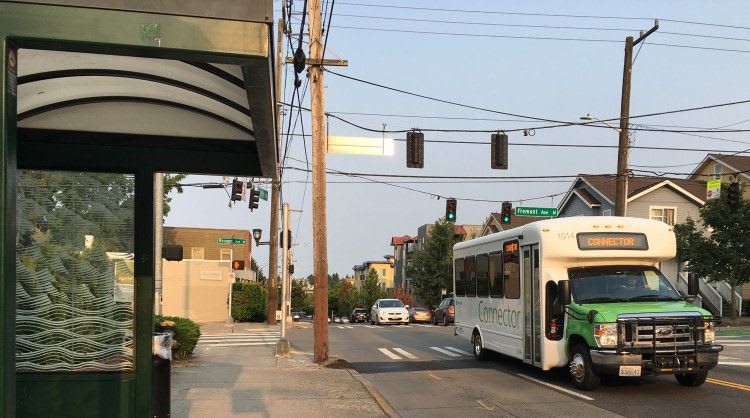
A private Microsoft shuttle drives past a King County Metro bus stop in north Seattle during the morning commute. Photo: Sarah McQuate/University of Washington

While many Puget Sound residents have to choose between taking public transit or personal vehicles to work, Microsoft and Seattle Children’s Hospital employees have an additional option: private commuter buses.
Last year, King County Metro and the Seattle Department of Transportation started a pilot program that allowed these shuttles to pick up employees at a few public bus stops throughout the city. But some residents are concerned that sharing stops with private shuttles could make public transit less reliable.
Now a recent study from researchers at the University of Washington suggests that public buses are unaffected by private shuttles most of the time. The study, which will appear in the print edition of the Journal of the Transportation Research Board this fall, examined how well public buses adhered to their schedules both before and during the pilot period.
“There’s this huge symbolic meaning that these private buses have, and their potential impact on public transit would basically be salt in the wound,” said Don MacKenzie, a co-author of the study and an assistant professor in civil and environmental engineering. “Your neighborhood is gentrified, your friends and neighbors have been forced to move out and now your bus is going to be late? But we found that, by and large, the buses aren’t running behind.”

To determine if the shuttles negatively impacted public buses’ reliability, MacKenzie and civil and environmental engineering doctoral student Elyse Lewis partnered with Swiftly, a company that acquires and cleans up real-time performance data from trackers on public transit.
Lewis and MacKenzie used data for the six weeks leading up to the pilot start date on April 24, 2017, and then six weeks afterward for nine stops included in the trial run. The stops spanned the city, including stops in West Seattle, lower Queen Anne, Capitol Hill, and northeast Seattle. The team compared data from those stops to nearby control stops that were not part of the program, which was set to run for six months.
“We asked questions like: To what degree are buses arriving late? And does that change after the pilot starts?” said MacKenzie, who also leads the Sustainable Transportation Lab at the UW. “We’re interested in what happens in the worst-case scenarios before and after to see if the worst case gets worse. If buses start arriving 10 minutes late, that’s really problematic.”
On average, bus reliability stayed the same for all of the stops combined. But when the researchers looked at each stop individually, one stop on Sand Point Way in northeast Seattle was affected. The bus that stops there, the 75, was more likely to arrive two to three minutes later after the pilot program started.
It’s hard to tell exactly what’s happening at that stop without a more in-depth look, the researchers said.
“We wanted to do a quick study with data that’s available to see if there was an overall problem with the pilot program,” said Lewis, who is the corresponding author on the paper. “So rather than the city having to spend time and resources going out and having someone sit and watch every single stop, now they can follow up with only the problem stops.”
From a transportation standpoint, Seattle could benefit from having these private shuttles use public transit stops, the researchers said.
“These companies pay a monthly fee to stop, pick up and drop off passengers there,” said Lewis. “So they have the potential to add a new source of income that goes into improving the transit system.”
The team is optimistic that the results show that having access to real-time data like this can answer important questions that will help influence public policy.
“This is just one example of how open data can help us understand the impacts of these services, but there are certainly more questions,” said Lewis. “If we want to get at bigger questions, such as whether these shuttles are causing gentrification, then we need access to more available data.”
Regina Clewlow, founder and CEO of Populus, was the team’s partner at Swiftly and is also a co-author on this paper.
More Bus
DART Taps Nathaniel P. Ford Sr. as Next President/CEO
Since 2012, Ford has served as the CEO of the Jacksonville Transportation Authority
Read More →
AC Transit’s Cecil Blandon on Building the Next Generation of Transit Maintenance Leaders
The agency’s maintenance chief discusses leadership, workforce development, zero-emission technology, and preparing technicians for the future of public transportation.
Read More →
Building the Next Generation of Transit Technology
In this edition of METROspectives, Luminator CEO Magnus Friberg discusses the company's transformation, the growing role of AI and software, and what's next for transit technology.
Read More →
June LA Metro Ridership Surges 2 Million Year Over Year
Total June ridership increased for both weekdays and weekends. Weekday ridership was 953,820, which grew 8.4% from June 2025; Saturdays increased nearly 13% year-over-year to 708,826; and Sundays increased 7.7% to 611,534 from June 2025, according to LA Metro.
Read More →
Washington's Pierce Transit Board Sends Transit Funding Measure to November Ballot
With the adoption of Resolution 2026-006, the measure moves to the Pierce County Auditor, giving voters in the Pierce Transit service area the decision on whether to fund an expansion of local transit service within the agency’s service area.
Read More →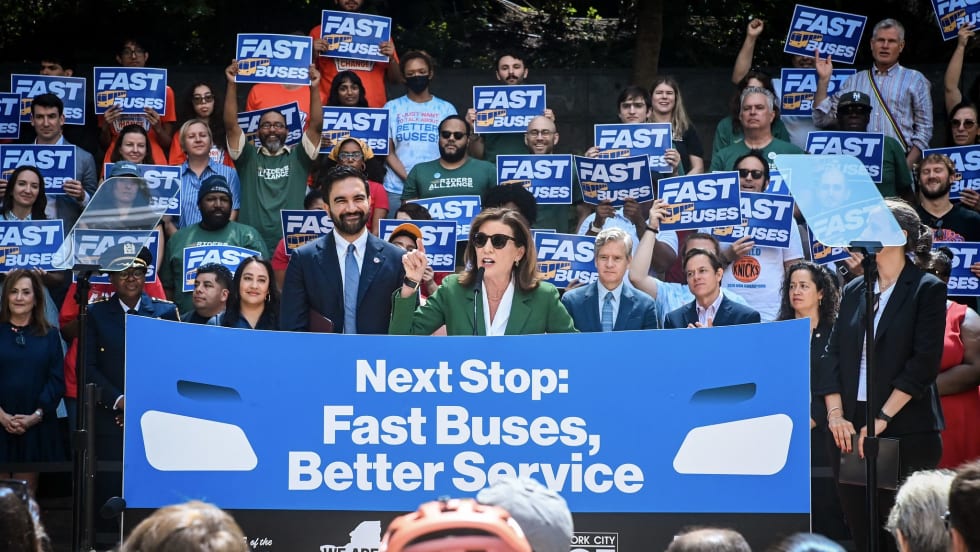
New York Unveils Sweeping Plan to Modernize City Bus Service
Next Stop: Fast Buses, Better Service identifies 50 priority bus corridors for improvements across the five boroughs and launches the City’s next generation of rapid bus service along five key routes.
Read More →
CTDOT Taps STV for Electric Bus Facility Design
The firm will work with CTDOT and RVT to define the facility layout, operational requirements, and long-term flexibility for RVT’s growing electric fleet.
Read More →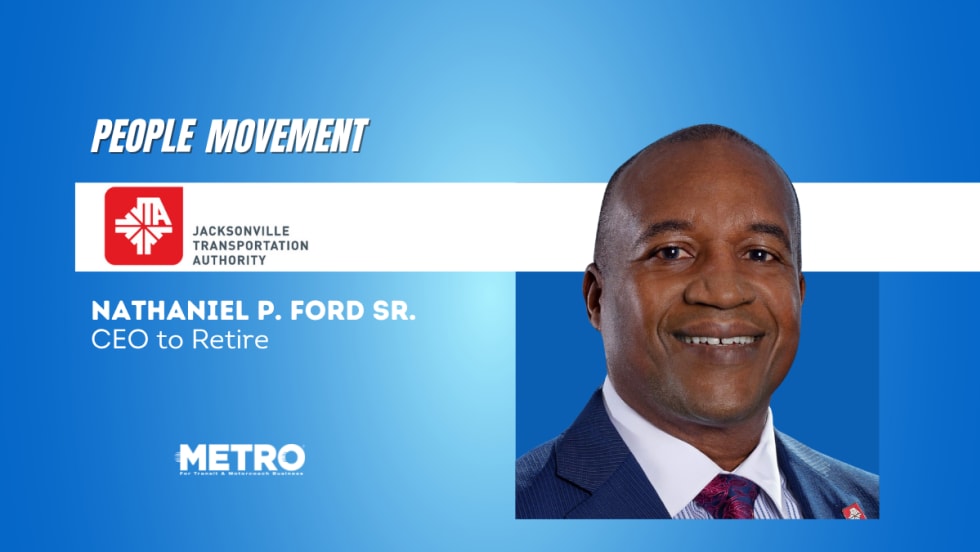
Ford to Leave JTA After More Than 10 Years as CEO
He plans to continue his work advancing innovative mobility solutions to improve the quality of life in communities across the nation. He did not announce specific plans.
Read More →
Transit Leaders Push for Bus Procurement Reforms to Reduce Costs
Industry experts said reducing unnecessary bus customization and modernizing purchasing practices could help transit agencies buy more vehicles, improve reliability, and make better use of limited funding.
Read More →
Executive Order Aims to Improve Transit Access Across California
The order directs state agencies to streamline transit project delivery, improve coordination, and expand access to bus and passenger rail services across California.
Read More →