



The prominence of cycling as a mobility solution in Europe
Against the framework of this year's Polis conference in Brussels, we take a look at how bicycles are growing in usage to connect with public transit, or not.

One of the key themes that appeared throughout the conference was the prevalence of cycling as the solution to urban mobility.
No Attribution required

One of the key themes that appeared throughout the conference was the prevalence of cycling as the solution to urban mobility.
No Attribution required
The 30th annual Polis conference returned to Brussels in November. Polis calls itself a forum for “Innovation in Transport for Sustainable Cities and Regions.” Its activities are very much led by the needs of its public authority members with the support of other government agencies, innovators, advocacy groups, and academics. While separate from the numerous European Union agencies, it benefits from the wider eco-system of policy work in sustainability and transport in the capital of the EU.
The conference was held in the city center near the main Gare du Midi train station. The station, which is the largest in Belgium, is an impressive example of multimodal transport.
However, the local area around Gare du Midi has struggled for several years with dereliction, vagrancy, and vandalism. Brussels is a city that often isn’t what it seems and remains part of one of the wealthiest areas of Europe, even if parts of the urban realm seem to be in a state of chaos. Impressive 19th century architecture near the station has been damaged by an earlier attempt to make central Brussels an ideal environment for car travel. Busy roads, widespread parking, congestion, and confused pedestrian routes are prevalent. But much is changing, and the city is rediscovering its public realm and the needs of pedestrians and bicyclists. The location of the conference was an excellent chance to again see this progress, although much still needs to be done on the streets of the city.
The conference, attended by over 600 European and global mobility professionals, began with Henrik Hololei, director general for DG Move from the European Commission, welcoming the attendees and focusing his speech on the new commission’s focus on delivering a climate-neutral transport network. This needs to be “safe, sustainable, and smart, as well as delivering quality of life for citizens,” he said.
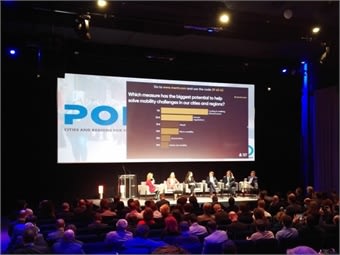
Polis was held this year at The Egg conference center, which is in the city center near the main Gare du Midi train station.
Giles Bailey
The keynote was by David Zipper from Harvard’s Kennedy School of Government. Zipper focused his talk, and the following panel debate, on the “Fear of Missing Out” and its potentially unhelpful tendency to push innovations that may be inappropriate for many cities, while crowding out progress on the provisions of the basics of a robust and sustainable transport system.
As mentioned, the center of Brussels is an active work in progress of pedestrianization, cycle infrastructure provision, car traffic suppression, and gentrification of its historic architecture. This includes the major redesign of the key north-south Blvd Maurice Lemonnier, which bisects the historic city center and has become a depressed and traffic-clogged introduction to the city. One of the main Metro routes travels below this boulevard and its previous design was a direct result of the removal of earlier surface trams to allow for a more “modern” car accessible design.

One of the main Metro routes travels below the Blvd Maurice Lemonnier and its previous design was a direct result of the removal of earlier surface trams to allow for a more “modern” car accessible design.
Giles Bailey
Cycling as a solution
One of the key themes that appeared throughout the conference was the prevalence of cycling as the solution to urban mobility. Benefits are widespread and well-known including health, via physical activity, reduced air pollution and noise, streetscape design, encouraging compact development, efficient use of land regarding parking, and linking together multimodal opportunities.
The conference was not far from The Netherlands, and as well as Flanders within Belgium, where cycling has been turned into a dominate form of urban mobility in most cities. This has been as a result of a long and determined effort by advocates, policy makers, and cities to remake transport policy and alter the post WWII mobility assumptions. The leading cities in this transformation include Utrecht in The Netherlands — where over one-third of mobility is by bicycle; Bremen in northwest Germany — over one-quarter; or Copenhagen in Denmark — one-third. In one session I attended, Rotterdam apologized for only having 20% of trips being made by bicycle and said it was doing much to “improve” this to more typical Dutch levels through a series of targeted initiatives. Note that all these cities are medium- to large-sized urban areas with substantial mixed employment and not, for example, “university towns.”
Many other cities are trying to make this transformation, including both Paris and London.
It still seems a distant ideal for many of the cities in Spain, or Italy, where cycling is often seen as a sporting activity. But, policy makers from these locations were also present and looking to what could be done.
There seemed to be a view at the Polis conference, and more generally in European mobility discussions, that mass cycling is indeed a/the key part of any solution to a sustainable mobility plan. The Dutch and Danish examples prove that cycle use isn’t just for a narrow set of the population, but for the old, young, for a wide range of trip purposes.
Many European cities are starting from an historic base of relatively compact and dense urban form with a focus of activity in the city center, but this is not universal. In more dispersed or hilly areas, e-bikes are often a key part of the “cycling solution.”
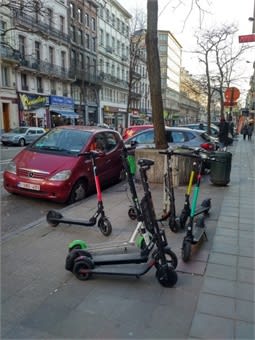
Shared and privately-owned micromobility can also support cycle user cases.
Giles Bailey
The road ahead
Shared and privately-owned micromobility can also support cycle user cases.
A fundamental challenge is creating safe and well-designed cycle routes as well as parking and changing mindsets about cycling for a wide set of the population. However, the converging opinion seems to be on the substantial increase in the use of the bicycle.
It does raise issues of the extent and role of classic public transport. While most would say that these modes are essential to modern urban mobility, the percentage of trips using these modes are shockingly low in the high cycle rate cities versus other European metropolises.
Sitting within the conference and reflecting on my experience in London, I also wondered how many North American policy makers and/or residents could be ready to accept and support this vision? As well as the range of interventions that would be required to ever make this type of sustainable transport solution a viable reality.
The conference finished with a final plenary focused on road safety.
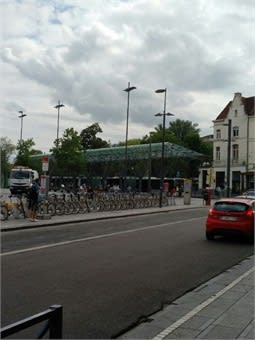
Multimodal interchange in Brussels.
Giles Bailey
Travelling around the city on the day after the conference I noticed a vigorous climate change protest march in the city center. This is symptomatic of the new politics in Europe and the desire by many to see immediate and substantial changes in society and the transport system. Brussels is at the forefront of reimaging urbanism. What makes it a most interesting case is its European profile, location at the border of the high cycling rate cities, until recent car-centered design, and yet extensive public transport systems.
Gothenburg, Sweden has been elected President of Polis for the next two years replacing Manchester, UK. The Polis conference will visit Gothenburg in 2021 for the city’s 400th anniversary, while the 2020 conference will be in Arnhem/Nijmegen in The Netherlands — no doubt the cycling debate will intensify.
Giles K. Bailey is a director at Stratageeb Ltd., a London-based consultancy assisting businesses think about their strategic vision and innovation.
More New Mobility

From Hardware to Digital Partner: Luminator Charts Its Next Chapter
CEO Magnus Friberg discusses Luminator’s shift toward becoming a digital partner, the growing importance of software and interoperability, and how AI can help agencies improve operations and passenger experience.
Read More →
Biz Briefs: Alstom Lands Canadian Contract, LYT to Supply California TSP, and More
In METRO's latest installment, we take a look at recent news from Complete Coach Works, Beep, FlixBus, and more partnerships making headlines across the transportation sector.
Read More →
CharterUP’s Armir Harris on Technology, AI, and the Future of Group Mobility
In a recent episode of METROspectives, CharterUP Founder/CEO Armir Harris discussed the company’s evolution from an online charter bus marketplace into a technology platform supporting public- and private-sector mobility and much more.
Read More →
Jacksonville’s NAVI Project Charts a New Course for Autonomous Public Transportation
Through its NAVI program, JTA is showing how autonomous vehicles, intelligent infrastructure, and coordinated operations can work together to deliver everyday public transportation.
Read More →
Biz Briefs: Luminator Marks Milestone and More
From manufacturers and suppliers to transit agencies and motorcoach operators, these updates offer a snapshot of the projects, partnerships and business moves driving the industry forward.
Read More →
New Tricks for Old Bureaucracies: Joshua Schank on Making Transit Innovation Stick
Former LA Metro Chief Innovation Officer Joshua Schank discusses why good ideas aren't enough, how transit agencies can overcome resistance to change, and why today's challenges demand more innovation.
Read More →
How DART's GoPass Is Redefining Regional Mobility
Serving 14 transit agencies, GoPass simplifies multimodal travel by allowing riders to plan, pay for, and manage an entire trip through one app.
Read More →
Biz Briefs: OCTA Taps Clean Energy for Hydrogen Station, Stadler to Supply Via Rail Vehicles, and More
From manufacturers and suppliers to transit agencies and motorcoach operators, these updates offer a snapshot of the projects, partnerships and business moves driving the industry forward.
Read More →CharterUP Expands Into New Mobility and Autonomous Transportation
Vice President of New Mobility Stephen Joos discusses how CharterUP is leveraging its nationwide transportation network, technology platform, and autonomous vehicle partnerships to expand into workforce mobility, campus shuttles, and transit solutions.
Read More →
METRO Magazine Announces 2026 Innovative Solutions Awards Winners
Projects Recognized for Advancing Mobility Through Technology, Accessibility, Workforce Innovation, and Operational Excellence
Read More →