



Suppliers Stepping Up Offerings to Help Transit Deal with ‘New Normal’
While agencies were hit particularly hard because of the pandemic, many suppliers, also deemed as “essential,” had to adjust to not only providing the goods and services they already offered, but also find ways to meet the new demands of their long-time partners.
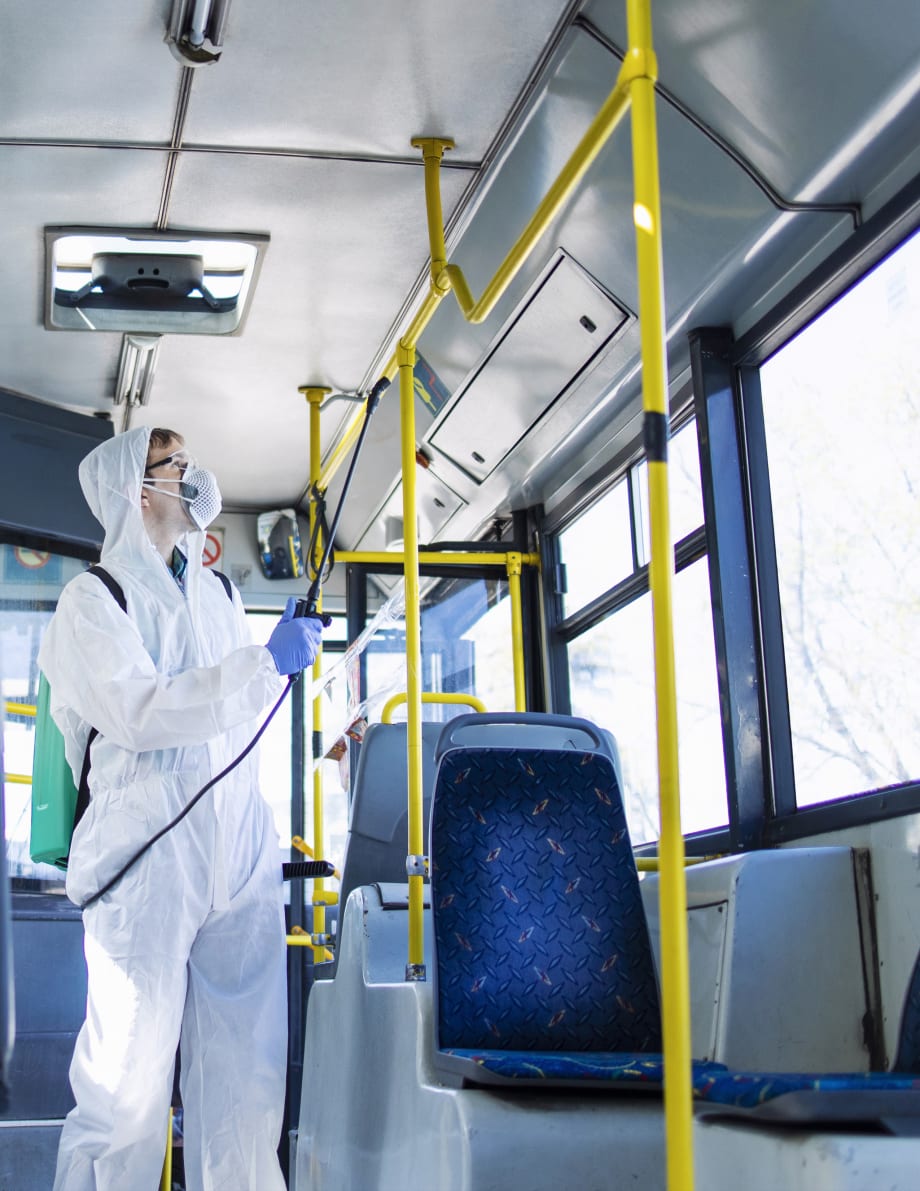
From a technologyaspect, Zonar adapted its offerings to meet some of the new cleaning and sanitizing standards suggested by the CDC, as well as associations including APTA and CUTA.
Zonar
While COVID-19 shutdown the operations of several industries throughout the nation, it has been well documented how transit agencies stepped up to continue providing transportation services to “essential workers.” Likewise, their supplier partners, also deemed essential, not only stepped up to make sure transits had the parts and other typical support they needed from them, but also began to look ahead to what agencies may need for the “new normal,” both during and after the pandemic.
“Once the pandemic was declared, our focus first and foremost was to keep our employees safe, so we took several measures at all of our facilities to make sure we did that while also keeping operations going,” explains Brian Dewsnup, president at NFI Parts. “Second, was making sure that our customers had enough of our products to continue to run their buses, as well as help them with whatever else they may need as we continued to move forward during this unprecedented time.”
“Initially, the pandemic impacted us with an incredible amount of uncertainty, because we did not know what was going to happen in the marketplace with our customers, the people who build buses, or people who order parts for buses,” adds Dan Cohen, president for Freedman Seating Company. “So, we were like ‘OK, what do we do?’ Then, once we started getting more information as the world did as well, we were able to start developing a plan, which honestly has been modified on a weekly, daily, or even hourly basis as this all has continued to progress.”
Listening, meeting new needs
Relying on the relationships built over the years with their transit partners, much of the planning for what could be next for suppliers came from interfacing with their customers.
“We set up a hotline, in a sense, so that our customers, both large and small, could reach out and we could help manage them through what was going on and what they might need going forward,” says H. Kevin Mest, sr. VP & GM, passenger services, at Zonar. “Obviously, those needs varied some based on size, but looking ahead it became clear that sanitizing and keeping passengers and operators safe was going to be a universal issue.”
“We absolutely got a lot of feedback from our customers. In fact, it was more than expected to be quite honest,” adds Dewsnup. “From those conversations, we basically polled our staff, which really led to the portfolio of products we have now. What we are now offering is what customers were looking for and what they were asking for, along with some things that we've added that we think can be helpful.”
Adapting on the fly
While there are some companies that reacted to their communities’ needs, such as United Safety, who began producing and supplying Personal Protective Equipment (PPE) to first responders who were experiencing a dearth of the necessary equipment, many suppliers, including United Safety, NFI Parts, Freedman, and Zonar, began reacting instantly to transit’s new needs.
For its part, NFI Parts released a White Paper covering the four principles of transportation safety for transit, paratransit, and motorcoach providers to combat COVID-19 — distancing, disinfecting, air quality, and PPE — as well as products that fit within those four pillars.
“From the White Paper standpoint, obviously, we would like to do business with our customers, but there are a lot of products out there,” says Dewsnup. “Truly, our main interest is making sure the industry is safe, whether people read our White Paper and buy some products from us or from a competitor, our goal is to make sure the industry is operating as safely as we can.”
One major step companies like NFI Parts, AROW Global, Bentech, and Vapor Bus have taken are to adapt driver protection barriers to emphasize bus operator protection from COVID-19 while passengers are boarding and exiting the vehicle, as opposed to previous models that were designed to prevent operators from physical assaults.
From a technology aspect, Zonar adapted its offerings to meet some of the new cleaning and sanitizing standards suggested by the CDC, as well as associations including APTA, CUTA, the ABA, and the UMA, when it took its patented Electronic Verified Inspection Reporting (EVIR®) solution and added a new electronically verifiable configuration for ensuring and documenting the sanitation of buses.
“COVID-19 really has highlighted the need for safety, as well as letting the riding public know that they are safe,” explains Mest. “We created a configuration on our inspection solution so it could be used to document and ensure that buses are being cleaned and transit agencies were doing everything they were being expected to do not only day to day, but several times a day.”
Freedman’s Cohen explains that while some of his company’s products are designed to meet specific needs of the transit industry today, there are some offerings being revived that did not necessarily take hold in the market previously.
“There are things like plastic grab handles that are inherently anti-microbial and anti-bacterial that we introduced years ago, but agencies didn’t necessarily see the need for them. Now they do,” he says. “We are also reintroducing sneeze guards on seats and seat bands, which are now very important as agencies try to implement social distancing on their buses.”
Cohen, as well as other suppliers, adds that as further needs are communicated to them from their transit agency partners, the company will continue to create products that fit those needs for safety and social distancing.
“It takes time to develop these solutions, but we are going to continue to build out our portfolio so that any size of transit agency that needs, what we’re calling passenger protective equipment, can have access to it,” he says.
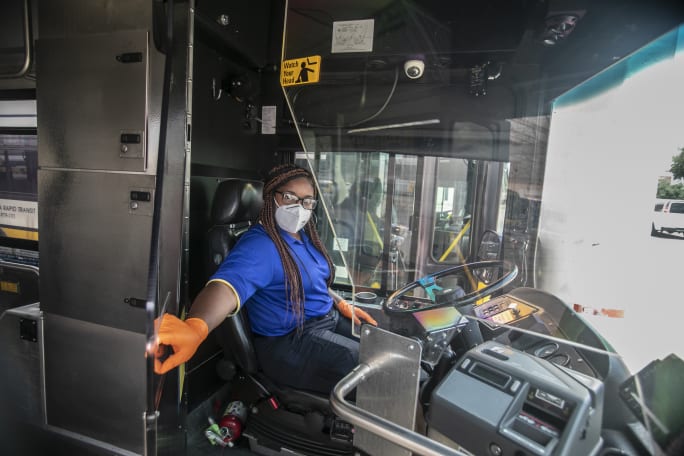
As the pandemic continues, suppliers are working with transit agencies to find ways to protect both passengers and bus operators.
DART
Moving ahead
With suppliers continuing to evolve their COVID-19-related products for transit (see equipment roundup on pg. 22), they admit that the road ahead, especially the return to regular ridership numbers, is still murky at best.
“While I certainly do not have a crystal ball, I think post-pandemic ridership numbers may not get to where they were before, because many industries are seeing the benefits of working from home,” says Zonar’s Mest. “Because those practices will be maintained, we’ll see a flattening in ridership during the typical peak times, bringing with it less necessity for express-type services, and perhaps, more of a need for on-demand solutions.”
“People still need to get to work, the doctor, and to buy groceries, so that type of ridership will continue to rebound as the economy opens up, but it’s going to take a while for those discretionary trips to come back, which will hold back the overall rebound in the industry,” adds Cohen. “From our perspective, though, our product line, and the offerings from the supplier industry, will continue to evolve to fit whatever transit’s new needs will be.”
As those products continue to evolve, NFI’s Dewsnup explains that adding fogging equipment, disinfectants, UV lights, hand sanitizer, sneeze guards, and upping the amount of times a transit agency cleans a vehicle per day is only half of the challenge.
“If you add antimicrobial products or put UV filters in your HVAC systems, for example, that’s great, but it’s something that the passengers don’t necessarily see or maybe even hear about,” he says. “I think transit has to show the communities they serve what they are doing, as well as make it known what has been done or what is being deployed on the vehicles themselves. For instance, we have developed signage and decals, which will help instill confidence in the passengers as they choose to ride transit again.”
More Security and Safety

Transit Agencies Highlight Safety Gains at National Summit
Leaders from 15 major transit systems shared crime-reduction results and safety initiatives while discussing the role of continued federal support.
Read More →
DART Launches Major Security, Fare Enforcement Initiative
The 90-day demonstration will deploy coordinated security teams at five light rail stations while testing controlled access and gathering data to guide future investments.
Read More →
RTD Launches NextRide App to Consolidate Trip Planning, Fares, Security Reporting
The app expands on RTD’s existing NextRide web application and allows customers to view real-time vehicle locations and service alerts, purchase and store digital fares, and access customer support.
Read More →

TAPTCO Updates OSHA Compliance Training for Transit Maintenance Operations
The revamped program addresses 26 OSHA standards for maintenance facilities, with TAPTCO pointing to training, documentation, and everyday shop hazards as continuing challenges for transit operations.
Read More →
How VaporVision Adds Value to Transit Door Systems
Wabtec engineers explain how the system improves doorway detection, strengthens diagnostics and gives transit agencies and OEMs greater operating flexibility.
Read More →
FRA Announces $5.3B in Rail Investments, Including $2B for Amtrak
Funding will support grade-crossing improvements, infrastructure upgrades, and new Amtrak equipment in 23 states.
Read More →
Chicago, Maryland Expand Non-Law-Enforcement Safety, Rider Support
The CTA and MTA are launching new programs aimed at de-escalation, crisis response, rider assistance, and greater transparency.
Read More →
LA Metro, City of West Hollywood, and Partners Advance Smarter Bus Lane Enforcement
The award-winning partnership combines AI-powered detection with human oversight to improve bus reliability, accessibility, and enforcement efficiency.
Read More →
LA Metro Reports 57% Decline in Homelessness on Transit System Since 2024
The agency's latest homelessness count offers new data on how care-based services and cross-sector partnerships can complement traditional transit security strategies.
Read More →
FTA Launches 'Transit Moves America' Dashboard to Highlight Agency Safety and Performance
The online dashboard transforms National Transit Database information into a public-facing resource that allows users to compare transit agencies on key operational and safety metrics.
Read More →