




RELATED: What Rail Operators Can Learn from Airports in Smoothing Journeys
USDOT Makes Historic Funding Available to Expand Passenger Rail
Selected projects will improve existing rail corridors and create new ones, broadening access to intercity passenger rail services for communities across the country.
December 7, 2022
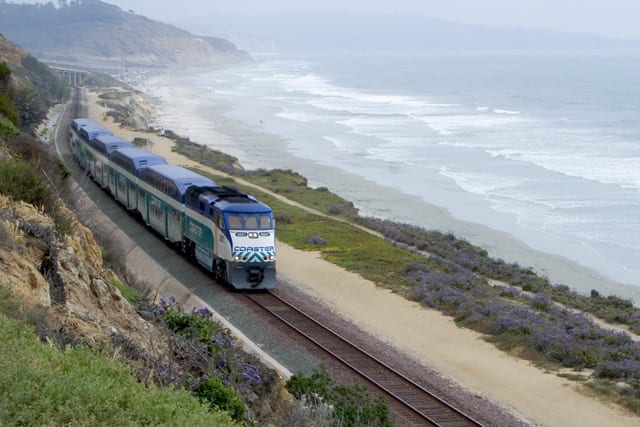
The funding announcement comes after USDOT and FRA made available over $1.4 billion in Consolidated Rail Infrastructure and Safety Improvement funds in September for projects that improve America’s freight and passenger rail network and strengthen supply chains.
Credit:
NCTD
2 min to read
The U.S. Department of Transportation (USDOT) issued a Notice of Funding Opportunity (NOFO) announcing the availability of almost $2.3 billion in funding to expand and modernize intercity passenger rail nationwide through the Federal-State Partnership for Intercity Passenger Rail Grant Program (Partnership Program).
The announcement marks the strongest commitment to date for the expansion of the national network of intercity passenger and high-speed rail projects, according to the Department. Selected projects will improve existing rail corridors and create new ones, broadening access to intercity passenger rail services for communities across the country.
“This is one of the two most significant investments in the past 50 years to modernize passenger train service across the country,” said U.S. Transportation Secretary Pete Buttigieg. “Americans deserve excellent passenger rail services, and through the Bipartisan Infrastructure Law, we’re working to deliver it.”
Administered by the Federal Railroad Administration (FRA), the Partnership Program has long funded the revitalization of rail assets, such as fixing track, structures, and grade crossings. Previous grants have funded rehabilitation type projects such as the Kalamazoo to Dearborn rail corridor in Michigan and the Piedmont Corridor in North Carolina. These routes and others are used by tens of millions of Americans each year, and new investments will increase the reliability and frequency of service and reduce delays.
President Biden’s Bipartisan Infrastructure Law greatly expands the scope, funding, and vision of the Partnership Program. Beginning with the FY 2022 NOFO, eligible entities can apply to expand and establish new intercity passenger and high-speed rail services. In addition, projects that improve the safety, reliability, and performance of intercity passenger rail services and project planning elements, such as environmental review and final design, are also now eligible for funding under the Partnership Program.
“This Partnership Program NOFO offers exciting opportunities to expand federal support for intercity passenger and high-speed rail services to all parts of our nation,” said FRA Administrator Amit Bose. “FRA will work closely with states and stakeholders to provide sustained and dedicated investments in this vital mode of transportation, and together, we will reshape America’s passenger rail network for generations to come.”
The funding announcement comes after USDOT and FRA made available over $1.4 billion in Consolidated Rail Infrastructure and Safety Improvement funds in September for projects that improve America’s freight and passenger rail network and strengthen supply chains. Additional Partnership Program funds for projects located on the Northeast Corridor will be made available later this year. In total, FRA has announced more than $607 million for 85 projects in 37 states and the District of Columbia this year, and made available more than $4.2 billion in funding, jumpstarting the implementation of $66 billion in Bipartisan Infrastructure Law investments.
More Rail

New York MTA Advances Final Contract for Second Avenue Subway Expansion
Contract Four is the largest in the Second Avenue Subway Phase 2 project and includes construction of station infrastructure, tracks, and signals for the subway expansion, MTA officials said. Work on Contract Four will begin in 2027.
Read More →
San Diego MTS Breaks Monthly Trolley Ridership Record
Agency officials said July’s ridership indicates MTS’s continued recovery from the pandemic.
Read More →
Report Examines NJ TRANSIT Reliability, Funding Challenges
The Garden State Initiative analysis examines the roles of Amtrak infrastructure, fleet management, and agency operations while recommending a more performance-based approach to improving reliability.
Read More →
Stadler, CapMetro Sign Long-Term Rail Fleet Support Agreement
Beginning in 2027, Stadler will provide on-site technical expertise, spare parts support, training, and obsolescence management to help extend the reliability and longevity of CapMetro’s GTW fleet.
Read More →
Biz Briefs: Alstom Lands Canadian Contract, LYT to Supply California TSP, and More
In METRO's latest installment, we take a look at recent news from Complete Coach Works, Beep, FlixBus, and more partnerships making headlines across the transportation sector.
Read More →
CATS Gold Line Marks 5 Years of Service, 2.8M Passenger Trips
With a six-mile expansion planned, the Charlotte streetcar is positioned to connect more neighborhoods and major transit hubs across the region.
Read More →
Why Simulating Pedestrian Movement Has Become Essential for Modern Rail Stations
Pedestrian microsimulation is helping rail planners identify bottlenecks, test station designs, and prepare complex transit hubs for growing passenger volumes.
Read More →
Amtrak Begins Major Construction at New York’s Sunnyside Yard
The new maintenance facility will support Amtrak’s Airo trainsets while improving maintenance efficiency and turnaround times in New York.
Read More →
Chicago Leaders Unveil Plans for O’Hare Airport Express Train
The privately developed project would offer a 15-minute trip between downtown and O’Hare’s Terminal 2, with trains operating every 15 minutes on a dedicated track. The service would use battery-electric trains and three existing freight rail rights-of-way.
Read More →
OCTA Maps Out 30-Year Strategy to Protect Coastal Rail Corridor
The draft feasibility report identifies strategies to protect the coastal rail line for decades as the agency continues near-term stabilization and sand placement efforts.
Read More →