Predictive Maintenance in Railways: Exploring Best Practices with IoT
Let’s find out why predictive maintenance is considered the most promising service approach for rail and how to get the most out of its implementation.
by Julia Seredovich
September 15, 2023
With the advent of the Internet of Things (IoT), Predictive Maintenance in Railways has proven to be the most effective and promising maintenance strategy.
Credit:
Pixabay/geralt
7 min to read
In the UK, only 38% of rail passengers are satisfied with the way rail companies deal with delays that are often caused by asset failures. It speaks eloquently that despite the fact maintenance is the bulk of costs for the rail industry, the current approaches can’t provide an adequate service level.
With the advent of the Internet of Things (IoT), Predictive Maintenance in Railways has proven to be the most effective and promising maintenance strategy. However, most of the railway assets in the world are still not equipped even for real-time monitoring. How critical is this situation?
Ad Loading...
The need for Predictive Maintenance (PdM) is felt differently for different regions and depends on the traffic of a particular railway network.
In the U.S., where there has been a significant increase in demand for rail transportation over the past five years, the infrastructure must be in perfect condition to withstand such an increase in loads.
For such cases, you can hardly avoid Predictive Maintenance if you want to minimize unexpected failures, and preferably eliminate them. Can we achieve this? To find out, PSA shares its expertise on PdM use cases and IoT technologies that have shown themselves to be the most promising PdM solutions for rail, focusing on how to approach them reasonably.
Applicability of Predictive Maintenance in Railways
Predictive Maintenance — is an approach that allows service activities to be carried out only for vulnerable components of equipment or structures before the probability of their failure reaches a maintainable limit. This method is based on the processing of actual, real-time data of specific equipment, as opposed to scheduled maintenance based on statistics. The principle of PdM is simple — by monitoring changes in the machine’s parameters in real-time, we can calculate its remaining useful life (RUL) and schedule maintenance accordingly.
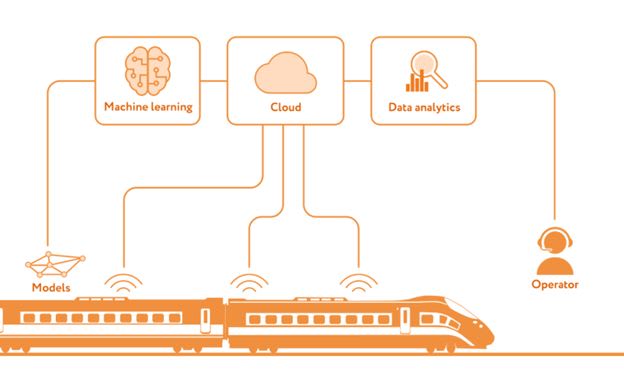
The data that allows the execution of PdM can be fully provided automatically through IoT, but to make it cost-effective, the enterprise needs custom research & development activities. Technically, solutions for Predictive Maintenance in Railways should contain the following components:
Ad Loading...
Sensor-based & external data collection. By equipping rail assets with IoT sensors, their continuous and remote monitoring becomes possible. The more volume of data we gather, the more chances we gain to build a robust analytical model capable of the most accurate predictions. Also, the precision increases to the extent that we consider more factors by including various data from different sources. Historical data from field inspections, engineering data on the mechanical parameters, remote control systems data, asset management data, and external data like weather conditions or GPS coordinates might be relevant for building a workable predictive model.
Data transmission to the cloud. Reliable connectivity should be established to transmit the data generated in the field in real-time or close to real-time manner. It can require the installation of additional equipment, like a radio tower, implementation of cellular-based data transmission, and wired or wireless communication — these are points to pay attention to. Generally, MQTT, XMPP, AMQP, or WebSocket are applied for PdM using machine learning, while train-to-ground applications can be built using LTE or WLAN.
AI-based data analysis. By picking up the relevant status indicators that notify upcoming failure, you can build a robust predictive-analytical model, and then deploy it in the cloud. Thus, the real-time field data can be processed and analyzed in a cloud application to give accurate predictions on RUL, as well as create reports.
Although Predictive Maintenance has only started to gain momentum in rail, positive results are already seen. Also, the world's best global practices on PdM allow the rail to get the most out of its implementation reducing the number of trials and errors, and, therefore, iterations.
Credit:
Professional Software Associates Inc.
Predictive Maintenance in Railways: Use Cases
Predictive Maintenance in Railways covers digital and mechanical devices, as well as engineering structures. These components can be considered mission-critical and safety-critical, which makes them target assets for Predictive Maintenance implementation.
The approach slightly differs for every case, but the principle is the same. For digital devices, we measure their electronic health, for mechanical — functional health, and for construction — structural integrity. Predictive Maintenance is recommended for railways also since it involves non-destructive inspections, without affecting the structure or its components.
Predictive Maintenance for Level Crossings
Level crossing failures take the first place among the causes of rail accidents in Europe. Due to the lack of digitalization and control, a crossing breakdown can become known only after public reports.
Even real-time monitoring can significantly reduce incident-response time, but PdM enables more advanced opportunities. For example, by equipping crossings with hardware that senses the gate opening angle, it’s possible to track its decrease over time and link this to upcoming failure. Since level crossings are deteriorating gradually, the algorithm makes an assumption about remaining useful life. Maintenance activities can be planned automatically.
Ad Loading...
RUL for the gate control device can also be calculated by measuring current surges, unstable voltage, high temperatures of the hardware, and the oxidation of its components. PdM solutions can track how the performance of the equipment decreases to make an accurate assumption on when it might fail.
Predictive Maintenance for Bridges
Violation of the structural integrity of railway bridges is the most dangerous, costly, and long-term failure to fix. Unfortunately, issues related to the structural health of rail bridges are inevitable, since the actual loads often exceed the design ones, while the operating conditions are frequently tough. IoT-based analytical tools can combine the info regarding static and dynamic loads, and the quality of materials with the actual state of the bridge to make accurate predictions when it might fail. Once the bridge reactions on various loads have been simulated, the model can be supplemented with additional parameters, such as bridge behavior during seismic events, rail profile irregularities, and so on.
Major cracks that might cause bridge collapse do not appear at once. They result from minor cracks that violated the structural health of the bridge for weeks or months. In this regard, vibration diagnostics, as well as continuous visual monitoring of displacement, deviation, and inclination, have proven themselves well.
Predictive Maintenance for Tunnels
Rail tunnels can mainly suffer from seepage, delamination, cracks, delamination of concrete, corrosion of steel, drainage, and structural failure of the tunnel lining. In particular, water leaks in the concrete lining of the tunnel usually cause corrosion of the steel reinforcement.
To prevent such cases, IoT sensors can provide visual and sonic inspections to identify stratification of the concrete; ultrasonic sensors and radars measure speed in the material to monitor its structural integrity; magnetic and electrical inspections immediately identify corrosion. By adding info on maintenance and repair history, external loads, mechanism of failure, and so on, you gain a complete view of tunnel behavior over time, allowing for optimizing maintenance strategies.
Ad Loading...
Predictive Maintenance for Signaling Infrastructure
Speaking about track circuits, railroad switches, and axle counters, we first speak about failures that are caused by external factors, such as weather conditions. Thus, their real-time monitoring comes down to the protection against contamination that might lead to icing, corrosion, etc.
Indeed, here we speak more about condition-based than predictive maintenance since weather conditions can hardly be calculated in advance. By detecting any kind of debris as soon as it appears, an IoT-based management platform can instantly provide the alarm on it informing dispatchers and maintenance teams on issues.
To have a complete view of maintenance needs for railway signaling solutions, it’s valuable to equip it with additional sensors. Thus, all the critical data, such as voltages in track circuits, current power consumption, time of the points shifting, and cable resistance, will promptly reach the control center to be reliably monitored. The keyword here is “promptly” since it eliminates delays-related costs and significantly reduces incident-response time if the failure still happens.
When it comes to outdated control devices, IoT has a workable practice of how to get legacy systems online utilizing edge devices containing both outdated and modern communicating protocols.
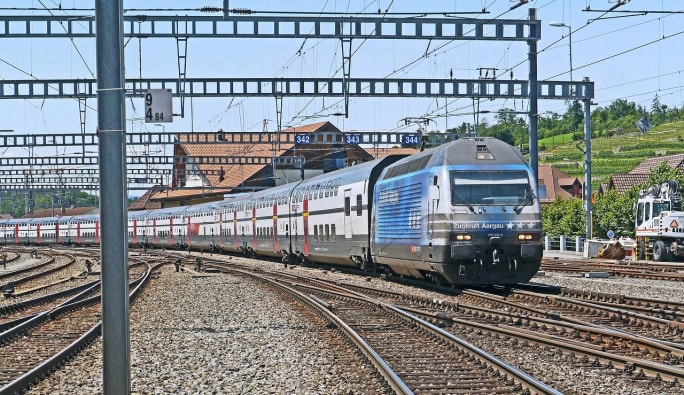
The need for Predictive Maintenance is felt differently for different regions and depends on the traffic of a particular railway network.
Credit:
Pixabay/hpgruesen
Predictive Maintenance in Railways: Summing up
Suming up predictive maintenance in railways:
Ad Loading...
Predictive Maintenance has only started to gain momentum for rail applications but has already proven its value for different rail components.
Intending to implement PdM for rail assets, it’s crucial to provide the data as fully as possible, that contains engineering, maintenance, external, and control data at least; consider harsh conditions of exploitation to ensure stable connectivity; take time to build a workable analytical model for every type of asset.
By applying Predictive Maintenance for engineering structures, you gain continuous monitoring of their structural health, which can be established via visual, vibration, sonic, magnetic, and other inspections. This allows for tracking minor cracks, inclinations, or deflections before they lead to major issues.
PdM for control devices allows for tracking their performance changes that might lead to failure.
In METRO's latest installment, we also take a look at recent news from STV, WSP, Prevost, and more partnerships making headlines across the transportation sector.
The company’s CEO discusses carrying forward a third-generation family legacy, ABC’s continued evolution in passenger transportation, support for increasingly complex fleets, and how technology and continued investment could help operators improve uptime.
ETA founder and CEO John Maglio explores the evolution of transit technology, the importance of reliable systems, and how stronger partnerships can help agencies improve operations and the passenger experience.
The new mid-sized bus features a full flat-floor design, eight-inch curbside step-in height, and zero-entry rear ramp to improve passenger access and operational flexibility.
John Hroncich discusses BAE Systems’ modular and scalable approach, lessons learned from decades of real-world operations, and how agencies can identify electrification strategies that fit their fleets.
Transit leaders, manufacturers, and industry professionals gathered in Chicago to explore new technologies, share ideas, and discuss the future of public transportation.
In METRO's latest installment, we also take a look at recent news from Masabi, MCI, Samsara, and more partnerships making headlines across the transportation sector.
Following a 20-station pilot, the agency plans to install new fare gates at 20 additional subway stations as part of a $1.1 billion modernization initiative.