



New York MTA Extends Automated Camera Enforcement Program
Vehicles that improperly use busways and bus lanes, block bus stops, or illegally double-park will receive warning notices in the mail for an initial period of 60 days, followed by summonses thereafter.

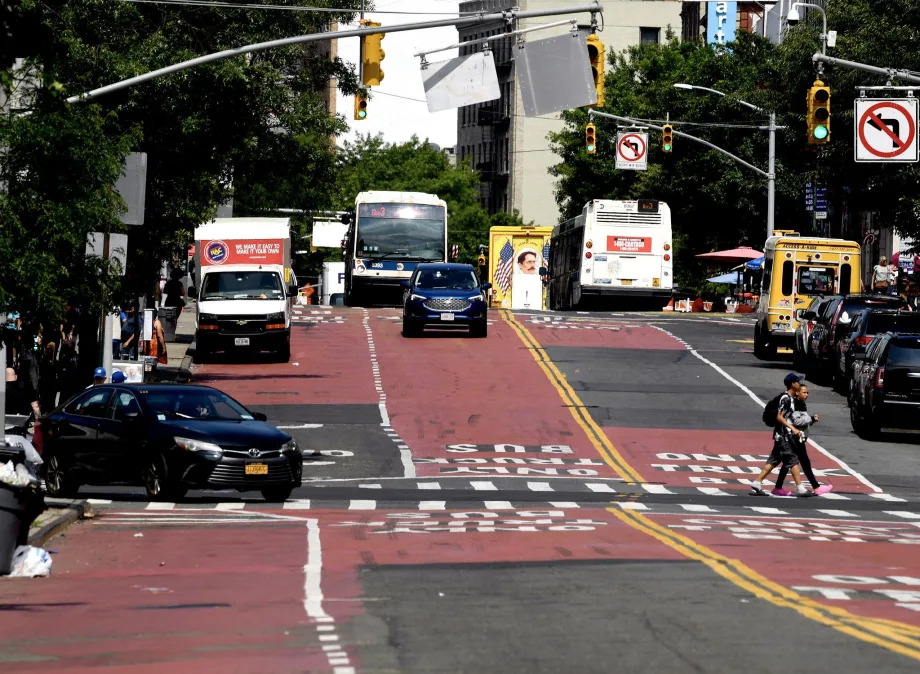
The goal of the program is to improve bus service by enhancing compliance with existing traffic rules. Summonses for rule violations start at $50 and escalate to $250 for repeat offenders.
Marc A. Hermann
- New York MTA extends automated camera enforcement to monitor misuse of busways and bus lanes.
- Initial warning notices will be sent to violators for 60 days before transitioning to summonses.
- The enforcement program targets vehicles blocking bus stops and illegally double-parking.
*Summarized by AI
The New York Metropolitan Transportation Authority (MTA) announced that two more bus routes will now be equipped with Automated Camera Enforcement (ACE).
The 60-day warning period on the B15 and M31 bus routes in Brooklyn and Manhattan will begin on April 13. Vehicles that improperly use busways and bus lanes, block bus stops, or illegally double-park will receive warning notices in the mail for an initial period of 60 days, followed by summonses thereafter.
The goal of the program is to improve bus service by enhancing compliance with existing traffic rules. Summonses for rule violations start at $50 and escalate to $250 for repeat offenders.
The two routes are in addition to the 58 routes currently enforced. More than 1,700 buses are now ACE-equipped, covering 560 miles of routes and benefiting over one million customers on an average weekday, according to MTA officials.
MTA’s ACE Program
ACE enables bus service to run faster, safer, and more reliably for riders. ACE, when combined with dedicated bus lanes and street upgrades, has helped improve bus speeds across the full length of ACE-enabled routes, with some segments achieving gains of nearly 30%, according to the MTA.
The routes have also experienced a 20% reduction in collisions and an estimated 5% to 10% reduction in emissions. There has also been a 40% reduction in the number of bus stops blocked by vehicles on ACE routes.
The ACE program is administered in partnership with the New York City Department of Transportation and the New York City Department of Finance. Once violations are captured by cameras on multiple buses, the resulting video, images, license plate information, location, and timestamp details are securely transmitted to NYCDOT for review by City employees and processing thereafter.
Since its launch in June 2024, ACE has rapidly expanded from a few select routes to a citywide initiative covering all five boroughs, serving bus riders, including a large share of essential workers, seniors, and New Yorkers who rely on transit every day.
The agency reports that the program has demonstrated measurable success in improving bus speeds, reducing collisions, and keeping bus stops clear, ensuring more reliable service for daily bus customers.
Quick Answers
The program aims to reduce unauthorized use of bus lanes and busways, prevent the blocking of bus stops, and eliminate illegal double-parking to improve traffic flow and safety.
*Summarized by AI
More Technology

ENC Lands MATA Contract and More in Biz Briefs
In this edition of Biz Briefs, we spotlight the latest developments shaping the future of mobility.
Read More →
Strada360’s Steve Lassey on Turning Transit Data Into Better Decisions
From breaking down data silos to preparing for AI, Strada360 CEO Steve Lassey discusses how transit agencies can use technology to improve operations, customer information, and long-term decision-making.
Read More →
Almaviva Looks to Open Architecture to Advance Transit Technology
Eric Reese discusses how interoperability, open architecture, and modular design can help transit agencies control costs, reduce vendor lock-in, and upgrade technology without starting over.
Read More →

Driving Smarter Paratransit
John Hanlon shares how AlphaRoute is leveraging AI-powered technology to help paratransit providers optimize operations, support frontline staff, and enhance the rider experience.
Read More →
From Hardware to Digital Partner: Luminator Charts Its Next Chapter
CEO Magnus Friberg discusses Luminator’s shift toward becoming a digital partner, the growing importance of software and interoperability, and how AI can help agencies improve operations and passenger experience.
Read More →
Beyond the Checklist: A Structured Approach to Transit Maintenance
Reliability-Centered Maintenance helps transit agencies move beyond routine checklists to focus limited resources on the assets and failures that have the greatest impact on safety, reliability, and service.
Read More →
NJ TRANSIT Advances Bus Technology Upgrades Across Statewide Fleet
More than 1,500 buses now feature upgraded technology designed to improve arrival predictions and provide free Wi-Fi, with deployment expected to reach nearly 2,000 buses by the end of 2026.
Read More →
Building a Flexible Path to Transit Electrification
John Hroncich discusses BAE Systems’ modular and scalable approach, lessons learned from decades of real-world operations, and how agencies can identify electrification strategies that fit their fleets.
Read More →
Biz Briefs: Alstom Lands Canadian Contract, LYT to Supply California TSP, and More
In METRO's latest installment, we take a look at recent news from Complete Coach Works, Beep, FlixBus, and more partnerships making headlines across the transportation sector.
Read More →
From Legacy Silos to Conversational Intelligence
What if transit leaders could ask any operational question and get a trusted answer in seconds? Conversational AI is transforming how agencies use their data.
Read More →