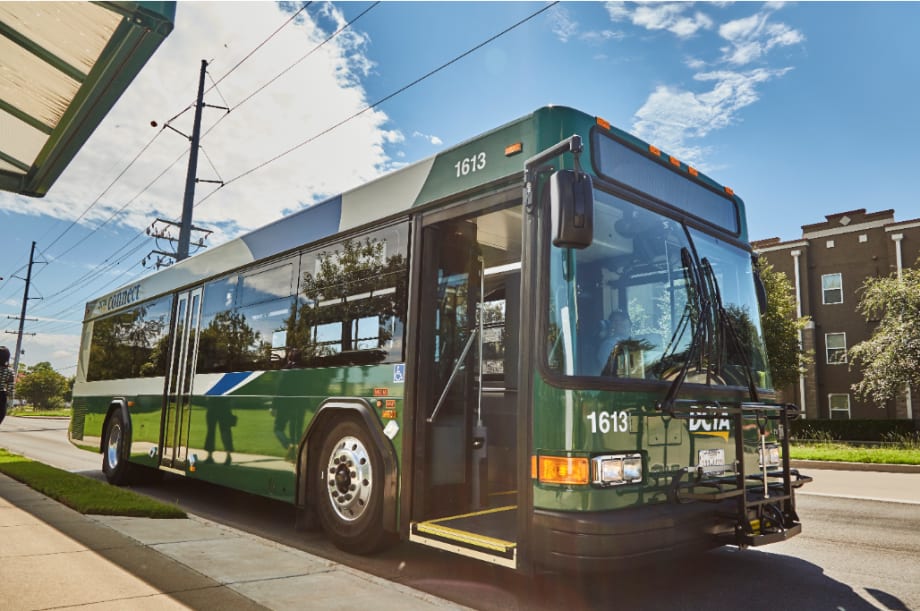
DCTA remains one of the few transit agencies in the country that has fully recovered ridership levels to pre-pandemic totals.
Photo: DCTA
3 min to read
Texas’ Denton County Transportation Authority (DCTA) delivered over 2.9 million passengers to their destinations in Fiscal Year 2023, completing its best year of service since the pre-pandemic days of 2019. Overall, DCTA saw 33% more riders in 2023 than in 2022.
DCTA attracted its strongest ridership gains aboard its combined bus services, as well as its GoZone on-demand rideshare service. As compared to 2022, DCTA bus services drew 37% more riders in 2023, and GoZone drew 38% more riders as opposed to last year.
Ad Loading...
“We’re excited to see the outstanding growth in ridership across our entire network of transit offerings,” said Paul A. Cristina, president and CEO of DCTA. “Our remarkable growth in 2023 shows our team’s efforts to focus on the customer experience and strengthen our service offerings really resonated with our customers.”
Returning Ridership
DCTA remains one of the few transit agencies in the country that has fully recovered ridership levels to pre-pandemic totals.
“Our Connect Bus system serving the City of Denton provided one of the highlights for the year, growing by 77% over last year due to our efforts to improve it with more bus frequency and faster intervals,” said Cristina. “We’ve also seen tremendous growth in ridership on our other bus systems including the UNT Campus Shuttle network.”
Also driving DCTA ridership growth is GoZone, the on-demand rideshare service operating in two zones covering Denton, Lewisville, and Highland Village. GoZone ridership grew at a 38% clip over last year, completing over 853-thousand rides in FY2023.
GoZone also celebrated major milestones in 2023, completing its one-millionth ride overall, as well as two full years of operational success.
Ad Loading...
In the zones where GoZone operates (Denton and Lewisville/Highland Village), the service has expanded residents’ access to jobs within a 30-minute commute by almost 94%. The service has also successfully gotten more citizens onto public transit, with about 50% of GoZone trips replacing rides previously served by private cars.
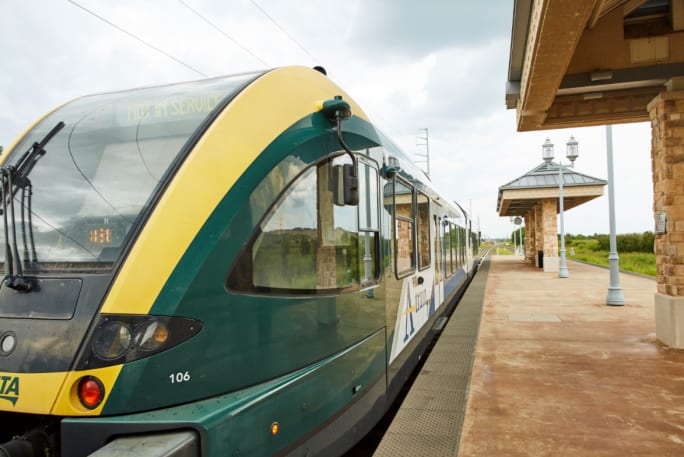
Ridership aboard DCTA's A-train also marked a great story for the year, growing by more than 28% over 2022 with over 225,000 riders boarding the train in 2023.
Photo: DCTA
A-train Ridership Growing
Ridership aboard the A-train also marked a great story for the year, growing by more than 28% over 2022 with over 225,000 riders boarding the train in 2023. The strong growth comes after an increase of more than 55% in 2022.
“While we are happy to see even more riders come back to the A-train this year, we have a lot more work to do in growing our commuter rail customer base because rail remains an outstanding alternative to the stress of commuting on a busy freeway,” said Cristina. “We continue to see a bright future for the A-train which includes service enhancements, more frequent trains and extensions to the service.”
DCTA’s other services including Commuter Vanpool, Access paratransit, and various regional on-demand services all saw increased ridership.
CEO Magnus Friberg discusses Luminator’s shift toward becoming a digital partner, the growing importance of software and interoperability, and how AI can help agencies improve operations and passenger experience.
In METRO's latest installment, we take a look at recent news from Complete Coach Works, Beep, FlixBus, and more partnerships making headlines across the transportation sector.
In a recent episode of METROspectives, CharterUP Founder/CEO Armir Harris discussed the company’s evolution from an online charter bus marketplace into a technology platform supporting public- and private-sector mobility and much more.
Through its NAVI program, JTA is showing how autonomous vehicles, intelligent infrastructure, and coordinated operations can work together to deliver everyday public transportation.
From manufacturers and suppliers to transit agencies and motorcoach operators, these updates offer a snapshot of the projects, partnerships and business moves driving the industry forward.
Former LA Metro Chief Innovation Officer Joshua Schank discusses why good ideas aren't enough, how transit agencies can overcome resistance to change, and why today's challenges demand more innovation.
From manufacturers and suppliers to transit agencies and motorcoach operators, these updates offer a snapshot of the projects, partnerships and business moves driving the industry forward.
Vice President of New Mobility Stephen Joos discusses how CharterUP is leveraging its nationwide transportation network, technology platform, and autonomous vehicle partnerships to expand into workforce mobility, campus shuttles, and transit solutions.