



MBTA Launches Improved Bus Stop Signage Pilot
The bus stop signage pilot comes in advance of anticipated bus service changes to come as part of the Bus Network Redesign Program.

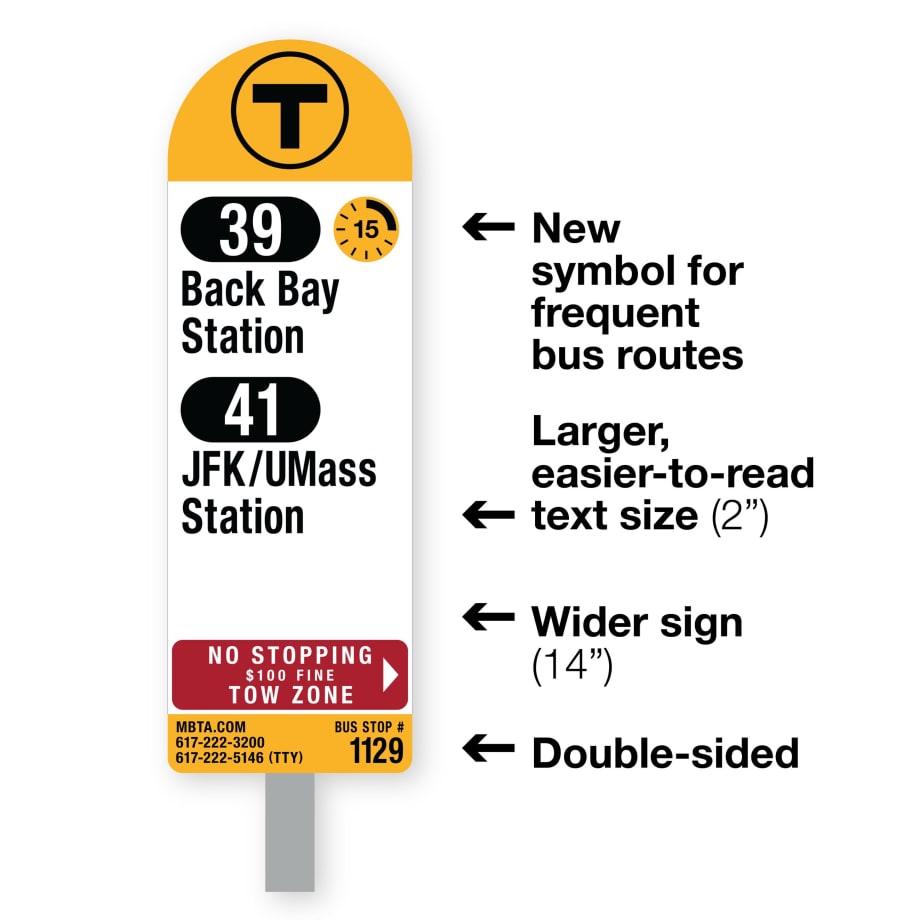
To prepare for the upcoming anticipated bus service changes as part of BNR, the new bus stop sign design is being piloted at various locations between April 8 and May 3.
Photo: MBTA
Boston’s MBTA announced a pilot, which will continue through May 3, to redesign bus stop signs in an effort to improve their accessibility and findability. The MBTA will also host eight pop-up events at pilot bus stops to gather rider feedback.
The bus stop signage pilot comes in advance of anticipated bus service changes to come as part of the Bus Network Redesign (BNR) Program.
“As we begin this pilot of new sign designs for buses that are intended to improve our riders’ experience and provide clear information at bus stops, we are asking for public feedback to best ensure we are meeting your expectations,” said MBTA GM/CEO Phillip Eng. “As we focus on delivering more reliable and frequent trips, information and communication is equally critical for both existing and future riders. Your input is invaluable as we embark on the first phase of Bus Network Redesign in December 2024. We look forward to seeing and hearing from everyone at any of the upcoming bus stop pop-up events.”
MBTA’s New Bus Stop Design
To prepare for the upcoming anticipated bus service changes as part of BNR, the new bus stop sign design is being piloted at various locations between April 8 and May 3. The signs will include the following:
Increased size: The sign’s width will increase from 12 to 14 inches to improve visibility.
Double-sided: The signs will be double-sided to make it easier to find bus information from both directions.
Improved legibility: The signs will include larger two-inch text and numbers to make them easier to read.
Frequent bus route symbol: The signs will include a clock symbol to indicate this bus stop serves one or more frequent bus routes.
Improving the Passenger Experience
BNR is a complete reimagining of Greater Boston’s bus network that will better reflect the travel needs of the area and create a better experience for current and future bus riders.
A new core network of frequent bus routes — operating every 15 minutes or better throughout the day — is the center of this redesign. The MBTA is implementing the new bus network in phases over the next five years.
In December 2024, the MBTA anticipates that Phase 1 bus service changes will be implemented throughout several communities, including:
Changing six bus routes, increasing service by 60% on the north side.
Increasing service frequency for four routes to 15 minutes or less, all day, every day.
New connections to the Red, Orange, Green, and Blue lines.
More Technology

From Hardware to Digital Partner: Luminator Charts Its Next Chapter
CEO Magnus Friberg discusses Luminator’s shift toward becoming a digital partner, the growing importance of software and interoperability, and how AI can help agencies improve operations and passenger experience.
Read More →
Beyond the Checklist: A Structured Approach to Transit Maintenance
Reliability-Centered Maintenance helps transit agencies move beyond routine checklists to focus limited resources on the assets and failures that have the greatest impact on safety, reliability, and service.
Read More →
NJ TRANSIT Advances Bus Technology Upgrades Across Statewide Fleet
More than 1,500 buses now feature upgraded technology designed to improve arrival predictions and provide free Wi-Fi, with deployment expected to reach nearly 2,000 buses by the end of 2026.
Read More →

Building a Flexible Path to Transit Electrification
John Hroncich discusses BAE Systems’ modular and scalable approach, lessons learned from decades of real-world operations, and how agencies can identify electrification strategies that fit their fleets.
Read More →
Biz Briefs: Alstom Lands Canadian Contract, LYT to Supply California TSP, and More
In METRO's latest installment, we take a look at recent news from Complete Coach Works, Beep, FlixBus, and more partnerships making headlines across the transportation sector.
Read More →
From Legacy Silos to Conversational Intelligence
What if transit leaders could ask any operational question and get a trusted answer in seconds? Conversational AI is transforming how agencies use their data.
Read More →
USDOT Announces Rail Vehicle Replacement Grants, Chattanooga AV Shuttle Funding
More than $191 million in federal funding will help three transit agencies replace aging rail vehicles and support a new autonomous shuttle service in Chattanooga.
Read More →
Bus Tech Talk: Keeping Transit Technicians Ahead of the Technology Curve
LA Metro’s Obed Mejia discusses technician training, evolving maintenance technology, fleet replacement, and strategies for getting the most out of today’s transit fleets.
Read More →
Biz Briefs: RIPTA Unveils New Frontrunners, Clevland RTA Adds New Siemens, and More
In METRO's latest installment, we take a look at recent news from Siemens, Prevost, Dodge, and more partnerships making headlines across the transportation sector.
Read More →
Why Simulating Pedestrian Movement Has Become Essential for Modern Rail Stations
Pedestrian microsimulation is helping rail planners identify bottlenecks, test station designs, and prepare complex transit hubs for growing passenger volumes.
Read More →