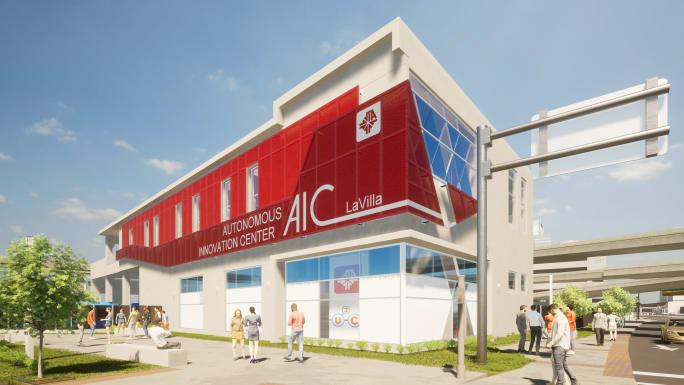
As lead of the V2R team, Balfour Beatty will build the two-story AIC on an existing parking lot with a secure perimeter.
Photo: Eric Luttmann
2 min to read
Florida’s Jacksonville Transportation Authority (JTA), together with the Balfour Beatty Vision 2 Reality (V2R) team, including Beep Inc., launched the Autonomous Innovation Center (AIC) at LaVilla — a vibrant hub centered around an advanced command-and-control center that will store, service, monitor, and maintain the city’s electric, autonomous mobility system.
The AIC is an integral part of the upcoming Bay Street Innovation Corridor (BSIC), Phase I of the Ultimate Urban Circulator (U2C) program — a comprehensive initiative to modernize and expand transportation options in the Downtown Jacksonville area and introduce autonomous vehicles (AVs) into JTA’s transportation system.
Ad Loading...
Establishing an innovative mobility network to connect a rapidly developing downtown with neighborhoods on both sides of the St. Johns River is a critical cornerstone to revitalizing the area.
“The groundbreaking of the AIC is a culmination of hard work alongside the V2R team to provide the Jacksonville community with at-scale autonomous mobility,” said JTA CEO Nat Ford. “Throughout this project, JTA has leveraged its partners’ experience and expertise, and this groundbreaking is a visible symbol of our collective, forward-thinking progress. Today, we are one step closer in realizing our shared goal of providing a passenger service that is sustainable and adaptable and places Jacksonville as a city at the forefront of modernization.”
How The Partnership Works
As lead of the V2R team, Balfour Beatty will build the two-story AIC on an existing parking lot with a secure perimeter.
The facility’s top floor will feature the command-and-control center. The first floor includes maintenance bays for vehicle service and covered AV parking with charging stations. Balfour Beatty’s full V2R team includes Superior Construction Company Southeast, Beep, WGI Inc., Urban SDK, Miller Electric, and Grayline to deliver the AIC project.
Shared autonomous mobility solutions provider, Beep, is providing insights around the command-and-control center and design as it relates to managing autonomous vehicle systems to ensure the JTA and its community are planning for key features across safety, sustainability, and efficiency.
Ad Loading...
Built for the community, the AIC also includes an open terrace that allows for guided tours and educational opportunities that showcase the program in-action with an optimal viewing area of the AVs arriving and departing the facility.
Photo: Eric Luttmann
Additional Benefits of JTA’s AIC
Built for the community, the AIC also includes an open terrace that allows for guided tours and educational opportunities that showcase the program in-action with an optimal viewing area of the AVs arriving and departing the facility.
Additionally, in partnership with LaVilla Heritage Trail & Gateways, an area outside of the secure perimeter will be provided along Bay Street for food trucks.
CEO Magnus Friberg discusses Luminator’s shift toward becoming a digital partner, the growing importance of software and interoperability, and how AI can help agencies improve operations and passenger experience.
In METRO's latest installment, we take a look at recent news from Complete Coach Works, Beep, FlixBus, and more partnerships making headlines across the transportation sector.
In a recent episode of METROspectives, CharterUP Founder/CEO Armir Harris discussed the company’s evolution from an online charter bus marketplace into a technology platform supporting public- and private-sector mobility and much more.
Through its NAVI program, JTA is showing how autonomous vehicles, intelligent infrastructure, and coordinated operations can work together to deliver everyday public transportation.
From manufacturers and suppliers to transit agencies and motorcoach operators, these updates offer a snapshot of the projects, partnerships and business moves driving the industry forward.
Former LA Metro Chief Innovation Officer Joshua Schank discusses why good ideas aren't enough, how transit agencies can overcome resistance to change, and why today's challenges demand more innovation.
From manufacturers and suppliers to transit agencies and motorcoach operators, these updates offer a snapshot of the projects, partnerships and business moves driving the industry forward.
Vice President of New Mobility Stephen Joos discusses how CharterUP is leveraging its nationwide transportation network, technology platform, and autonomous vehicle partnerships to expand into workforce mobility, campus shuttles, and transit solutions.