Most dictionaires define safety as “Freedom From Risk.” If you are free from risk, you are safe.
Photo: Canva
4 min to read
Safety, Safety, Safety. This word is used repeatedly, and in many contexts, without most people understanding what it actually means.
The safety director of a large agency was recently explaining to me how his agency had a passion for safety. Impressive, but when I asked him to define safety, he answered “having no accidents.”
Ad Loading...
I took this opportunity to explain that having no accidents was the consequence of safety, it was not the actual meaning. For example, if I closed my eyes and ran across a busy street and I made it. I did not have an accident, but I certainly wasn’t safe. Having no accidents is the consequence of operating safely.
Upon explaining this, he took another shot at explaining what safety is. “Acting in a caring way, doing all the things you neeed to operate safely.”
Quite honestly he was waffling, and it was clear he had no idea. How can you have a passion for safety if you do not even know what safety really means.
This safety director is not alone in repeatedly using the word safety while having no idea what operating safely actually means. Think about it, do you? If you go to the dictionary and look up safety, what will it say? Do you have any idea?
Defining Safety
Most dictionaires define safety as “Freedom From Risk.”
Ad Loading...
If you are free from risk, you are safe. If you reduce risk, you are safer. So, if you have a passon for safety, this means you have a passion for removing or reducing risk.
Risk is defined as “The possibility of bodily injury or damage to property.” When we put these definitions together, Safety equals freedom from the possibility of bodily injury or damage to property. That makes sense.
So, risk is the enemy. We need to remove or reduce risk and to do that we need to understand where risk comes from. Well, it comes from two areas — unsafe conditions and unsafe behaviors.
Unsafe Conditions
This refers to the equipment, such as brakes, tires, steering and the other factors around the driver, such as motor vehicle record reviews, drug tests, criminal record checks, etc.
We engineer away the risks from unsafe conditions such that less that 5% of risk comes from unsafe conditions.
Ad Loading...
Concious and Deliberate Unsafe Behaviors
Most risk, 95%, comes from the conscious and deliberate unsafe behaviors performed by the drivers.
Yes, conscious and deliberate unsafe behaviors that can all be avoided. No one deliberately causes an accident, but drivers do consciously perform unsafe behaviors that lead to accidents.
One example is that 30% of all accidents are rear-end collissions. These are caused by following too closely. Following too closely is a conscious and deliberate unsafe behavior that can lead to an accident. In fact, it leads to millions of accidents, every year.
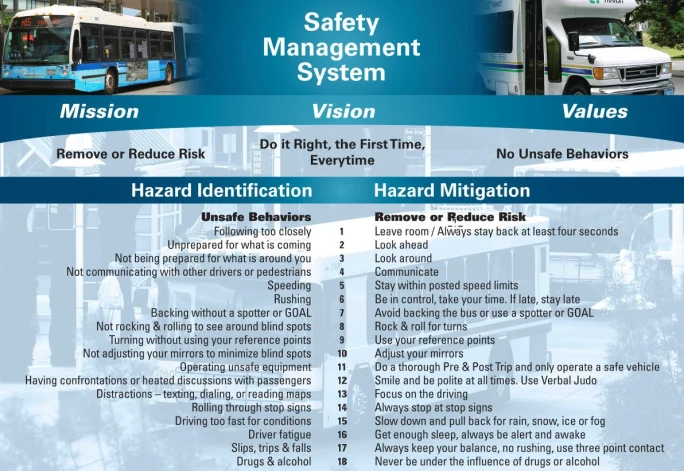
We have identified 18 conscious and deliberate unsafe behaviors from operating a transit or paratransit vehicle that lead to almost every accident. These are detailed on this poster.
TAPTCO has identified 18 conscious and deliberate unsafe behaviors from operating a transit or paratransit vehicle that lead to almost every accident.
Photo: TAPTCO
When bus drivers avoid the 18 unsafe behaviors detailed on the left side of this poster and only practice the reciprocal safe behaviors on the right side of the poster, they will have removed or reduced risk and will be operating safely.
Not looking ahead and being prepared for what is coming is conscious and deliberate.
Not looking around and being conscious of any risks around us is conscious and deliberate.
Texting or dialing while driving is conscious and deliberate.
Driving too fast for conditions, like snow or rain, is conscious and deliberate.
Ad Loading...
In fact the poster lists the 18 conscious and deliberate unsafe behaviors that lead to almost every accident.
In 2023, 45,000 Americans were killed on the roads and 2.4 million were injured. In almost every case these tragedies were the result of conscious and deliberate unsafe behaviors by the drivers.
To most people, safety is a grey subject. It is a concept, a desire, but they are unsure of the actions they need to take to put this goal into practice.
Photo: Canva
What Does This Mean?
To most people, safety is a grey subject. It is a concept, a desire, but they are unsure of the actions they need to take to put this goal into practice.
By training, encouraging, and requiring drivers to avoid the 18 unsafe behaviors on the left side of the poster and to always follow the 18 safe behaviors on the right side of the poster, such actions will enable you to indoctrinate a safety culture.
This is easy to understand and easy to put into practice. To summarize:
Ad Loading...
If you care about safety, you care about removing or reducing risk.
To do this, you need to teach, train, inform, encourage, and require drivers to follow the 18 safe behaviors on the right side of the poster and avoid the 18 unsafe behaviors on the left side of the poster. It really is that simple.
If there are any future accidents, identify the behavior that led to the accident and link this back to the poster. Discuss the behavior and use the drivers mistake to help persuade the other drivers not to repeat it.
Safety is removing or reducing risk, it really is that simple.
Did you know that there are literally tens of millions of people worldwide with hearing loss, many of whom will use some form of public transit at some point?
Thirty-five years after the passage of the Americans with Disabilities Act of 1990 (ADA), the impact of this landmark piece of civil rights legislation cannot be overstated.
Safety, on-time performance, and customer experience are critical elements in intercity bus operations. But getting them right doesn’t come down to plans or protocols alone. It comes down to execution. How well your team performs on the ground, in real time, is what defines success.
With Data Privacy Day Jan. 28, I want to spotlight a critical challenge faced by service providers in the mass transit sector: managing personal information responsibly in an era of rapidly evolving privacy regulations.
Retrieving and reviewing data and video can be a cumbersome process for fleet managers. Each system or tool provides a piece of the puzzle, but seeing the complete picture requires tedious manual synchronization.
In today’s highly connected world, cybersecurity is of utmost importance, particularly for transportation agencies overseeing transit bus systems that rely increasingly on sophisticated technologies, including the use of data analytics in traffic signal networks, to manage and operate their systems.
In the daily hustle and bustle of city life, transit buses serve as the backbone of urban transportation, allowing millions of city dwellers to get from point A to point B each day reliably.
Thirty years ago, drivers not only had to drive the bus and navigate heavy traffic, but they were also responsible for tasks like supervising passenger loading and unloading, selling tickets, and providing passengers with various kinds of information, all while sitting in an often ill-fitting workstation.
The old joke that you wait ages for one bus and suddenly three come along at once may be consigned to the history bin thanks to developments in artificial intelligence (AI).