




More News: Long Island Rail Road Celebrates Strongest Year to Date
Southern California's Metrolink Adjusts Schedules to Enhance Reliability
Metrolink is adjusting their San Bernardino Line schedule to combat congestion on the track and make their service run smoothly for everyone.
January 15, 2025
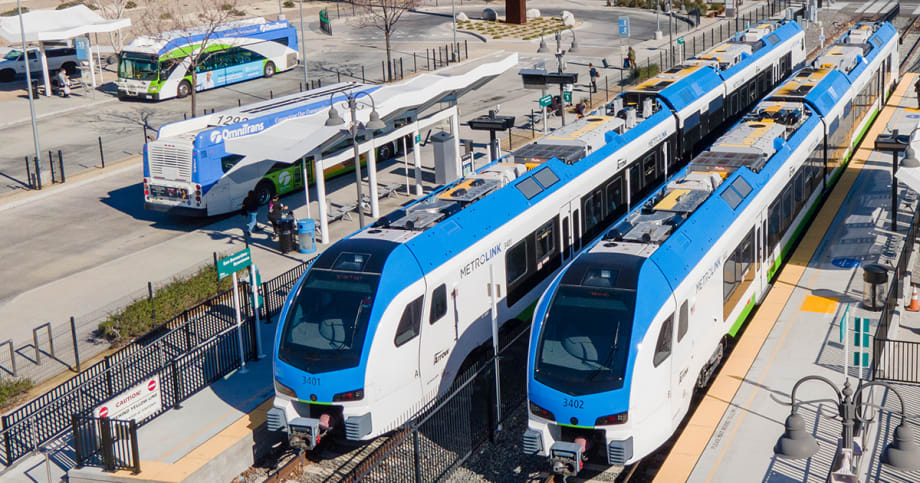
Metrolink is adjusting their San Bernardino Line schedule to reduce the number of delayed and cancelled trips as well as respond to customer feedback.
Photo: Metrolink
3 min to read
Metrolink, Southern California’s regional passenger rail system, is implementing significant adjustments to its San Bernardino Line schedule beginning on January 27.
The changes are designed to relieve train congestion on the heavily traveled corridor and improve on-time performance and service reliability for customers. The changes are planned to extend to the Arrow service, and minor modifications to four Ventura County Line trains will also be taking effect.
“Last fall, we embarked on the most ambitious schedule expansion in Metrolink’s history with the goal of delivering greater flexibility and convenience for our customers,” Metrolink CEO Darren Kettle said. “While this aspirational change was made with our riders’ needs in mind, we’ve learned some important lessons over the last several months, particularly on our San Bernardino Line where we’ve seen cascading delays due to limited track capacity. In response to these challenges and feedback we’ve received from customers, we’re making some much-needed changes to our schedule to improve operations and ensure we provide the high-quality service our passengers expect and deserve.”
Becoming a Regional System
As part of the agency’s ongoing transformation from a commuter railroad to a true regional passenger rail provider, Metrolink introduced 32 new weekday trains in October. This was implemented accounting for a nearly 23% systemwide service expansion with more midday and late-evening options.
Eighteen of the new trains were added on the San Bernardino Line, including 10 roundtrips between Los Angeles and Covina that shortened train intervals at LA Union Station to 30 minutes throughout much of the day.
Despite extensive planning and modeling, when the increased volume was introduced in a real-world setting customers experienced recurring delays and cancellations caused by train congestion.
Adjustments to the Schedule
The primary challenge to operate the current schedule effectively is track capacity. To resolve the issues while still delivering an enhanced level of service for San Bernardino Line user, Metrolink is incorporating the following changes:
The 10 Covina roundtrips will be discontinued. They will be replaced by five roundtrips between LA Union Station and the Montclair Station, where travelers with connections in San Bernardino County can transfer to and from many local transit providers.
Metrolink will continue to operate 17 roundtrips between San Bernardino and Los Angeles, along with one roundtrip connecting the Redlands-Downtown Station and Union Station.
The two limited stop express trains between Redlands and Los Angeles will now serve all station stops, benefiting more communities and riders.
A late-evening train from Los Angeles to San Bernardino will be reinstated in response to customer feedback.
The Arrow service schedule is being updated to better align with the new San Bernardino Line schedule, while the impacted Ventura County Line trains will see only slight schedule adjustments to improve service.
More Rail

New York MTA Advances Final Contract for Second Avenue Subway Expansion
Contract Four is the largest in the Second Avenue Subway Phase 2 project and includes construction of station infrastructure, tracks, and signals for the subway expansion, MTA officials said. Work on Contract Four will begin in 2027.
Read More →
San Diego MTS Breaks Monthly Trolley Ridership Record
Agency officials said July’s ridership indicates MTS’s continued recovery from the pandemic.
Read More →
Report Examines NJ TRANSIT Reliability, Funding Challenges
The Garden State Initiative analysis examines the roles of Amtrak infrastructure, fleet management, and agency operations while recommending a more performance-based approach to improving reliability.
Read More →
Stadler, CapMetro Sign Long-Term Rail Fleet Support Agreement
Beginning in 2027, Stadler will provide on-site technical expertise, spare parts support, training, and obsolescence management to help extend the reliability and longevity of CapMetro’s GTW fleet.
Read More →
Biz Briefs: Alstom Lands Canadian Contract, LYT to Supply California TSP, and More
In METRO's latest installment, we take a look at recent news from Complete Coach Works, Beep, FlixBus, and more partnerships making headlines across the transportation sector.
Read More →
CATS Gold Line Marks 5 Years of Service, 2.8M Passenger Trips
With a six-mile expansion planned, the Charlotte streetcar is positioned to connect more neighborhoods and major transit hubs across the region.
Read More →
Why Simulating Pedestrian Movement Has Become Essential for Modern Rail Stations
Pedestrian microsimulation is helping rail planners identify bottlenecks, test station designs, and prepare complex transit hubs for growing passenger volumes.
Read More →
Amtrak Begins Major Construction at New York’s Sunnyside Yard
The new maintenance facility will support Amtrak’s Airo trainsets while improving maintenance efficiency and turnaround times in New York.
Read More →
Chicago Leaders Unveil Plans for O’Hare Airport Express Train
The privately developed project would offer a 15-minute trip between downtown and O’Hare’s Terminal 2, with trains operating every 15 minutes on a dedicated track. The service would use battery-electric trains and three existing freight rail rights-of-way.
Read More →
OCTA Maps Out 30-Year Strategy to Protect Coastal Rail Corridor
The draft feasibility report identifies strategies to protect the coastal rail line for decades as the agency continues near-term stabilization and sand placement efforts.
Read More →