



Iowa's DART Opens Public Input for Proposed Bus Network
The proposed network aligns DART’s bus routes and services with available funding in Fiscal Year 2027 and the region’s priorities for public transit. It features fewer routes with more frequent service all day and all week, increasing the number of people with access to frequent, 15-minute bus service.


Compared with DART’s current bus network, the new network would increase the number of residents and jobs near any transit service and near frequent 15-minute service.
Photo: DART
Iowa’s DART is asking riders and residents from across Greater Des Moines to give feedback on the Reimagine DART draft bus network — the first major redesign of services in more than a decade.
The proposed network aligns DART’s bus routes and services with available funding in Fiscal Year 2027 and the region’s priorities for public transit. It features fewer routes with more frequent service all day and all week, increasing the number of people with access to frequent, 15-minute bus service.
"Reimagine DART is about more than changing bus routes — it’s about building a transit network that maximizes our resources and delivers the services our region values most,” said Amanda Wanke, DART CEO. “Designing a new network that prioritizes ridership allows people to travel farther, faster than they can today, making the service more useful for more people in central Iowa.”
Seeking Draft Feedback
The agency is seeking broad input on the Draft Network because public transit is a public service for all residents. DART’s ridership increased to 3.75 million trips last year. 60% of riders use DART to get to work. These rides are essential to the region’s economy — staffing hospitals, schools, grocery stores, and other businesses residents depend on and enjoy, agency officials said.
DART is asking riders and residents to visit its Reimagine DART website to view the map of the proposed new network, details of how service will be delivered, and bus stop locations, then give their feedback. Central Iowans can also attend one of nine public meetings throughout September to learn more and ask questions.
All input collected will be shared with the DART Commission and considered as the network is finalized. The earliest new routes would take effect is summer 2026, said agency officials.
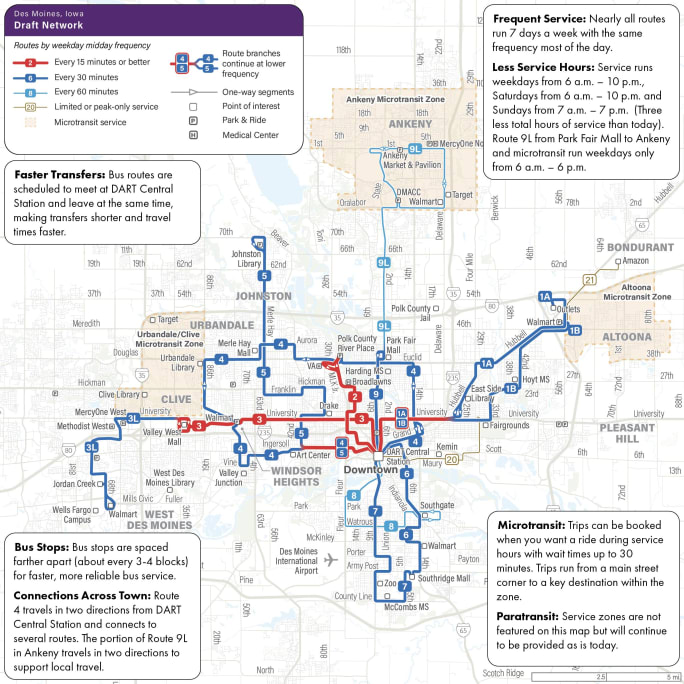
DART is seeking broad input on the Draft Network because public transit is a public service for all residents.
Photo: DART
DART’s Proposed New Bus Network
DART staff worked with consultants and traffic planners from several of DART’s member communities to draft the new network based on public input and this direction from DART’s governing board, the DART Commission:
Prioritize high ridership for the region overall, with fewer routes that have more frequent service, with coverage service in Ankeny, Altoona, and Clive.
Maintain 90% of DART’s current total hours of service to limit property tax growth for the next few years.
To align with this direction, the new bus network features:
10 main routes along the busiest streets of the region, with buses running more often and more consistently throughout the day and week.
Timed transfers at DART Central Station and bus stops spaced farther apart speed up travel time and increase efficiency in the system.
Updated service hours reduce service at times when ridership is the lowest.
Three microtransit zones that provide transit access to more places in less dense suburban areas.
Compared with DART’s current bus network, the new network would increase the number of residents and jobs near any transit service and near frequent 15-minute service. The average resident would be able to reach 21% more jobs within 45 minutes compared to the existing transit network, said DART officials.
More Bus

New York MTA Plans Largest Bus Fleet Upgrade in More Than a Decade
The agency is seeking manufacturers for 650 new CNG buses to replace aging vehicles, improve reliability, and advance its broader fleet modernization strategy.
Read More →
Building a Flexible Path to Transit Electrification
John Hroncich discusses BAE Systems’ modular and scalable approach, lessons learned from decades of real-world operations, and how agencies can identify electrification strategies that fit their fleets.
Read More →
Bus Tech Talk: Keeping Transit Technicians Ahead of the Technology Curve
LA Metro’s Obed Mejia discusses technician training, evolving maintenance technology, fleet replacement, and strategies for getting the most out of today’s transit fleets.
Read More →
Biz Briefs: RIPTA Unveils New Frontrunners, Clevland RTA Adds New Siemens, and More
In METRO's latest installment, we take a look at recent news from Siemens, Prevost, Dodge, and more partnerships making headlines across the transportation sector.
Read More →
People Movement: Holly Arnold Joins Transdev and More
In this edition, we also cover recent appointments and announcements at Pace, CamTran, MCI, and more, showcasing the individuals helping to shape the future of transportation.
Read More →
The High Cost of Transit Buses: Industry Leaders Look to Procurement Reform
Transit leaders and policymakers examine how standardized bus designs, streamlined procurement, and predictable funding could help agencies stretch budgets and deliver better service.
Read More →
The Business Voice Behind Public Transportation
As chair of APTA’s Business Members Board of Governors, Ray Melleady explains how more than 850 business members are partnering with transit agencies to advance funding, innovation, and industry-wide collaboration.
Read More →
From Surviving to Thriving: Building Stronger Transportation Organizations
Bus Business Consultants founder Brian Dickson shares lessons on leadership, organizational health, and creating options for long-term success in a changing transportation industry.
Read More →
Finding the ‘Happy Medium’: Optimizing Maintenance Without Sacrificing Reliability
The key to maintenance optimization isn’t doing less work—it’s doing the right work at the right time on the right assets.
Read More →
LA Metro, City of West Hollywood, and Partners Advance Smarter Bus Lane Enforcement
The award-winning partnership combines AI-powered detection with human oversight to improve bus reliability, accessibility, and enforcement efficiency.
Read More →