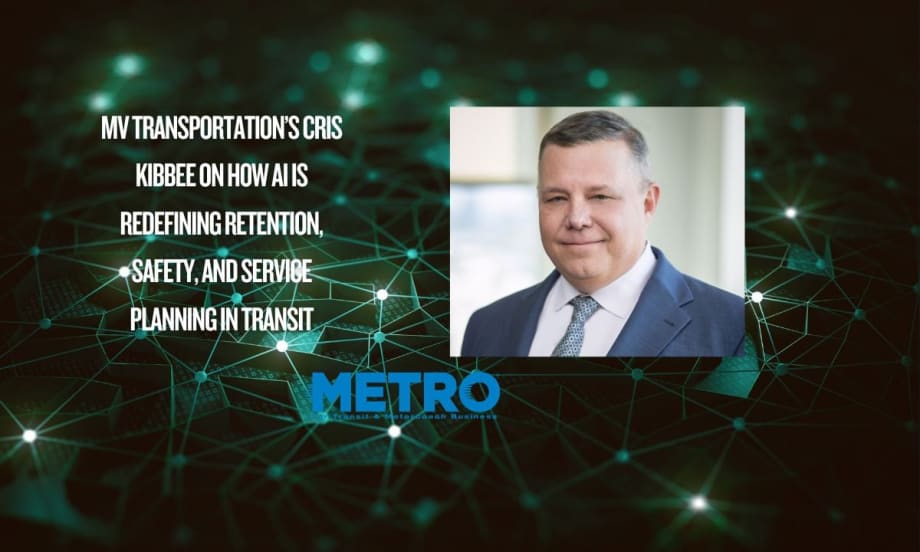
At MV Transportation, Chief Innovation Officer Cris Kibbee is leading several initiatives that demonstrate how AI can drive measurable improvements.
Photo: METRO/MV Transportation
7 min to read
Cris Kibbee discusses with METRO Magazine how MV Transportation is leveraging AI to enhance retention, safety, and service planning within its operations.
The interview explores AI's role in transforming transit services and its impact on MV's various properties.
Kibbee emphasizes the potential of AI technology to redefine what is achievable in public transportation.
*Summarized by AI
As artificial intelligence (AI) moves from concept to implementation, its practical benefits are becoming increasingly evident in public transportation.
From predictive analytics that anticipate staffing challenges to generative AI tools that streamline planning and dispatch, technology is beginning to solve some of the industry’s longest-standing pain points.
Ad Loading...
At MV Transportation, Chief Innovation Officer (CIO) Cris Kibbee is leading several initiatives that demonstrate how AI can drive measurable improvements — particularly in workforce retention, safety, and operational efficiency.
In less than two years, Kibbee and his team have implemented predictive models that have cut driver attrition by 50%, developed generative AI tools that make complex data instantly actionable, and laid the groundwork for real-time scheduling and routing capabilities that can work across both new and legacy systems.
Kibbee sat down with METRO Magazine Executive Editor Alex Roman to discuss how MV is using AI to help reshape what is possible at its many properties.
Combating Driver Attrition
Can you start by sharing a bit about your background and your role at MV?
I joined MV Transportation in early 2024 as Chief Innovation Officer. I oversee all aspects of the company's technology. I’m fortunate to work with a very seasoned and talented technology team of genuine problem solvers who deeply understand the business.
We have been developing and implementing several AI initiatives designed to address long-standing industry challenges.
Ad Loading...
Two of those projects focus on how we can utilize AI to understand and address one of transit’s most significant issues: driver attrition.
Driver turnover has always been a challenge in the industry. Can you discuss how MV is utilizing AI to address this issue?
Yes, attrition is one of those persistent issues that impacts everything downstream: safety, reliability, customer experience, and cost. We began by examining years of applicant and employee data. We developed a predictive model that determines, based solely on application data, whether a candidate is likely to become a long-tenured employee.
We consider dozens of factors related to their work history and do not use any personal or demographic data, including conducting regular re-evaluations to ensure the process is bias-free.
Once someone becomes an employee, a second predictive model takes over. That model examines several dozen other data points, including hours worked, safety records, training completion, and other relevant factors. That model detects when a driver’s engagement is flagging, and the driver becomes a departure risk.
We pair those findings with an HR ‘playbook’ that coaches managers on how to best engage with those drivers, identify the root causes of declining engagement, and address issues as appropriate. Over time, this approach, in partnership with our outstanding human resources team and field leaders, has reduced driver attrition by about 50%, with a significant impact on stability, safety, and service quality.
Ad Loading...
In less than two years, MV's team has implemented predictive models that have cut driver attrition by 50%.
What does that improvement in retention mean for MV and your agency partners?
It’s extremely valuable for us and the agencies we serve. High turnover is expensive. It costs time and money to recruit, onboard, and train new drivers. If someone leaves after a short period, you’ve spent many thousands of dollars on training without much or any return on investment.
The even more significant impact, though, is operational. When drivers stay longer, service reliability improves. Fewer call-outs mean fewer missed pull-outs. Routes run on time. And for paratransit riders, especially, consistency is everything. Many passengers see the same driver daily and build personal relationships with them. That sense of familiarity and comfort significantly enhances the passenger experience.
Longer-tenured drivers are also safer drivers. They are more comfortable behind the wheel, more familiar with the routes, and better attuned to passenger needs.
AI in Operations
Beyond retention, MV is investing in AI for planning and operations. What does that entail?
We are working on several fronts there. The first is transit planning, which involves tasks such as route-cutting, analyzing service areas, and identifying where microtransit might overlap with fixed routes, thereby improving service while reducing costs. Traditionally, that’s a manual, extremely time-consuming process.
We have now moved that entire process to the cloud, with AI models running under the hood. Once fully implemented, tasks that used to take a week or two can be completed in minutes or hours. This allows us to sit down with clients and model real-world service adjustments in near real time.
Ad Loading...
It’s a real game-changer for agencies that want to optimize their service mix or respond quickly to changing demand.
What about agencies using older software platforms? How can they benefit from this technology?
That is a big focus for us, because many clients are running legacy platforms. To help them, we have developed tools that layer generative AI on top of existing systems. Think of it like a ChatGPT for transit data. A manager or dispatcher can ask, ‘Show me our on-time performance for the last three months’ or ‘Which hours of the day have the most service disruptions?’ and get instant, visual answers.
We are also applying this to call centers by introducing conversational AI-based reservation agents that can handle basic trip bookings or inquiries. These agents can detect frustration, transfer to a human when necessary, and operate with consistent quality. This approach ensures faster response times and more reliable service.
Ultimately, we are creating a custom large language model trained on historical transit data. It enables agencies to gain actionable insights without requiring a data analyst, making legacy systems more powerful and responsive.
MV's Chris Kibbee believes that AI ultimately allows his team to rethink what’s possible.
Dynamic Scheduling and Safer Routing
As far as building predictive capabilities for scheduling and routing, how far along is that?
We have made significant progress and anticipate rolling out some functionality in the coming months. Predicting operational outcomes, like tomorrow’s on-time performance, is more complex than analyzing historical data, but we’re making real progress. Our goal is to have AI dynamically adjust schedules and routing in real time, even on legacy systems.
Ad Loading...
Initially, the system will make recommendations to dispatchers, suggesting adjustments that could optimize performance based on current conditions. Eventually, it will make those changes automatically.
We are also integrating real-time external data, particularly from significant or unusual events that disrupt typical traffic patterns, to make operations smarter. Our AI models take those variables into account, helping us plan safer, faster, and more reliable routes.
Adding Value for Transit Agency Clients
From a client perspective, what’s the value of MV developing this technology in-house?
Our ability to provide this technology to our clients, along with the significant service and cost benefits it delivers, is a game-changer. First, we have made this investment and, through it, we can benefit all of our interested clients. As a result, the costs of implementing the technology are far lower for any individual client than if they tried to do it on their own. Second, because we started nearly two years ago and have invested heavily in time and capital, we can implement the functionality we’ve discussed today either now or in the near future, rather than years down the road. Finally, because these models are constantly learning from data across the country, our rate of improvement is far faster than any individual client could achieve on their own, further benefiting our clients.
When we reduce driver attrition, improve OTP, and minimize service disruptions, agencies see immediate improvements in performance and passenger satisfaction. We are helping them improve operations and reduce costs much more quickly and affordably than they could on their own, which is a real win-win.
What’s your long-term vision for AI within MV?
Our vision is to be at the forefront of technology in the transit industry. We want to make sure our clients benefit from the latest advances, whether they’re running cutting-edge systems or older legacy platforms.
Ad Loading...
Ultimately, AI allows us to rethink what’s possible. We can reimagine service delivery, eliminate inefficiencies, and create a more proactive, responsive transit operation. Importantly, because of all the work we have done since early 2024, we have fully exited the “crawl” phase and are firmly in the “walk/run” phase, allowing us to test and roll out new functionality much more successfully and quickly than we ever could have two years ago.
We are already demonstrating some of these capabilities at industry events, such as APTA TRANSform, with much more to come. We couldn’t be more excited about this work and the benefits it will deliver for our passengers and customers.
Quick Answers
MV Transportation is using AI to redefine retention, enhance safety, and improve service planning at its various properties.
Cris Kibbee of MV Transportation discussed the impact of AI with METRO Magazine Executive Editor Alex Roman.
AI is impacting retention, safety, and service planning in the transit industry.
Alex Roman conducted an interview with Cris Kibbee to explore how AI is reshaping MV Transportation's capabilities.
AI is considered advantageous for MV Transportation because it helps to reshape possibilities, presumably leading to improved efficiency and effectiveness in their operations.
The delivery marks the first car in a 374‑vehicle order and begins the arrival of a new generation of higher‑capacity, more reliable, and more comfortable trains for one of the country’s busiest commuter rail systems.
Vehicles that improperly use busways and bus lanes, block bus stops, or illegally double-park will receive warning notices in the mail for an initial period of 60 days, followed by summonses thereafter.
The project, finalized on February 12, provides the city with two different configurations of high-definition cameras to outfit 16 buses in the Pretzel City Area Transit fleet.
The proposed acquisition of a company with deep digital expertise and expected 2026 revenues of over $220 million marks a significant step in Hitachi Rail’s strategy to operate as a leading global digital mobility player, the company said.
The board authorized a five-year contract, with two one-year options, to Tolar Manufacturing Company Inc., for the fabrication and installation of upgraded passenger amenities at bus stops across the DART Service Area.
As motorcoaches navigate increasingly congested urban corridors filled with pedestrians, cyclists, scooters, and distracted drivers, safety leaders across the industry are confronting a growing challenge: visibility.