California's OCTA Advances 2026 Initiatives Centered on Balance and Sustainability
The priorities are outlined in the 2026 Board and CEO Initiatives and Action Plan, which serves as a roadmap to guide the agency’s work throughout the year and ensure continued progress and accountability on voter-approved transportation investments and essential mobility services.
To support these initiatives, OCTA staff will advance 104 planned projects and program milestones in 2026, with progress updates provided to the Board throughout the year.
Credit: OCTA
2 min to read
The Orange County Transportation Authority in 2026 will focus on delivering a balanced, sustainable, and equitable transportation system while strengthening organizational resiliency and fostering a culture of excellence and collaboration, the agency announced.
The priorities are outlined in the 2026 Board and CEO Initiatives and Action Plan, which serves as a roadmap to guide the agency’s work throughout the year and ensure continued progress and accountability on voter-approved transportation investments and essential mobility services.
Ad Loading...
Advancing OCTA’s Vision
Each year, the newly elected board Chair works with the CEO to develop and present a set of strategic initiatives that reflect community values, fiscal responsibility, and long-term planning. The initiatives were recently reviewed and accepted by OCTA’s 18-member board.
“This plan reflects our responsibility to deliver on our commitments to Orange County residents by providing safe, reliable, and accessible transportation choices,” said OCTA Chair Jamey M. Federico. “By focusing on balance, sustainability, and collaboration, we are ensuring that OCTA continues to meet today’s transportation needs while preparing for the challenges and opportunities of the future.”
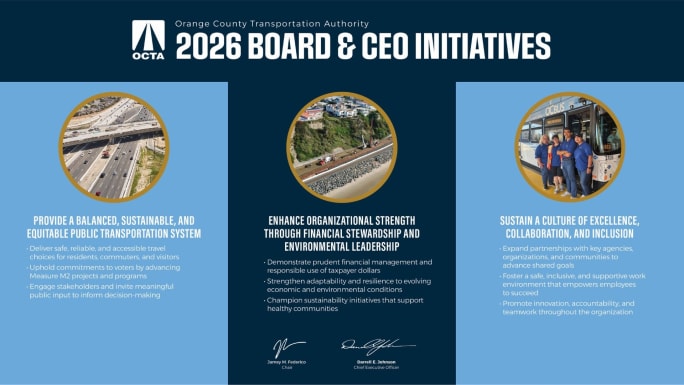
The 2026 Board and CEO Initiatives focus on three overarching priorities:
Providing a Balanced, Sustainable, and Equitable Public Transportation System: Delivering safe, reliable, and accessible travel options for residents, commuters, and visitors, advancing Measure M projects and programs, and engaging stakeholders through meaningful public input.
Enhancing Organizational Strength Through Financial Stewardship and Environmental Leadership: Demonstrating prudent financial management, responsibly using taxpayer dollars, strengthening adaptability to economic and environmental conditions, and championing sustainability initiatives that support healthy communities.
Sustaining a Culture of Excellence, Collaboration, and Inclusion: Expanding partnerships with key agencies, organizations, and communities, fostering a safe and inclusive workplace that empowers employees, and promoting innovation, accountability, and teamwork across the organization.
Each year, the newly elected board Chair works with the CEO to develop and present a set of strategic initiatives that reflect community values, fiscal responsibility, and long-term planning.
Credit: OCTA
What’s Next?
To support these initiatives, OCTA staff will advance 104 planned projects and program milestones in 2026, with progress updates provided to the Board throughout the year.
Ad Loading...
“By clearly defining our priorities and aligning them with measurable actions, we ensure accountability and transparency in everything we do,” said OCTA CEO Darrell E. Johnson. “This plan positions OCTA to remain fiscally responsible, environmentally conscious, and responsive to the communities we serve, while continuing to keep Orange County moving safely and efficiently.”
In his first State of CDTA address as CEO, Frank Annicaro highlighted the organization’s continued focus on delivering reliable service, investing in innovation, and strengthening connections across the region.
The special episode features an exclusive interview with Mark Miller, president of Constellation Software Inc. and executive chairman of the Volaris Group, who reflects on the podcast's early vision and the importance of creating a platform where transit leaders can share ideas and learn from one another.
The CAD facility enables NFI to complete full domestic production of heavy-duty transit vehicles, including zero-emission buses, in Winnipeg for the first time in 15 years.
The findings provide clear evidence that sustained Federal investment in public transit and passenger rail delivers significant returns for workers, communities, taxpayers, and the U.S. economy, APTA officials said.
On a recent episode of METROspectives, METRO Magazine’s Executive Editor Alex Roman sat down with Ana-Maria Tomlinson, Director of Strategic & Cross-Sector Programs at the CSA Group, to explore a bold initiative aimed at addressing those challenges: the development of a National Code for Transit and Passenger Rail Systems in Canada.
Over the next four years during the Spanberger Administration, DRPT will use the plan to prioritize funding for human service transportation projects and programs that reduce barriers, expand access, and promote equitable mobility, said department officials.
A new advisory group of current and former city leaders will collaborate on funding strategies, technology deployment, and best practices to modernize U.S. public transit systems.