



2014 Women In Transportation: Eve Williams
CEO/President Dikita Enterprises Dallas
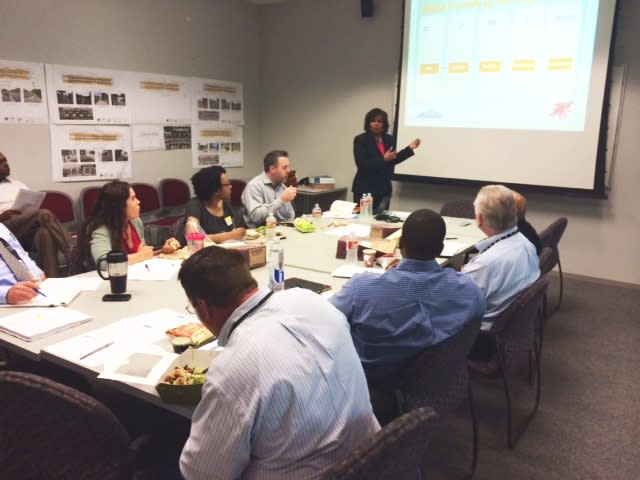
Williams is actively involved in her community on initiatives like local boards and city politics. She’s also chair of APTA’s Business Member Small Business Committee.
Williams is actively involved in her community on initiatives like local boards and city politics. She’s also chair of APTA’s Business Member Small Business Committee.
A strong background in business and computers is what makes Eve Williams, CEO/president of civil engineering firm Dikita Enterprises, an irreplaceable part of her team.
Williams, who holds an MBA in accounting and information systems, brought the first computer to Dikita. She computerized its financials in 1986 and went on to spearhead a ridership data collection initiative, which has become one of the company’s most marketable service offerings.
When it comes to engineering, planning and project management, Dikita promotes itself on a local level, working with notable transit authorities including Dallas Area Rapid Transit (DART). However, the company’s ridership data collection has grown as a national service.
“It’s sort of like a census,” Williams says. “If a municipality receives federal funds, they have to know certain information about their ridership. We collect that data, analyze it and pass it along. Transit agencies are then able to see how well they are serving their community. You can measure compliance, redesign routes or increase transit.”
Williams came up with the idea and software application in the early ‘80s when her father, Dikita’s founder Lucious Williams, was busy monitoring engineering projects. At the time, she was still in college and known as the “queen” of computer programming.
“Back then, we used a handheld computer the size of a cigarette carton — I was instrumental in programming it and influencing DART to use it,” she says. “Of course, the handheld devices are now cell phones, PDAs and tablets.”
When she saw passenger counting becoming automated, Dikita started incorporating origin-destination passenger interviews into their data collection offerings. The company collects real-time geographical information without the use of the Internet. This personalized component is now a key selling point.
Within the company, Williams has moved from VP, finance to chief financial officer to CEO.
“It’s a good thing I studied business,” Williams says. “When I see people managing an engineering company with only technical skills, I know they struggle. I absorbed management, marketing and accounting, and that’s helped me keep an edge for understanding what makes money and what doesn’t…and my computer skills help me use technology to analyze that quicker than everybody else.”
The company started in Milwaukee in 1979, but moved to Texas in 1983 to get involved with light rail systems. In 1991, Dikita became a prime consultant for DART, helping design roughly two miles of its first 20 miles of rail.
Dikita then went on to do program management, quality control, safety, systems integrations and railcar vehicle inspection for DART as a sub-consultant.
However, Dikita’s now designing and managing the construction of DART’s last two-and-a-half miles of rail, from the tracks to the stations, as a prime.
“DART has approximately 90 miles of rail since its start in 1991,” Williams says. “We started the first mile as a prime consultant, and now, we’re ending the last mile as a joint-ventured prime. Being a fairly small company with 48 employees, people are always amazed at what we can deliver.”
Despite her success, Williams says being a woman in transportation is often the most challenging part of her job.
“Aside from being a non-engineer in the engineering business, I’m also an African American female in a male-dominated industry,” Williams says. “My intellect and confidence is often tested, so as females, I believe we have to think smarter and have moxie.”
Williams is actively involved in her community on initiatives like local boards, city politics and the Chamber of Commerce. She’s also chair of APTA’s Business Member Small Business Committee.
“That might be one of the most gratifying things I do,” Williams says. “I help mentor other small businesses. I’m not afraid of creating competitors; I figure I’m fostering future partners.”
Outside of work Williams is an avid supporter of the arts for today’s youth. She contributes regularly to organizations like Dallas/Fort Worth’s The Black Academy of Arts and Letters as well as school foundations.
More Management

How Valley Metro Is Balancing Transit Growth With the Rider Experience
The APTA award-winning agency is pairing rapid system expansion with investments in workforce, safety, technology, and the fundamentals of transit service.
Read More →
Bus Tech Talk: Keeping Transit Technicians Ahead of the Technology Curve
In this episode of Bus Tech Talk, Complete Coach Works’ Business Development Manager Mark Hollenbeck and METRO’s Executive Editor Alex Roman sit down with Obed Mejia, Senior Technical Trainer for Bus Maintenance, at LA Metro to discuss how rapidly evolving bus technology is changing the maintenance shop — and the skills technicians need to keep pace.
Read More →
Michael Schneider Joins Paslay Group to Expand Transportation Practice
The longtime transportation executive will help Paslay Group grow its advisory and program management work across transit, highway, and other infrastructure sectors.
Read More →
People Movement: Connectpoint Expands Leadership Team, Stadler Names New Group CEO, and More
In this edition, we also spotlight recent personnel moves at Burns, UZURV, and more, highlighting the people taking on new roles across the transportation industry.
Read More →
More Than a Summer Job: Building the Next Generation of Transit Talent
The Delaware River Port Authority and PATCO have transformed their internship program into a hands-on professional development experience that introduces students to the breadth of transportation careers — and creates a pipeline for future employees.
Read More →
LA Metro Board Awards 220 Battery-Electric Bus Contract to ENC
The contract, which is the largest base award of battery-electric buses by a U.S. transit agency, will be built in Southern California, sustaining good jobs as LA prepares to welcome the world in 2028
Read More →
What’s Behind San Diego MTS’s Award-Winning Transit Strategy
Named one of APTA’s 2026 Outstanding Public Transportation Systems with 50 million or more annual passenger trips, California’s San Diego Metropolitan Transit System points to gains in ridership, safety, technology, and reliability as foundations of its success.
Read More →
Public Transit Conference Returning to GFX in 2027, Call for Papers Now Open
The Call for Papers is now open, allowing transit agency professionals and industry experts to help shape the PTC educational program by submitting session ideas for consideration.
Read More →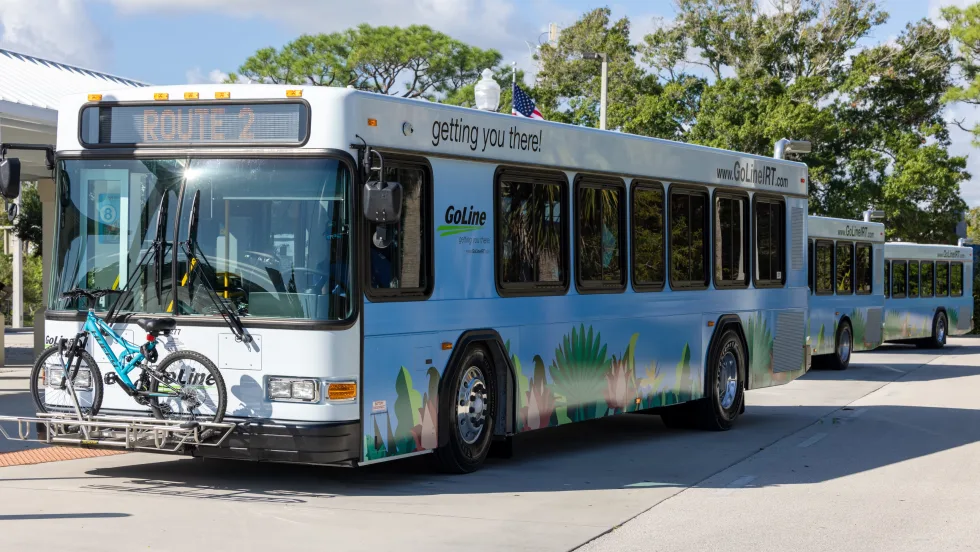
Indian River Transit’s Community-Focused Approach Earns National Recognition
Named APTA’s 2026 Outstanding Public Transportation System in its size category, Florida’s Indian River County transit system continues to grow ridership through fare-free service and a focus on evolving community needs.
Read More →
ENC Lands MATA Contract and More in Biz Briefs
In this edition of Biz Briefs, we spotlight the latest developments shaping the future of mobility.
Read More →