



5 Questions: Stephanie Negriff, Director, Big Blue Bus
Stephanie Negriff rose through the ranks of the Big Blue Bus (BBB) to become its director in August 2002. She recently announced her decision to retire from her position in October 2011 after 25 years of service with the City of Santa Monica.
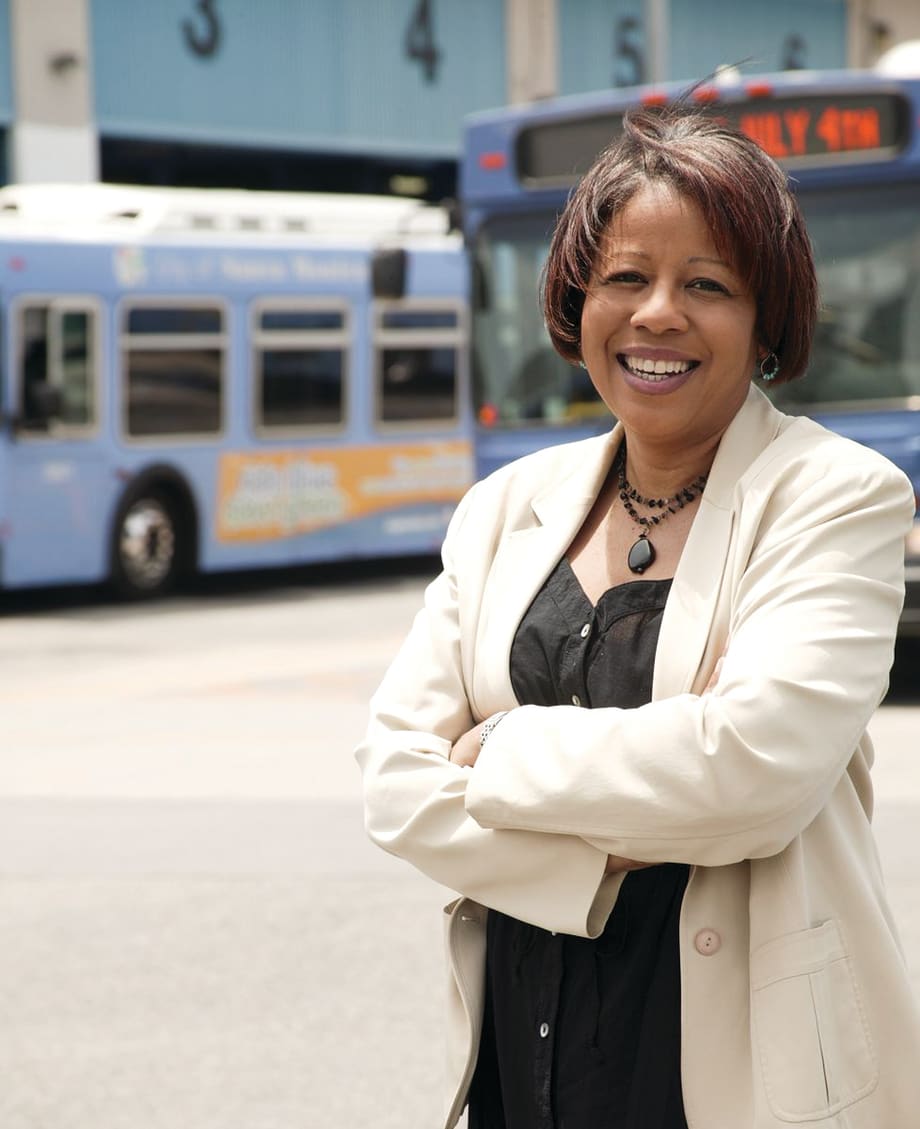
Stephanie Negriff rose through the ranks of the Big Blue Bus (BBB) to become its director in August 2002.
Stephanie Negriff rose through the ranks of the Big Blue Bus (BBB) to become its director in August 2002.
Stephanie Negriff rose through the ranks of the Big Blue Bus (BBB) to become its director in August 2002. She recently announced her decision to retire from her position in October 2011 after 25 years of service with the City of Santa Monica. Negriff has spent 33 years in transit service with 10 years as the BBB director. Prior to joining the transit system, she worked with transit agencies in Austin, Texas; St. Louis and Oklahoma City.
Reflect on your time at Big Blue Bus and what the situation was when you began.
When I arrived in Santa Monica in 1986, I was happy to be part of a beautiful, exciting city and the Big Blue Bus always had an outstanding reputation. I had just completed working on formation of the Capital Metropolitan Transportation Authority in Austin, Texas. We had gone through a referendum to create a dedicated sales tax in Austin, and I was really looking for my next new adventure. I was happy to find it in Santa Monica.
There was a county transportation commission that managed all of the regional funding, planning and policy issues and, then, there was the Southern California Rapid Transit District, the regional bus operator. I, primarily, was the liaison between the City of Santa Monica and the Los Angeles County Transportation Commission. It was just a natural fit for me. I was very excited to be in this major metropolitan area discussing regional service policy and coordination and learning about the various dedicated funding that was available in Los Angeles and in the state.
I also had the extreme privilege of working with the then-director of transit services, Jack Hutchison, who is in the APTA Hall of Fame. He's certainly a person that continues to be a mentor for me today, and one from whom I learned a tremendous amount about legislative and funding issues and the importance of making sure all of the transit systems in this area were at the table to make sure we received our fair share of the funding that was available.
[Currently,]I'm looking at some of the funding detail going back to 1986 and 1987 because it's applicable to some of the issues that we're working on now. We started reserving monies to plan for light rail transit back in the mid-1980s, and now, as I am ready to depart the city, they're actually building Phase II of the Exposition Line that's going to come to Santa Monica.
So, it really does reflect on a full circle moment of putting monies together that helped develop an alignment that is compatible with the city's land use and transportation goals. That's something that you don't often get to experience [on a] long-term, major capital project.
Discuss some of your accomplishments.
I think going into the next phase as Jack Hutchison retired; we were in a very strong financial position. As his successor came on, John Catoe, the city wanted to go into a direction of expansion of our transit service. I was really pleased to be a part of that. I was involved in developing the transit service expansion program that identifies where we wanted to enhance our services.
I was also involved in developing the community outreach process. We knew as we moved ahead with trying to decide how we wanted our transit system to grow, we needed to get input and support from our riders and the residents of Santa Monica. The community outreach process that was established in 1997 continues to be the model that we use today before we go out and make any type of service changes; whether they're service enhancements or service restructuring.
That's when we updated our fleet look to the new buses that have become an iconic symbol of transit in the west side, which is the periwinkle blue with 'Santa Monica's Big Blue Bus' printed on the side. It was a pretty significant transformation of our service at that time.
That was also around the time we had conceived this idea of a new maintenance facility, which has since been built and was opened in 2009. We started the conversion of our fleet, the diesel-powered fleet that we had, to an alternate-fuel fleet. Today, we stand at 100 percent alternate-fuel fleet, because even the 40 percent of our fleet that is still powered by diesel engines, uses biofuels. The policy decisions that directed our fleet to alternative fuels led to the construction of natural gas facilities and infrastructure, including our state-of-the-art maintenance facility.
What changes have you seen during your time in the transit industry?
One of the things I've enjoyed about working in this industry is things are always changing, and there's been tremendous progress in our industry over the several decades that I've been involved in, including legislative support at the local, state and federal levels.
I think our residents, our voters, particularly in the state of California, have really demonstrated the importance of public transportation and improved transportation services, because every referendum that we've had for public transit funding has been supported by the voters of the state of California. Even in 2008 as the economy was in free fall, the residents of L.A. County approved Measure R, which was another half-cent sales tax to support public transit. That level of support inspires me, as a transit professional, to be responsible steward of the public's trust.
In Santa Monica, we've been working over the last several years to develop an improved community transit network, using smaller hybrid-electric vehicles that can actually go into neighborhoods without being loud and cumbersome. We understand that as the Expo Light Rail Line comes to Santa Monica, improved downtown circulation is going to be critical, and transit is going to play a critical role in that.
[PAGEBREAK]
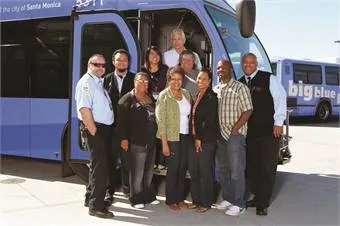
During her tenure, Negriff (third from left, bottom row) has helped usher Big Blue Bus into an era of alternative-fuel use, through the use of biofuels and CNG.
Which direction do you see public transit going over the next five to 10 years?
I think one of the real key issues that we'll need to address is the transportation reauthorization at the federal level. We know that this has been one of the most difficult economic times in recent history. I applaud all of my colleagues in the transit industry for keeping our transit services going in light of such difficult financial times. We've all had to face service reductions or fare increases as a way to balance our budgets and remain fiscally responsible. But, when we've gone out to communities, without question, the vast majority has accepted fare increases in lieu of service cuts. And, those are just some of the difficult decisions that we've had to make.
I'm delighted to see that this year, The Big Blue Bus, going into fiscal year 2012, will not have a structural deficit. That wouldn't have been possible had we not been very fiscally prudent. We've tried to maintain a service level that allows us to keep our budget in balance, and we've been successful finding innovative ways to generate additional revenues and control our costs.
On the revenue side, we're moving ahead with legislation through the sponsorship of assembly member Julia Brownlee, to allow the Big Blue Bus to demonstrate putting digital bus ads on the exterior of our buses, because we think we can generate more revenue with the digital ads than we do on the exterior print ads.
In terms of how we manage our services, I think one of the big changes that we've seen in our industry is the implementation of advanced technology transit management systems. So, we now have dispatchers who can actually see where the buses are and manage our on-street operations from the dispatch office, instead of having to increase supervision on the street. We also have digital video recorders on all of our buses. We have automated passenger counters. We have technologies that really allow us to manage our systems more efficiently, more effectively and deliver better service. Programs like that allow us to do more in terms of improving the quality of our service without having to increase our overall operating budget.
So, over the next five to 10 years, I think we're going to be looking at ways to use these technologies that are made available to us to actually manage our day-to-day services more effectively.
Why did you decide to retire and what are your plans for this next phase of your life?
Running a transit system requires a lot of time and energy. All I have ever done is worked at transit systems, and it has been a blessing. But, I would also like the opportunity to do some other things. I felt that this was the right time for me to leave the City of Santa Monica. I'm very interested in doing some non-profit work. I'm in the process of trying to establish a non-profit organization that helps provide transportation for the homeless and some of the most economically depressed residents in our area.
In addition to that, I'd be interested in being able to help other transit systems, as well as mentor the next generation of transit professionals. While I would like the opportunity to do that, I want to take a little time off, have more of my time to spend with my family and set the direction for the rest of my life. I'm interested in doing some writing and really trying my hand at some things that I never had the time to do, because I've devoted so much of my time to The Big Blue Bus and my other roles in the public transit field.
More Bus

New York MTA Plans Largest Bus Fleet Upgrade in More Than a Decade
The agency is seeking manufacturers for 650 new CNG buses to replace aging vehicles, improve reliability, and advance its broader fleet modernization strategy.
Read More →
Building a Flexible Path to Transit Electrification
John Hroncich discusses BAE Systems’ modular and scalable approach, lessons learned from decades of real-world operations, and how agencies can identify electrification strategies that fit their fleets.
Read More →
Bus Tech Talk: Keeping Transit Technicians Ahead of the Technology Curve
LA Metro’s Obed Mejia discusses technician training, evolving maintenance technology, fleet replacement, and strategies for getting the most out of today’s transit fleets.
Read More →
Biz Briefs: RIPTA Unveils New Frontrunners, Clevland RTA Adds New Siemens, and More
In METRO's latest installment, we take a look at recent news from Siemens, Prevost, Dodge, and more partnerships making headlines across the transportation sector.
Read More →
People Movement: Holly Arnold Joins Transdev and More
In this edition, we also cover recent appointments and announcements at Pace, CamTran, MCI, and more, showcasing the individuals helping to shape the future of transportation.
Read More →
The High Cost of Transit Buses: Industry Leaders Look to Procurement Reform
Transit leaders and policymakers examine how standardized bus designs, streamlined procurement, and predictable funding could help agencies stretch budgets and deliver better service.
Read More →
The Business Voice Behind Public Transportation
As chair of APTA’s Business Members Board of Governors, Ray Melleady explains how more than 850 business members are partnering with transit agencies to advance funding, innovation, and industry-wide collaboration.
Read More →
From Surviving to Thriving: Building Stronger Transportation Organizations
Bus Business Consultants founder Brian Dickson shares lessons on leadership, organizational health, and creating options for long-term success in a changing transportation industry.
Read More →
Finding the ‘Happy Medium’: Optimizing Maintenance Without Sacrificing Reliability
The key to maintenance optimization isn’t doing less work—it’s doing the right work at the right time on the right assets.
Read More →
LA Metro, City of West Hollywood, and Partners Advance Smarter Bus Lane Enforcement
The award-winning partnership combines AI-powered detection with human oversight to improve bus reliability, accessibility, and enforcement efficiency.
Read More →