



9 Tips for Planning Your Bus Charging Infrastructure
While adding a few charging stations to support pilot projects is relatively straight forward, transit agencies will need to consider several factors when planning to implement infrastructure that can support hundreds of electric buses, or more.

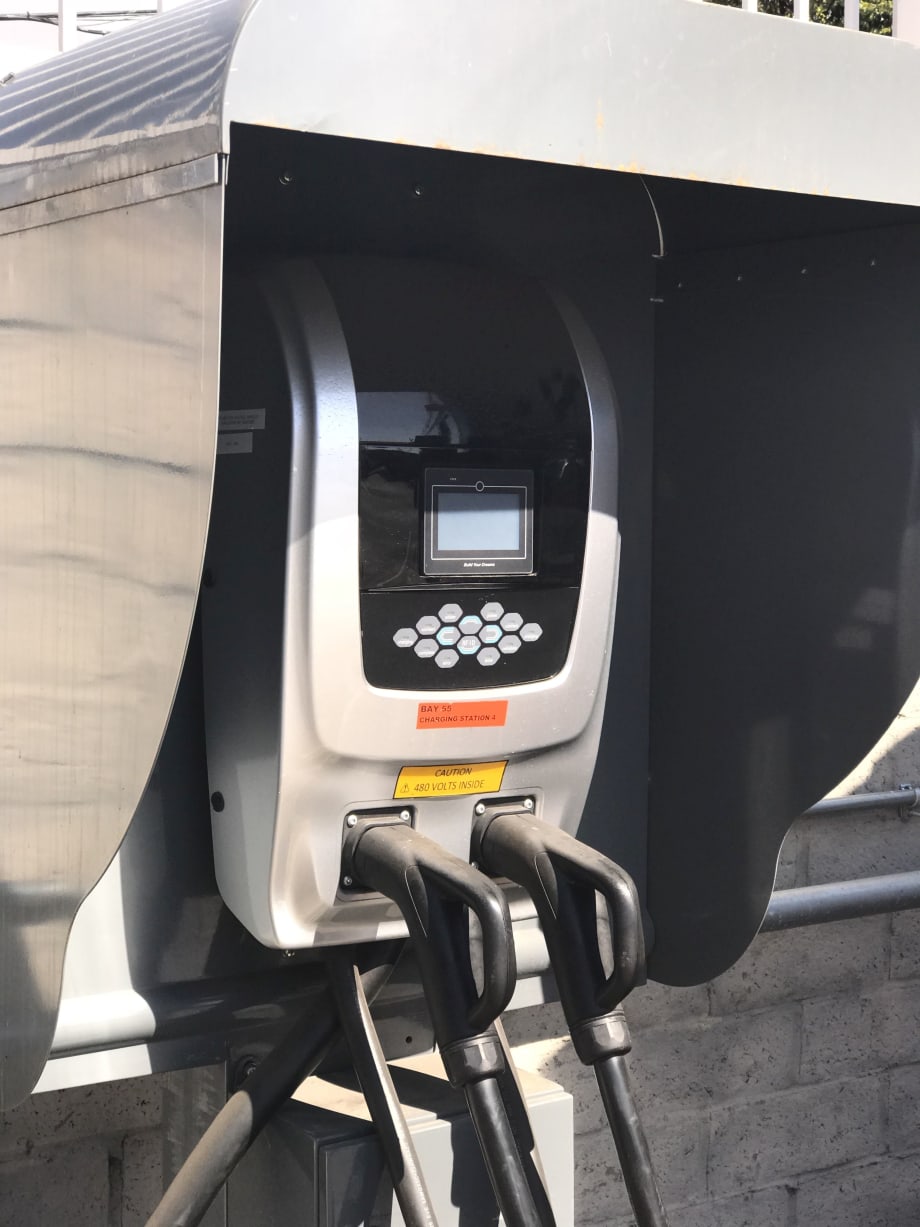
While you may only be implementing a few chargers for your initial pilot, it’s smart to plan for future growth.
Long Beach Transit
While you may only be implementing a few chargers for your initial pilot, it’s smart to plan for future growth.
Long Beach Transit
While adding a few charging stations to support pilot projects is relatively straight forward, transit agencies will need to consider several factors when planning to implement infrastructure that can support hundreds of electric buses, or more, explains James Tillman, director, business development, for MaxGen Energy Services. “The answers to the [first four basic] questions will drive the design component for the required infrastructure to support that fleet purchase.”
1. DETERMINE NUMBER OF BUSES TO BE CHARGED
2. WHAT IS BUS BATTERY CAPACITY
(kWh)?
3. WHAT IS BUS RATE OF CHARGE (kW)?
4. WHAT IS ALLOTTED TIME IN WHICH BUSES HAVE TO RECHARGE?
5. SPLITTING THE RFP “From the RFPs I’ve been reading, it’s clear there is a lack of understanding in terminology and technology, as well as the general understanding of the charging infrastructure that needs to accompany the buses,” says Tillman. “A lot of RFPs are pushing this responsibility onto the bus OEMs, and while those OEMs are great at making electric buses, they are not necessarily in the business of strategically designing infrastructure. I would recommend peeling off the vehicle purchase and the charging station design into two separate RFPs.”
6. UNDERSTAND BASICS “There is still a misconception on the speed electricity can move from the grid into a battery system. If you look at some of the RFPs out right now, some transit agencies are looking for a 600-kilowatt solution, which currently is only deliverable through an overhead system. However, agencies are demanding this be done through a traditional connector — these standards just don’t exist right now,” Tillman says. “Getting a general education on why components are located where they are and can’t really be relocated within a bus, as well as understanding the general underlying challenges to power, is important. We want these buses to perform like their traditional counterparts, and in almost every aspect they do, and sometimes outperform. However, keep in mind there is no benefit in ‘refueling’ an electric bus in 20 minutes at the barn when the rest time is five hours. While this may be possible, the cost to implement and ongoing operational expense will be astronomical with no real benefit.”
7. THINK AHEAD While you may only be implementing a few chargers for your initial pilot, Tillman says it’s smart to plan for future growth.
“The utility probably won’t give you a transformer for 100 buses if you’re only taking delivery of 10. But, there are certain things you can do like sizing the transformer, PME (Pad Mounted Equipment) switch, and capacitor pads appropriately for future upgrades and installing extra conduit so that when you do take delivery of those next 90-plus buses, you’re already ahead of the curve,” he says.
8. CONSIDER “HYBRID” APPROACH As charging infrastructure continues to mature, implementing a hybrid approach that includes both depot and on-route chargers may be the best path to choose.
“If you do go with a hybrid approach there are some creative solutions you can do with hub charging. For instance, you won’t always need to fill your buses to 100-percent capacity, but that analysis really comes with more mature battery-electric bus deployment,” he explains. “If you have several routes that come in and out of a major bus hub and you are able to install an overhead bus charging station there, as well as some other locations along your routes, it would reduce the amount of charging at the bus depot, the number of depot charging stations, and your overall demand charges.
9. USE A CONSULTANT A consulting firm can help transit agencies determine what charging options are best for their needs before adding electric buses to their fleet. In addition to the considerations mentioned, a strong consulting firm can also factor in operational procedures of the barn, future expansion needs, and integration of ultra-high powered in-route charging, amongst other unique circumstances of the agency.
“If agencies are working with a consultant, RFPs are significantly improved, which lead to stronger responses that meet the need of the agency,” he says. “You will save much time and heartache if you are working with somebody who really understands the space.”
More Technology
Biz Briefs: Luminator Launches AI Technology to Monitor Bus Stop Conditions and More
In METRO's latest installment, we also take a look at recent news from Masabi, Troman Industries, ioki, CCW, and more partnerships making headlines across the transportation sector.
Read More →
Public Transit Conference Returning to GFX in 2027, Call for Papers Now Open
The Call for Papers is now open, allowing transit agency professionals and industry experts to help shape the PTC educational program by submitting session ideas for consideration.
Read More →
ENC Lands MATA Contract and More in Biz Briefs
In this edition of Biz Briefs, we spotlight the latest developments shaping the future of mobility.
Read More →

Strada360’s Steve Lassey on Turning Transit Data Into Better Decisions
From breaking down data silos to preparing for AI, Strada360 CEO Steve Lassey discusses how transit agencies can use technology to improve operations, customer information, and long-term decision-making.
Read More →
Almaviva Looks to Open Architecture to Advance Transit Technology
Eric Reese discusses how interoperability, open architecture, and modular design can help transit agencies control costs, reduce vendor lock-in, and upgrade technology without starting over.
Read More →
Driving Smarter Paratransit
John Hanlon shares how AlphaRoute is leveraging AI-powered technology to help paratransit providers optimize operations, support frontline staff, and enhance the rider experience.
Read More →
From Hardware to Digital Partner: Luminator Charts Its Next Chapter
CEO Magnus Friberg discusses Luminator’s shift toward becoming a digital partner, the growing importance of software and interoperability, and how AI can help agencies improve operations and passenger experience.
Read More →
Beyond the Checklist: A Structured Approach to Transit Maintenance
Reliability-Centered Maintenance helps transit agencies move beyond routine checklists to focus limited resources on the assets and failures that have the greatest impact on safety, reliability, and service.
Read More →
NJ TRANSIT Advances Bus Technology Upgrades Across Statewide Fleet
More than 1,500 buses now feature upgraded technology designed to improve arrival predictions and provide free Wi-Fi, with deployment expected to reach nearly 2,000 buses by the end of 2026.
Read More →
Building a Flexible Path to Transit Electrification
John Hroncich discusses BAE Systems’ modular and scalable approach, lessons learned from decades of real-world operations, and how agencies can identify electrification strategies that fit their fleets.
Read More →