



Alstom Expands U.S. Presence with New Bay Area Facility
The new $1.4 million, 120,000-square-foot rail service facility on Mare Island, currently offers the capacity to work on 15 railcars. The site, which features a 50-foot maintenance pit, is set up to handle maintenance/wreck repair, renovation/rebuilds, and supply chain management services.
Courtesy Alstom
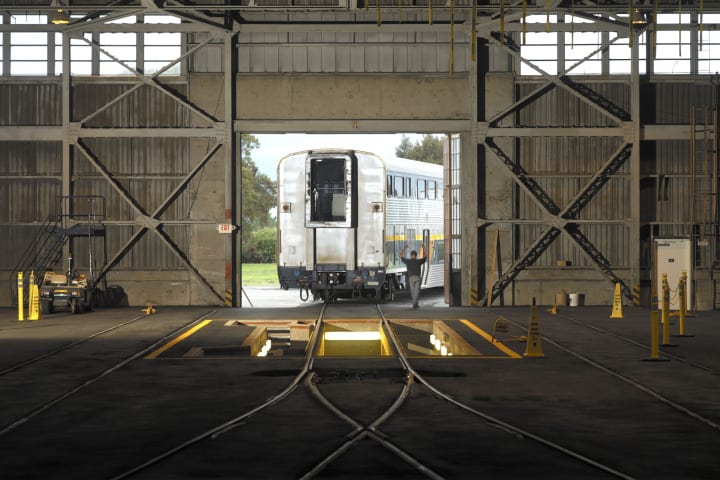
[IMAGE]Alstom-1.jpg[/IMAGE]Alstom Transport opened a new rail services facility on Mare Island, Calif., in December of 2009. Currently, the $1.4 million 120,000-square-foot facility offers the capacity to work on 15 railcars at one time. The site, which expands the company's presence on the West Coast, is set up to handle all of Alstom's Train Life Services (TLS), as their service philosophy is called, including maintenance/wreck repair, renovation/rebuilds, and supply chain management.
"Except for the few wreck repairs and the limited capacity we had in Oakland, we didn't have a presence on the West Coast," says Tommy Aspinwall, vice president, Train Life Services. "This [facility] is really putting us out there in true fashion."
Ideally located in the San Francisco Bay Area, the Mare Island facility is easily accessible to major cities, such as San Francisco, Oakland and Sacramento. "Our strategy is to reduce cost on logistics," says Aspinwall. "We need to get close to the customer and, as you can see with this facility, we are willing to invest to achieve that goal."
The island has a distinguished history, as it once served as a naval shipyard until it was closed in 1996. As railroads were a part of its operation, the tracks that lead up to the Alstom site were originally used by the military base.
New track was installed as part of the site's renovations. A 50-foot-long pit was also built to enable access beneath double-decker cars, whose weight makes it impossible to work by lifting. Five double-decker intercity cars have already been transported to the site for renovation as part of the contract signed in August 2009 with the California Department of Transportation (Caltrans). A total of 66 cars of this type will be modernized by 2011.
Skill sets in use
Currently, 15 people are working at the Mare Island site, with a potential for 40 to 45 more employees. "Seven of the employees were already working for us at Alstom's repair facility in Oakland," says Aspinwall. Workers include machinists, electrical engineers, mechanical engineers and welders. "We've got skill sets that cover every type of requirement," he adds.
Because there are several transit agencies in the area - San Francisco Muni, Bay Area Rapid Transit District, Caltrans and Amtrak - finding the people wasn't difficult, Aspinwall says. "What we have to do now is get them used to our way of working - a culture that we have to drive them toward."
This company culture he is referring to is customer-centric. "We are a service organization and, without the customer, we have nothing," Aspinwall says. "Everything we do had to add quality, cost or delivery with a customer focus."
"Some of the people on the floor here, started back when Morris Knudsen was in the business," says Joe Quigley, Alstom's Chicago-based customer director. "When there's an issue on a train, our mechanics see it and they'll ring up [the customer]. Even if it has nothing to do with the renovation or the work that we're doing, if there's something that's not right, they'll call them and say 'Hey, you have a problem.'"
Another philosophy being used by Alstom is called Condition-Based Maintenance (CBM). Avoiding catastrophic failure and extending the life of components is the basis of this philosophy, which has been in place for almost four years now, according to Aspinwall. By monitoring the health of various components, the company is able to create signatures so that it can determine where the component is in its "life." "Our goal is to expand our condition-based maintenance [program]," he said. "That's a big differentiator for Alstom."
Benefits of new site
The Oakland repair and maintenance facility, originally established by rail company Morrison-Knudsen in 1995, was taken over by Alstom when it purchased the company in 1998. Because the site was outdoors and did not have a roof, the move to the enclosed Mare Island facility has already proven beneficial. Workers are now protected from the elements, which also helped improve workflow efficiency. "When it started to rain in Oakland, the guys had to stop working," Aspinwall says.
The lack of a roof also presented a problem in that permanent equipment, such as a crane, could not be used. If anything needed to be lifted, mobile cranes had to be used. The previous site also didn't have a pit, which has made a big difference, he says. "It's very difficult to work underneath a train when you don't have a pit, especially one that's lit and has the right environment around it."
Switching trains is also faster and more efficient at the Mare Island site due to the presence of two tracks within the facility. "Because there was only one track in Oakland, in order to move cars, you had to take it out of the main facility, back onto the main line and then bring it back in again," Aspinwall says.
With the enhanced infrastructure, the company expects to deal with more volume in less time and more efficiently, says Aspinwall when comparing the two sites. The facility is currently set up to deal with 15 cars at any one time. If a third track were installed, the site would be able to service 20 cars. "To have a 20-car facility is a pretty big operation," he says. "With up to 45 people, we could satisfy a lot of work in that environment."
[PAGEBREAK]
Customer base
Because of the current economic climate, there aren't a lot of railroads that can go out and buy brand new cars. "Now, what they're trying to do is extend the life of the cars they've already got," says Aspinwall. "To be able to do that, you've got to modernize or renovate the cars, even if you run them to the maximum that you can, they still need work."
This fact coupled with the recognition that many West Coast-based transit agencies outsourced their maintenance were chief motivations for the investment in the Mare Island site. "We deemed from that intelligence that the facility that we need to set up is really wrapped up around mid-life update and renovation," Aspinwall says. While the initial focus of the facility is on renovation projects, he said it was important to set up the facility so it had the capabilities to adjust to maintenance or supply chain contracts as well.
A current customer, the aforementioned Caltrans, which provides among its many varied services intercity rail with a ridership of over three million passengers per year, tapped Alstom to renovate all 66 bi-level intercity passenger vehicles from its California car fleet. The fleet was manufactured by Morrison Knudsen in Hornell, N.Y. - an Alstom facility since 1998 - between 1994 and 1997. The fleet of vehicles is comprised of four distinctive car types - cab, trailer, coach and food service cars.
The contract, worth $13.1 million, includes the complete replacement of the door systems and upgrade of the wheelchair lifts, as well as the wreck repair of one car. The work will be performed over a two-year period without disrupting the daily service at the Mare Island facility, which is approximately 60 miles from Caltrans' headquarters.
The Caltrans fleet is operated and maintained by Amtrak, on the "San Joaquin Corridor" from Oakland to Bakersfield, and the "Capitol Corridor" going from Sacramento to San Jose - the third-busiest Amtrak-operated route in the nation. The fleet operates at speeds of up to 79 miles per hour on 350 miles of track, serving over 30 stations, with a yearly ridership in excess of two million passengers.
According to Caltrans, Alstom was chosen due to its past on-time and on-budget wreck repair performance on various types of passenger vehicles.
This new contract builds on Alstom's momentum in the field of renovations and upgrades in North America, exemplified by the Acela logistic project with Amtrak, originally contracted for a five-year period started in 2006, which was extended to a 10-year contract.
With the introduction of the new West Coast site, Alstom is poised to reach the heights of success of its East Coast brethren. Rolling Stock activities cover extensive rehabilitation programs as well as new build cars, in the Hornell, N.Y., Manufacturing Center of Excellence, for customers such as New York City Transit, the Washington Metropolitan Area Transit Authority and the Metropolitan Atlanta Rapid Transit Authority.
More Rail

New York MTA Advances Final Contract for Second Avenue Subway Expansion
Contract Four is the largest in the Second Avenue Subway Phase 2 project and includes construction of station infrastructure, tracks, and signals for the subway expansion, MTA officials said. Work on Contract Four will begin in 2027.
Read More →
San Diego MTS Breaks Monthly Trolley Ridership Record
Agency officials said July’s ridership indicates MTS’s continued recovery from the pandemic.
Read More →
Report Examines NJ TRANSIT Reliability, Funding Challenges
The Garden State Initiative analysis examines the roles of Amtrak infrastructure, fleet management, and agency operations while recommending a more performance-based approach to improving reliability.
Read More →
Stadler, CapMetro Sign Long-Term Rail Fleet Support Agreement
Beginning in 2027, Stadler will provide on-site technical expertise, spare parts support, training, and obsolescence management to help extend the reliability and longevity of CapMetro’s GTW fleet.
Read More →
Biz Briefs: Alstom Lands Canadian Contract, LYT to Supply California TSP, and More
In METRO's latest installment, we take a look at recent news from Complete Coach Works, Beep, FlixBus, and more partnerships making headlines across the transportation sector.
Read More →
CATS Gold Line Marks 5 Years of Service, 2.8M Passenger Trips
With a six-mile expansion planned, the Charlotte streetcar is positioned to connect more neighborhoods and major transit hubs across the region.
Read More →
Why Simulating Pedestrian Movement Has Become Essential for Modern Rail Stations
Pedestrian microsimulation is helping rail planners identify bottlenecks, test station designs, and prepare complex transit hubs for growing passenger volumes.
Read More →
Amtrak Begins Major Construction at New York’s Sunnyside Yard
The new maintenance facility will support Amtrak’s Airo trainsets while improving maintenance efficiency and turnaround times in New York.
Read More →
Chicago Leaders Unveil Plans for O’Hare Airport Express Train
The privately developed project would offer a 15-minute trip between downtown and O’Hare’s Terminal 2, with trains operating every 15 minutes on a dedicated track. The service would use battery-electric trains and three existing freight rail rights-of-way.
Read More →
OCTA Maps Out 30-Year Strategy to Protect Coastal Rail Corridor
The draft feasibility report identifies strategies to protect the coastal rail line for decades as the agency continues near-term stabilization and sand placement efforts.
Read More →