



RELATED: AMF-Bruns' products offers rear-end collision protection
AMF-Bruns Taps Expertise to Simplify Wheelchair Securement
AMF-Bruns’ PROTEKTOR wheelchair and occupant restraint system provides critical stabilization for passengers in the event of a collision, while The Hideaway system features restraints that are fully-integrated into the floor, which frees up valuable floor space and increases passenger capacity.
by Alex Roman, Managing Editor
February 6, 2017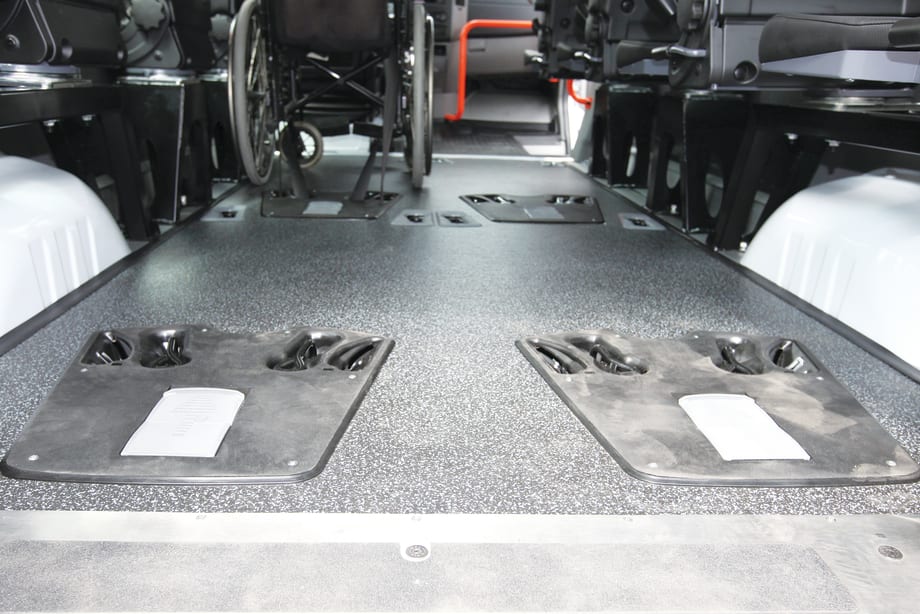
The Hideaway system features restraints that are fully-integrated into the floor, which frees up valuable floor space and increases passenger capacity.
3 min to read
AMF-Bruns of America combines state-of-the-art technology with skills accumulated from nearly 60 years of experience in the mobility industry.
“In the 1970s, we developed the industry’s first wheelchair safety and anchoring systems and were the first to pass an anchorage system crash test,” explains Steve Barker, sales manager for AMF-Bruns.
The company manufactures wheelchair securement products, occupant restraint systems, and associated equipment for the safe transportation of special needs passengers. Along the way they reached several milestones, including developing the first four-point retractor system and making the first power knots with an integrated wheelchair lap belt.
Founded in Germany in 1958, the U.S. manufacturing distribution facility opened in 2013. While the company now services customers in more than 50 countries, it first entered the North American market with the Smart Floor.
“It is an assembled aluminum floor that is actually glued to the chassis of a vehicle, instead of actually putting plywood on top of a metal floor,” explains Barker. “You assemble the aluminum and insert the ‘L’ track in spaces where you want positioning to go, whether it’s for track seating or wheelchair securement, and it proves to be stronger than the plywood flooring that is traditionally used.”
The Smart Floor is ideal for various vehicles, including the Ram ProMaster, the Mercedes-Benz Sprinter, and the Ford Transit.
AMF-Bruns of America’s latest innovation is the Hide-A-Way Wheelchair Securement System, where the restraints are fully-integrated into the floor — freeing up valuable floor space and increasing passenger capacity. It allows bus operators to mix and match passenger wheelchairs with non-wheelchair seats. The system is completely foot activated, making it simple to use.
“It’s a pretty neat system. You kick it forward and step down to activate the release mechanism and then you put the actual retractor hooks onto the wheelchair. When you kick it again backwards, it secures the chair, automatically locking everything in place, while the self-tension retractors actually secure the chair in place,” Barker says. “For the person being secured, it’s a little simpler to operate — you don’t spend a lot of time actually trying to secure someone with this system.”
The Hideaway system features restraints that are fully-integrated into the floor, which frees up valuable floor space and increases passenger capacity.
Features of the Hide-A-Way system include increased load capacity, a single-tensioning knob for additional tensioning, and a durable zinc die-cast cover. The product fits transit, paratransit, and mobility vehicle applications. It also meets all FMVSS/CMVSS, ISO, SAE, and CSA requirements.
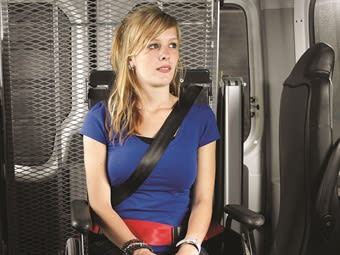
Meanwhile, the PROTEKTOR wheelchair and occupant restraint system — which includes the new WC18-approved Platinum Series retractors — provides critical stabilization for passengers in the event of a collision. Designed for heavier loads, the system’s heavy-duty four-point wheelchair retractor system ensures that the passenger is always secure.
“Our new Platinum Series retractors have no false internal housing like the Silver or Black Series. The stress of the lap belt and wheelchair gets put on the belt rather than going back into the floor. So, you’re shifting a load that used to go into the floor back into the WC 18 retractor, which has twice the strength of your typical retractor,” says Barker.
AMF-Bruns of America also provides complete training for operators, who have its systems installed on their vehicles.
“We’ve developed a full training program that is a little more sensitive to the actual occupant of the wheelchair itself, which is the biggest issue out there right now,” says Barker. “We can spend anywhere from an hour to five hours on training, depending on whatever the operator needs.”
Subscribe to Our Newsletter
More Paratransit

Biz Briefs: RIPTA Unveils New Frontrunners, Clevland RTA Adds New Siemens, and More
In METRO's latest installment, we take a look at recent news from Siemens, Prevost, Dodge, and more partnerships making headlines across the transportation sector.
Read More →
King County Metro Makes ADA Paratransit Easier to Navigate
METRO's Innovative Solutions Award winner replaces complex service-area descriptions with an accessible, interactive map that puts paratransit information directly in customers’ hands.
Read More →
Jacksonville’s NAVI Project Charts a New Course for Autonomous Public Transportation
Through its NAVI program, JTA is showing how autonomous vehicles, intelligent infrastructure, and coordinated operations can work together to deliver everyday public transportation.
Read More →
Driving Smarter Paratransit
John Hanlon shares how AlphaRoute is leveraging AI-powered technology to help paratransit providers optimize operations, support frontline staff, and enhance the rider experience.
Read More →
METRO Magazine Announces 2026 Innovative Solutions Awards Winners
Projects Recognized for Advancing Mobility Through Technology, Accessibility, Workforce Innovation, and Operational Excellence
Read More →
Biz Briefs: STV teams with Amtrak, Motorcoach Operators Boost Fleet and Land Contracts, and More
From manufacturers and suppliers to transit agencies and motorcoach operators, these updates offer a snapshot of the projects, partnerships and business moves driving the industry forward.
Read More →
Biz Briefs: Masabi Teams with St. Louis Metro and More
In METRO's latest installment, we take a look at recent news from Transdev, Hitachi, and more partnerships making headlines across the transportation sector.
Read More →
New York MTA Leverages Zoning Program to Advance Station Accessibility
Accessibility enhancements at Nevins St Station will be financed through a development agreement tied to the MTA's Zoning for Accessibility initiative.
Read More →
Reinventing Fleet Maintenance with Real-time Visibility and AI
Transit leaders need to know what needs fixing, where to look, who is responsible, when work is completed, and what it costs without having to chase information across disconnected systems.
Read More →
SamTrans Sets Priorities for Potential Connect Bay Area Revenue
The board-approved framework allocates future funding to maintaining service, rider improvements, equity initiatives, and infrastructure repairs.
Read More →