



Battery tech advances drive new approach to streetcar, bus projects
Today’s streetcars will be able to minimize or eliminate some of the traditional power elements, thanks to the improved technology.
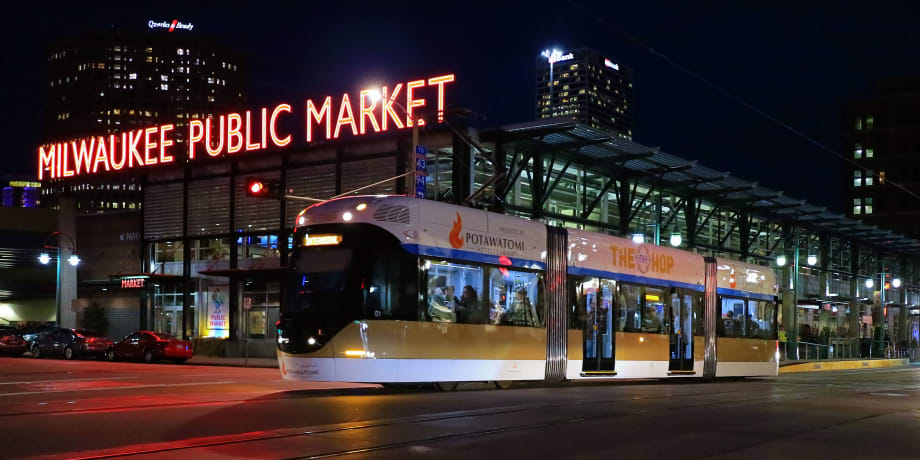
As the battery technology becomes more cost effective, communities will likely consider off-wire technology for aesthetic purposes, particularly in historic districts.
Photos via HNTB
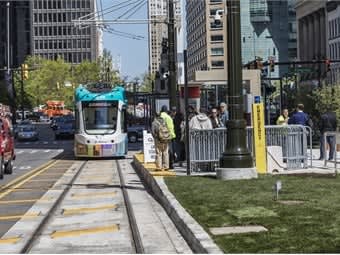
Streetcar routes opening after 2015, including those in Milwaukee, Detroit (shown), Seattle, and Dallas, use a combination of both off-wire and traditional overhead wire.
Photos via HNTB
Begin discussing the installation of a streetcar system in a modern city and residents and politicians likely still think of the old system, with significant overhead wires and miles of track.
But today’s modern streetcars will be able to minimize or eliminate some of the traditional power elements, thanks to the improved technology of electric batteries, which are stronger and provide a greater range.
There are 13 modern streetcar systems in the U.S., which began with Portland, Oregon in 2001. The first new light rail and streetcar systems still relied on overhead wires, or overhead catenary system, and other significant infrastructure to help power the systems. But the most recent streetcar system in Oklahoma City, opened this past December, operates significantly “off-wire,” meaning it was built with far less overhead wire and uses electric batteries to drive the streetcars along their routes.
Other streetcar routes opening after 2015, including those in Milwaukee, Detroit, Seattle, and Dallas, also use a combination of both off-wire and traditional overhead wire.
Visually pleasing, cost-effective
Dallas officials used an off-wire segment to get around a design challenge and allowed it to install a streetcar route over an historic bridge. As the battery technology becomes more cost-effective, communities will likely consider off-wire technology for aesthetic purposes, particularly in historic districts. Washington, D.C., officials are considering expanding that city’s streetcar system into historic districts, which could more be difficult to do with overhead wires.
Off-wire is not only eye-pleasing, it reduces system costs.
Some of the costs of overhead wire, pole and traction-power substations, and ancillary systems to power a light rail or a streetcar system can go away. Those cost reductions could be in the millions of dollars on a project-by-project basis.
For example, on the Milwaukee streetcar project, which HNTB Corp. worked on, there were three traction-power substations costing approximately $1 million each. A traditional approach would have required five. Overhead poles cost about $5,000 to $10,000 or more each, and with new systems using hundreds of poles, the savings mount.
Eliminating overhead wires can also reduce the amount of underground utilities that need to be moved due to large overhead-contact pole foundations or concerns over stray current.
A system that runs off-wire for short segments can often recharge on-board power from the overhead wires, once it makes contact again.
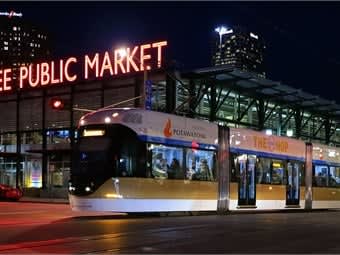
As the battery technology becomes more cost effective, communities will likely consider off-wire technology for aesthetic purposes, particularly in historic districts.
Photos via HNTB
Cautious adoption
Increasingly powerful batteries are driving these changes.
We’ve seen electric battery improvements in the private sector, particularly in the auto and autonomous vehicle industries, but the technology has been a little slower getting advanced into the transit industry.
Risk is one reason transit has been slower to adopt the off-wire technology. The technology must be functional. With the cost of stronger electric batteries coming down and technology improving, there will be less risk on both the transit-agency side and the vehicle-manufacturing side.
While improving, all new systems aren’t ready to go completely off-wire. Seattle is still planning to move forward with its Center City connector, but that system may not use off-wire technology. Sacramento, California won’t be using it in its system. Tempe, Arizona is considering a system, and so is Orange County, California, but neither of those will likely be off-wire systems.
What I do think will happen is that existing systems in places like Kansas City, Milwaukee, Oklahoma City, and Detroit could consider expanding the use of off-wire technology in future extensions. The better battery technology will allow existing systems to adopt it, and spur transit agencies to look at future off-wire systems.
Buses showing the way
And I really see transit systems pushing all-electric bus fleets and new bus rapid transit projects. Agencies like IndyGo in Indianapolis are already doing it. The reason is because of the improved technology.
It’s hard to know what costs for an upgrade to all-electric bus fleets or bus rapid transit projects will look like for cities, but the costs of stronger batteries to power those buses will likely come down over time, just as most technology has. I think eventually agencies and cities will take a stronger look at all-electric buses.
And it’s not just cities in the U.S. that are looking at all-electric buses. Last November, 100 all-electric buses were delivered to Santiago, Chile to enhance its traditional fleet, according to a recent New York Times opinion piece. That city is looking at electric buses to combat overall air pollution, as well as provide transportation that is quieter and has cleaner air inside the bus.
Chile now has more electric buses than any nation besides China, according to the article, and many governments see promoting electric fleets in the public sector as a way to promote cleaner energy, as well.
Other Latin America countries are also beginning to invest heavily in electric bus fleets. Costa Rican President Carlos Alvarado has promised that his administration will launch a plan to establish a fossil fuel-free transportation system by 2021, the Times article said.
Overcoming obstacles
That doesn’t mean there won’t be challenges. On the bus fleet side, the biggest challenge is to overhaul maintenance facilities to accommodate electric vehicles, including charging stations, rather than diesel maintenance. In that sense, it is more capital intensive on the facility side for buses, rather than the streetcar side. Streetcars are already installed with electric power systems.
But if you can create a product that is more cost effective, agencies or future agencies can build streetcar systems, and electric bus systems for that matter, at a lower cost, so they will be inclined to expedite the building of those transportation options.
That could also further drive economic development and transit-oriented developments, because fixed-rail systems such as streetcars help spur more dense communities from that investment.
Milwaukee’s streetcar system, called The Hop, has already witnessed those changes within just a few months of operations, with new high-rise office buildings and apartment projects being built along the streetcar’s initial route.
And as the new systems in Milwaukee, Oklahoma City, Seattle, Dallas, and Detroit come online and expand, they will learn from each other. That knowledge will help other communities decide whether to embrace off-wire technology.
Ashley Booth is HNTB Corp.’s National Streetcar Practice Leader, Associate VP, Great Lakes Transit Market Leader.
More Technology

From Hardware to Digital Partner: Luminator Charts Its Next Chapter
CEO Magnus Friberg discusses Luminator’s shift toward becoming a digital partner, the growing importance of software and interoperability, and how AI can help agencies improve operations and passenger experience.
Read More →
Beyond the Checklist: A Structured Approach to Transit Maintenance
Reliability-Centered Maintenance helps transit agencies move beyond routine checklists to focus limited resources on the assets and failures that have the greatest impact on safety, reliability, and service.
Read More →
NJ TRANSIT Advances Bus Technology Upgrades Across Statewide Fleet
More than 1,500 buses now feature upgraded technology designed to improve arrival predictions and provide free Wi-Fi, with deployment expected to reach nearly 2,000 buses by the end of 2026.
Read More →

Building a Flexible Path to Transit Electrification
John Hroncich discusses BAE Systems’ modular and scalable approach, lessons learned from decades of real-world operations, and how agencies can identify electrification strategies that fit their fleets.
Read More →
Biz Briefs: Alstom Lands Canadian Contract, LYT to Supply California TSP, and More
In METRO's latest installment, we take a look at recent news from Complete Coach Works, Beep, FlixBus, and more partnerships making headlines across the transportation sector.
Read More →
From Legacy Silos to Conversational Intelligence
What if transit leaders could ask any operational question and get a trusted answer in seconds? Conversational AI is transforming how agencies use their data.
Read More →
USDOT Announces Rail Vehicle Replacement Grants, Chattanooga AV Shuttle Funding
More than $191 million in federal funding will help three transit agencies replace aging rail vehicles and support a new autonomous shuttle service in Chattanooga.
Read More →
Bus Tech Talk: Keeping Transit Technicians Ahead of the Technology Curve
LA Metro’s Obed Mejia discusses technician training, evolving maintenance technology, fleet replacement, and strategies for getting the most out of today’s transit fleets.
Read More →
Biz Briefs: RIPTA Unveils New Frontrunners, Clevland RTA Adds New Siemens, and More
In METRO's latest installment, we take a look at recent news from Siemens, Prevost, Dodge, and more partnerships making headlines across the transportation sector.
Read More →
Why Simulating Pedestrian Movement Has Become Essential for Modern Rail Stations
Pedestrian microsimulation is helping rail planners identify bottlenecks, test station designs, and prepare complex transit hubs for growing passenger volumes.
Read More →