



BRT Survey: Land Use is Top Hurdle for Projects
Funding did run a close second, at 23 percent. Several survey respondents cited difficulties of complying with regulations across multiple municipalities and jurisdictions, including traffic signal priority agreements.

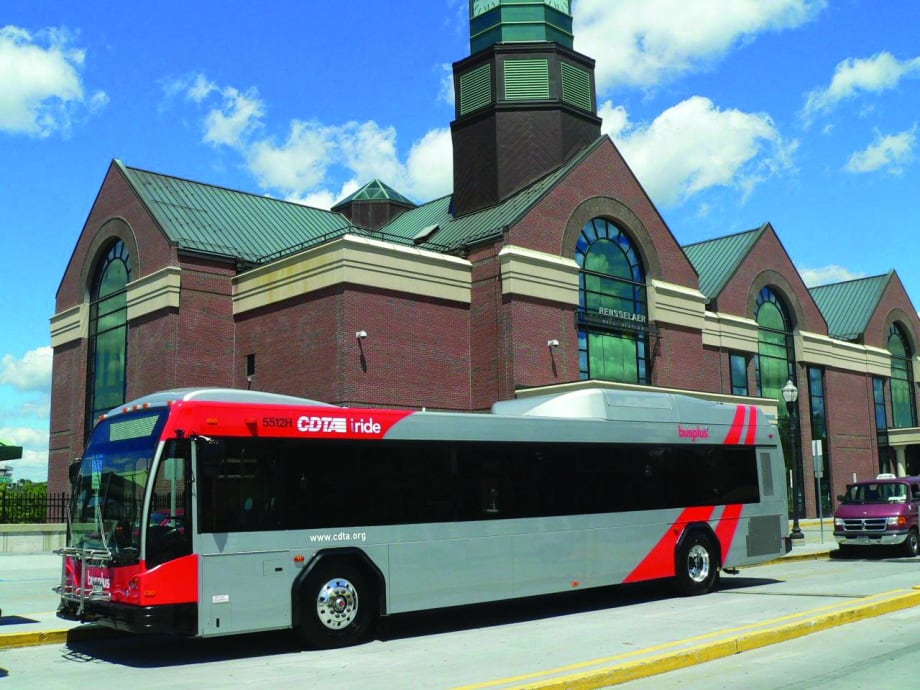
CDTA unveiled the Albany, N.Y., area's first BRT line, Bus Plus, in early April 2010.
CDTA unveiled the Albany, N.Y., area's first BRT line, Bus Plus, in early April 2010.
METRO's bus rapid transit (BRT) survey results for 2011 feature 40 projects, 37 of which are located in the U.S., with three in Canada. This year, we are presenting the survey results a bit differently, to provide more insight into individual projects. We are offering, instead of our list of 25 projects as a current snapshot of BRT, a few more in-depth profiles of projects that are opening this year and one project that is slated to be unveiled in 2013.
This is a prominent year for BRT; based on our survey, nine new lines are opening or have already opened. These project locations are found all over the U.S. and Canada, including Fort Worth Transportation Authority's East Lancaster Enhanced Bus Corridor; the Troost MAX from Kansas City Area Transportation Authority in Kansas City, Mo., and Brampton, Ontario-based Brampton Transit's ZÜM.
Once again, the region producing the highest number of BRT systems is the West Coast, at 17 projects, with California in the lead, featuring two-thirds of the lines listed. Projects in this region combined totaled $3.6 billion, a slight increase over last year's $2.3 billion figure.
Federal funding included FTA Very Small Starts and the Urbanized Area Formula Funding Program (5307), Congestion Mitigation and Air Quality Improvement Program (CMAQ) and ARRA. These comprised two-thirds of financial backing. About one-quarter of the projects received some type of state funding, and local support contributed to about one-half of all projects. These numbers are all down significantly from last year, possibly signaling the aftereffects of the still sluggish economy and the tail-end of ARRA disbursement.
Surprisingly, funding was not the primary challenge facing most participating transit operators this year. Land use coordination was listed most consistently, at 28 percent, as the top challenge to contend with. Funding did run a close second, at 23 percent. Several respondents commented on the difficulties of complying with regulations across multiple municipalities and jurisdictions, including traffic signal priority agreements. Other hurdles cited were lack of community support, construction and project coordination. One operator commented that their agency's project was hampered by, "lack of a political champion" and "opposition [from] some local businesses."
Despite these concerns, operators had plenty to say about the project benefits. Most respondents describing relatively recent projects - those that opened in 2008 or later - noted that the lines helped bring ridership numbers back up during the recession. Others claimed the lines dramatically reduced travel times and are serving as catalysts for transit-oriented development projects.
Potential advantages cited extended to the community at large. Many respondents noted that their BRT projects serve as major connectors to schools, downtown hubs and other transit systems. One California operator, whose agency's line has been the subject of some contention in the business community said, when implemented, the rapid transit line will more effectively serve low income populations.
Transit agencies have plans to buy 293 vehicles in 2011, a sizable uptick compared to the purchase plans of 102 buses from 2010's survey. On average, this comes to 17 buses per project listed.
Nearly one-half of operators surveyed are looking at hybrid-electric propulsion for their buses, down slightly from last year's 60 percent. With one-third of operators selecting this option, clean diesel was the second-most popular choice, trading places on the list from last year with hybrid-electric. One-quarter of respondents chose CNG, running about the same as last year's 28 percent figure.
For ITS options, agencies primarily selected passenger information, at 92 percent, vehicle tracking and signal manipulation at 89 percent and 87 percent, respectively, and three-quarters chose voice annunciation. Security was also selected by slightly more than one-third of respondents. Other offerings cited included passenger Wi-Fi, NextBus arrival signs and queue jump lanes.
The most popular station characteristic selected by respondents was designated stations, weighing in at 70 percent, with pedestrian-friendly areas coming in second. Close behind was intermodal terminals, at 57 percent. Running-way features selected by the largest number of respondents included mixed-flow (90 percent), dedicated (42 percent), at-grade (25 percent) and grade-separated (10 percent).
For more, click here.
More Bus

New York MTA Plans Largest Bus Fleet Upgrade in More Than a Decade
The agency is seeking manufacturers for 650 new CNG buses to replace aging vehicles, improve reliability, and advance its broader fleet modernization strategy.
Read More →
Building a Flexible Path to Transit Electrification
John Hroncich discusses BAE Systems’ modular and scalable approach, lessons learned from decades of real-world operations, and how agencies can identify electrification strategies that fit their fleets.
Read More →
Bus Tech Talk: Keeping Transit Technicians Ahead of the Technology Curve
LA Metro’s Obed Mejia discusses technician training, evolving maintenance technology, fleet replacement, and strategies for getting the most out of today’s transit fleets.
Read More →
Biz Briefs: RIPTA Unveils New Frontrunners, Clevland RTA Adds New Siemens, and More
In METRO's latest installment, we take a look at recent news from Siemens, Prevost, Dodge, and more partnerships making headlines across the transportation sector.
Read More →
People Movement: Holly Arnold Joins Transdev and More
In this edition, we also cover recent appointments and announcements at Pace, CamTran, MCI, and more, showcasing the individuals helping to shape the future of transportation.
Read More →
The High Cost of Transit Buses: Industry Leaders Look to Procurement Reform
Transit leaders and policymakers examine how standardized bus designs, streamlined procurement, and predictable funding could help agencies stretch budgets and deliver better service.
Read More →
The Business Voice Behind Public Transportation
As chair of APTA’s Business Members Board of Governors, Ray Melleady explains how more than 850 business members are partnering with transit agencies to advance funding, innovation, and industry-wide collaboration.
Read More →
From Surviving to Thriving: Building Stronger Transportation Organizations
Bus Business Consultants founder Brian Dickson shares lessons on leadership, organizational health, and creating options for long-term success in a changing transportation industry.
Read More →
Finding the ‘Happy Medium’: Optimizing Maintenance Without Sacrificing Reliability
The key to maintenance optimization isn’t doing less work—it’s doing the right work at the right time on the right assets.
Read More →
LA Metro, City of West Hollywood, and Partners Advance Smarter Bus Lane Enforcement
The award-winning partnership combines AI-powered detection with human oversight to improve bus reliability, accessibility, and enforcement efficiency.
Read More →