



National Pupil Transportation Associations Release Joint Statement on Federal Mask Mandate
Combining Cleaning Technologies for Optimal COVID Combat
Two safe cleaning and disinfecting options at the top of the list for their effectiveness that also have a reduced impact on the user and the environment are UV-C and electrostatic sprayer technology.
by Michael Wilson
February 11, 2021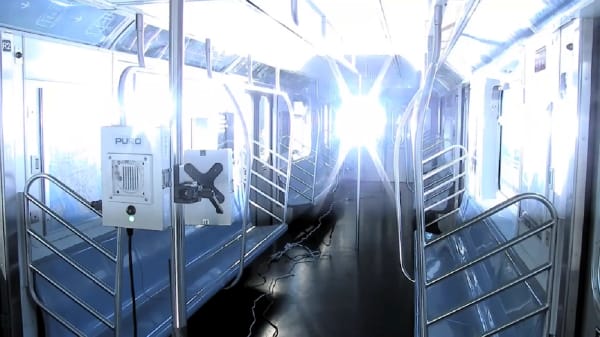
Shown here is a UV-C system on a New York Metropolitan Transit Authority (MTA) train.
Photo courtesy New York MTA
7 min to read
The Coronavirus has impacted people throughout the world and virtually all organizations. It took some time to fully understand the virus and how it spreads, and in the process, there has been so much misunderstanding and misinformation.
For instance, if you remember, back in March 2020 — it seems so long ago — the Centers for Disease Control and Prevention (CDC) and other health experts in the U.S. instructed us not to wear masks. The U.S. Department of Health and Human Services Secretary Alex Azar said at the time, “Our advice remains as it has been that the average American does not need an N95 mask. These are more for healthcare providers.”1
Of course, now we know that masks are our most significant defense against the virus. Some public health officials are even recommending that for added protection, people in certain age groups continue wearing masks even after they have been vaccinated.
As to stemming the spread of the virus, there was also confusion about how long it lived on surfaces and whether it could be transmitted from surfaces to people. Most experts now agree the virus can survive on surfaces for a few hours to a few days, depending on the type of surface, how frequently it is touched, and other conditions.
As far as being transmitted to people from surfaces, the CDC reported in May that the virus is “mainly spread by inhalation” and was not as likely to spread by touching surfaces. However, since then, the agency has backtracked, indicating that this virus, just like so many others, can be transmitted by touching a contaminated surface and then touching our eyes, nose, mouth, or food that is later consumed.
High-Touch Hazard
There is the possibility for even greater transmission of the virus if these contaminated surfaces are touched frequently. These are known as “high-touch” surfaces, and that’s where buses — both school and transit — as well as most types of public transportation vehicles, come into the picture.
For instance, in a school or transit bus, it may be challenging to find a surface that is not a high-touch surface. Windows, ledges, railings, poles, straps, seating areas, etc., are touched repeatedly throughout the day by passengers. Moreover, bacteria and viruses can mutate faster on these surfaces than a cleaning crew can manually disinfect them, compounding the difficulty of protecting passengers and drivers from exposure.
To help stop the spread of the virus, we need to do all we can to keep these surfaces clean and disinfected. Performed manually, this is a very time-consuming process. In most cases, surfaces must be cleaned first and then disinfected, a two-step process. This method also requires using large amounts of cleaning solutions and disinfectants. Because disinfectants in the U.S. are not green-certified, the necessary amounts can potentially harm the user, passengers, and the environment.
To address this, during the early months of the pandemic, many transportation organizations began looking into other cleaning and disinfecting options. Two that have surfaced to the top for their effectiveness and have been shown to have a reduced impact on the user and the environment are UV-C and electrostatic sprayer technology. Below is a breakdown of each technology and recommended use on school and transit buses.

Michael Wilson, vice president of marketing for Afflink, says that some cleaning experts and public health professionals suggest UV-C and electrostatic sprayer technologies be used together to help stop the spread of the Coronavirus.
Photo courtesy Afflink
UV-C Technology
In May 2020, the New York Metropolitan Transportation Authority (MTA) announced that it would begin using ultraviolet (UV) light to kill the Coronavirus. Over time, it would be phased in on subways, buses, and other transit vehicles throughout the system. As to why they selected this technology, the MTA reported in a news release:
“UV-C light is an efficient, proven, and effective technology for eliminating viruses, including SARS-CoV-2, [which] causes COVID-19, from surfaces in MTA’s system. UV-C is demonstrated to kill viruses in many other applications, including hospital operating rooms, urgent care clinics, universities, and fire stations.”
The transit agency also stated in that release that the UV-C systems would first be used on the administration’s “rolling stock” overnight, when the vehicles are not in use, and then be used in “occupational facilities, including maintenance areas, crew rooms, operations and technology centers, and offices,” for disinfection purposes throughout the MTA system.
Background
Before explaining this technology further, some things need to be clarified. According to Karl Linden, a professor of environmental engineering at the University of Colorado:
• UV is not new. It has been used for disinfecting purposes in hospitals, cleanrooms (rooms designed to maintain extremely low levels of particulates, such as dust and airborne organisms), and transit vehicles for decades.
• UV is electromagnetic radiation, which includes radio waves, visible light, and X-rays. These are measured in nanometers.
• UV is divided into UV-A (315–400 nanometers), UV-B (280–315 nanometers), and UV-C (200–280 nanometers).
• Of the three types, UV-C is the most effective at killing pathogens.
How It Works
UV-C is absorbed into the DNA and RNA (ribonucleic acid) of pathogens. As it is absorbed, it renders the genetic material inside the microorganism unable to replicate or cause an infection, essentially inactivating the pathogen.2
Benefits
Along with proven efficacy of up to 99.9%, other benefits of UV-C include:
• Eliminating the need for any cleaning solutions — a major cost savings.
• UV-C is an antimicrobial; it can kill many types of disease-causing pathogens, not just the Coronavirus.
• The technology promotes sustainability; fewer materials need to be packaged, transported, or manufactured.
• Depending on the system, it can provide 360 degrees of coverage up to 10 feet from the unit. Often the unit is moved through a vehicle via remote control.
• When used properly, it is perfectly safe.
• Because no cleaning solutions are used, there is no impact on the user or the environment.
• When used, a larger area is disinfected at one time, reducing time and labor costs.
According to Linden, as we learn more about the potential for UV-C, more uses for it and fighting the spread of COVID-19 are likely to be uncovered. He believes UV-C systems will be added to HVAC systems to disinfect air in all types of facilities, as well as public transportation vehicles. This means UV-C technology can be used both for disinfecting surfaces as well as disinfecting the air we breathe.
Electrostatic Sprayers
Electrostatic sprayers are also not new. They were developed in the 1930s and used primarily for industrial spraying and coating of equipment and machinery. These systems spray a disinfectant onto surfaces. In most cases, these surfaces must be cleaned first before the spray can be applied, which is not always necessary with the UV-C technology just discussed.
How They Work
As the disinfectant spray — or “mist,” as it is often called — is released by the machine, it places a negative electrical charge on the disinfecting solution as it leaves the nozzle. Because most surfaces in a transit vehicle or facility are neutral or positively charged, this helps ensure the mist adheres to these surfaces.3 In doing so, it starts to kill or deactivate pathogens within seconds.
Benefits
This technology has the same or similar benefits of the UV-C technology:
• It is also a labor saver, because large areas can be covered and disinfected at one time.
• This reduces time, making it a cost savings.
• While it is recommended that the user wear gloves and goggles, these systems are safe if used properly.
• Fewer cleaning solutions are used, reducing the cleaning’s impact on the environment and promoting sustainability.
• It can kill or deactivate a wide range of microbials, not just those related to the Coronavirus.
What we are witnessing now is that both technologies are being used in all types of transit vehicles and facilities to help eliminate the pathogens that cause coronavirus. In fact, some cleaning experts and public health professionals suggest both technologies be used together to help stop the spread of the coronavirus. This way, if any pathogens are missed using one system, the second will likely catch them, ensuring public transit systems promote health and help us get through this difficult time as safely as possible.
Michael Wilson is vice president of marketing for Afflink, a distributor-membership organization that markets electrostatic sprayers and other products designed to protect human health. He can be reached atwmwilson@afflink.com.
1. U.S. health officials say Americans shouldn’t wear face masks to prevent coronavirus—here are three other reasons not to wear them. MarketWatch, March 3, 2020.
2.“Ultraviolet light can make indoor spaces safer during the pandemic—if it’s used the right way.” Karl Linden, University of Colorado, Boulder, Sept. 9, 2020.
3. Coulomb’s law: Like charges repel each other; unlike charges attract. Thus, two negative charges repel one another, while a positive charge attracts a negative charge or vice versa.
Topics:Security and Safety
Originally posted on School Bus Fleet
Subscribe to Our Newsletter
More Security and Safety
FTA Ends Direct Oversight of MBTA Safety Actions
The federal agency closed its remaining special directive to the Massachusetts Department of Public Utilities following a safety review that began in 2022.
Read More →
Transit Agencies Highlight Safety Gains at National Summit
Leaders from 15 major transit systems shared crime-reduction results and safety initiatives while discussing the role of continued federal support.
Read More →
DART Launches Major Security, Fare Enforcement Initiative
The 90-day demonstration will deploy coordinated security teams at five light rail stations while testing controlled access and gathering data to guide future investments.
Read More →
RTD Launches NextRide App to Consolidate Trip Planning, Fares, Security Reporting
The app expands on RTD’s existing NextRide web application and allows customers to view real-time vehicle locations and service alerts, purchase and store digital fares, and access customer support.
Read More →
TAPTCO Updates OSHA Compliance Training for Transit Maintenance Operations
The revamped program addresses 26 OSHA standards for maintenance facilities, with TAPTCO pointing to training, documentation, and everyday shop hazards as continuing challenges for transit operations.
Read More →
FRA Announces $5.3B in Rail Investments, Including $2B for Amtrak
Funding will support grade-crossing improvements, infrastructure upgrades, and new Amtrak equipment in 23 states.
Read More →
Chicago, Maryland Expand Non-Law-Enforcement Safety, Rider Support
The CTA and MTA are launching new programs aimed at de-escalation, crisis response, rider assistance, and greater transparency.
Read More →
LA Metro, City of West Hollywood, and Partners Advance Smarter Bus Lane Enforcement
The award-winning partnership combines AI-powered detection with human oversight to improve bus reliability, accessibility, and enforcement efficiency.
Read More →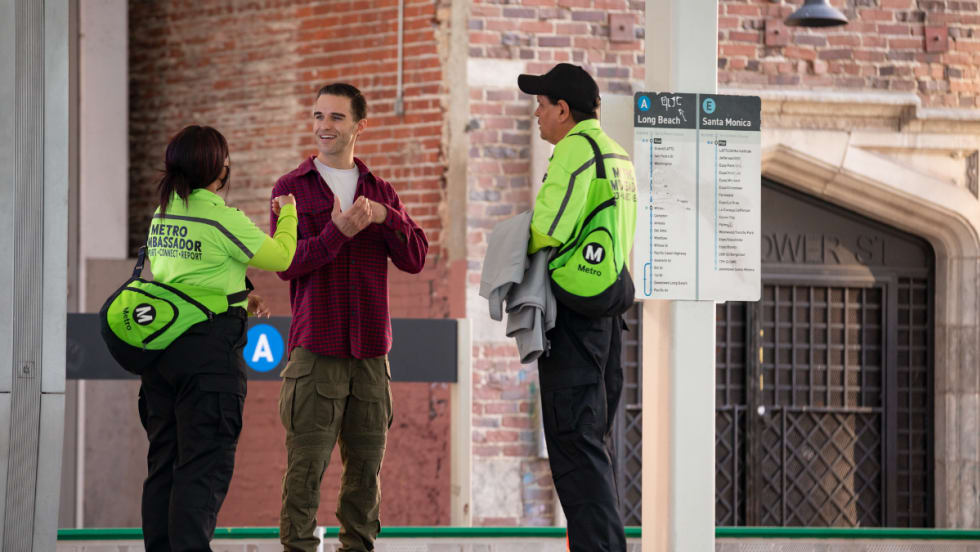
LA Metro Reports 57% Decline in Homelessness on Transit System Since 2024
The agency's latest homelessness count offers new data on how care-based services and cross-sector partnerships can complement traditional transit security strategies.
Read More →
FTA Launches 'Transit Moves America' Dashboard to Highlight Agency Safety and Performance
The online dashboard transforms National Transit Database information into a public-facing resource that allows users to compare transit agencies on key operational and safety metrics.
Read More →