



CTDOT, Partners to Test Autonomous Buses on BRT Service
In addition to testing SAE Level 4 autonomy, the project will also test automated docking to improve accessibility and platooning to increase vehicle efficiencies.
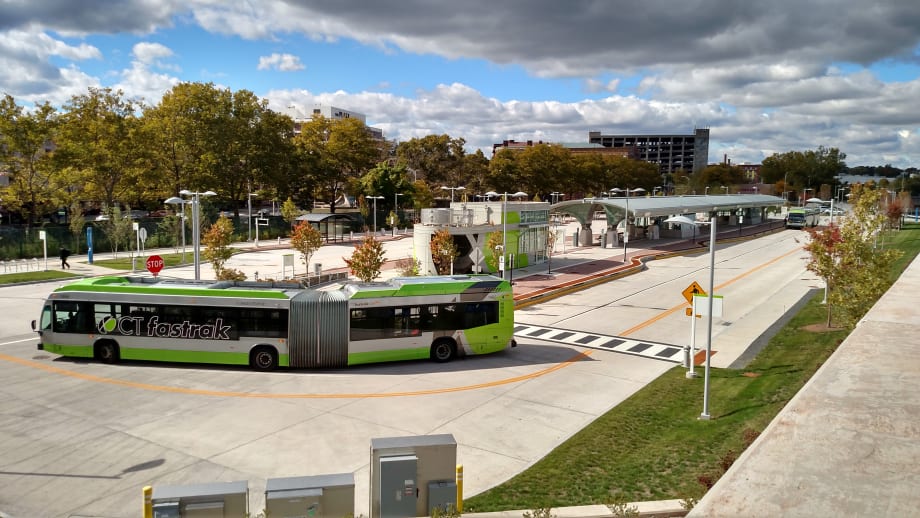
The automated buses will operate on the CTfastrak bus rapid transit guideway — a 9.4-mile dedicated BRT route connecting downtown Hartford and downtown New Britain.
Photos Courtesy CTDOT
The Connecticut Department of Transportation (CTDOT) is planning to introduce the first automated heavy-duty buses in revenue service in North America, with the project set to go live in approximately a year. The project includes the deployment of three battery-electric 40-foot New Flyer Xcelsior CHARGE™ vehicles. CTDOT is scheduled to take delivery of the first vehicle in December 2020.
The automated buses will operate on the CTfastrak bus rapid transit (BRT) guideway — a 9.4-mile dedicated BRT route connecting downtown Hartford and downtown New Britain. The guideway was built on current and former railroad rights-of-way owned by the State of Connecticut and Amtrak, allowing for the minimal taking of private land. From Downtown New Britain Station to Newington Junction, the busway follows the former Newington Secondary rail line. From the Newington Junction Station to Downtown Hartford, the busway operates side-by-side with the Hartford Line rail service on Amtrak’s New Haven-Springfield Line. Another guideway feature is a five-mile multi-use trail, 10-feet wide and separated with a fence, for pedestrians and cyclists to access stations and use for recreational purposes.
Along much of its length, the guideway is constructed as a grade-separated limited-access highway. There are five at-grade crossings of local roads — three in New Britain, one in the Elmwood section of West Hartford, and one in Hartford.
Because of the way the infrastructure is set in place on CTfastrak, CTDOT’s Transit Administrator Dennis Solensky says it is an opportune place to test several technologies including automated buses.
“Because we manage the guideway, the signalization, and the buses themselves, it makes the CTfastrak a nice, safe environment to introduce and test this type of equipment,” Solensky explains. “We would like CTfastrak to become the premier testing ground for this type of equipment, as well as other technologies in the U.S., because it is essentially a controlled environment.”
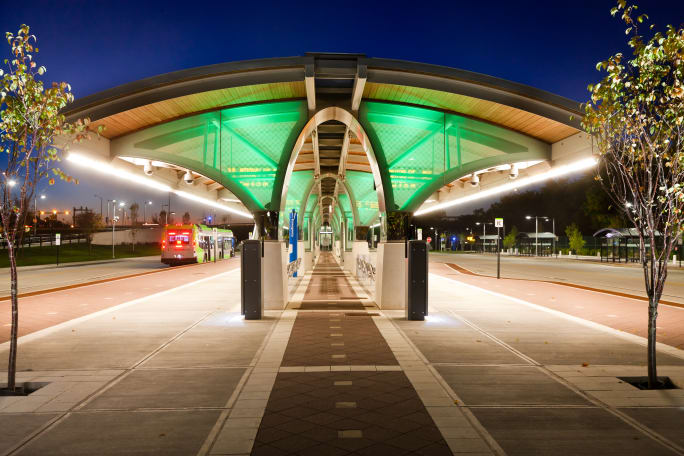
The guideway was built on current and former railroad rights-of-way owned by the State of Connecticut and Amtrak,allowing for the minimal taking of private land.
The Project
The pilot program consists of several partners, including CTDOT, New Flyer, and Robotic Research Inc., which is supplying, configuring, and supporting the automated driving systems that will be integrated into the New Flyer buses. Also on board are the Center for Transportation and Environment (CTE), who is acting as the project manager and technical consultant for the program, as well as the University of Connecticut and the Capital Region Council of Governments.
“From the manufacturer supplying the buses, to our folks who are managing the project and collecting data and the internal team we have here who are set to ensure the safety of the vehicles, we have assembled a tremendous team for this project. It’s this team that is allowing us to move forward confidently,” says Solensky.
The project began in earnest a few years ago, Solensky explains, just as he was coming on board at CTDOT.
“We started interviewing all the bus manufacturers to gauge their interest in developing automated technology. We also brought those folks in for tours, as well as folks who did autonomous pilot projects in the past and reached out to everyone we could at conferences and by telephone,” says Solensky. “Eventually, we submitted a grant proposal in partnership with New Flyer, who had in turn developed a partnership with Robotic Research.”
The pilot program is focused on successful demonstration of the use of automated technology on buses on public roads, the collection of relevant data to guide future policymaking, and the advancement of Advanced Driving Assist System (ADAS) technology for enhanced safety. The buses will demonstrate Society of Automotive Engineers (SAE) J3016 Level 4 technology.
“To this point, many of the autonomous pilots that have taken place in transit have focused on shuttles all settled on private property in many instances,” explains David Warren, director, sustainable transportation, at New Flyer. “What we’re doing with this project is ambitious, because we are demonstrating SAE Level 4 automation on a heavy-duty transit bus, which has hardly been demonstrated in passenger vehicles, let alone a heavy-duty bus.”
Solensky adds that the automated buses will operate with an on-board safety attendant at the operator’s controls to ensure passenger safety during the pilot program.“The fact that there will be a driver onboard that is able to take over at all times is a key piece of information that we want to communicate to the public,” Solensky says. “The bus will function autonomously at times, but there will be a driver there in case any interventions need to be made.”
New Flyer will integrate the Robotic Research LLC’s proprietary AutoDrive® automated driving technology into the new buses. The buses will operate through a technology called Lidar, which measures distances and determines through wavelengths of light what the digital representation of the object is that is sensed. Lidar uses light waves, while radar uses soundwaves.
“I wouldn’t say the process of integrating the kits onto our buses has been easy, but because we have had an existing partnership and Robotic Research has a history of developing this technology in other industries, including for the military, we didn’t have to reinvent the wheel, so to speak, for their technology to fit well with ours,” says Warren about the process.
New Flyer will also supply the charging infrastructure for the battery-electric buses through its New Flyer Infrastructure Solutions brand.Funding for the project is in part through the Federal Transit Administration’s (FTA) Integrated Mobility Innovation (IMI) program, and the Low or No Emission Bus Program. The IMI program funds projects that demonstrate innovative and effective practices, partnerships, and emerging technologies to enhance public transportation effectiveness, increase efficiency, expand quality, promote safety, and improve the traveler experience.
“We have been looking at testing automated buses on our guideway for some time, so as we developed this project the FTA has been, and continues to be, a great partner,” says Solensky. “In addition to the federal discretionary capital funding, we also have some 5307 money going into the project as well as funding from our state partners who we have a long and positive history with.”
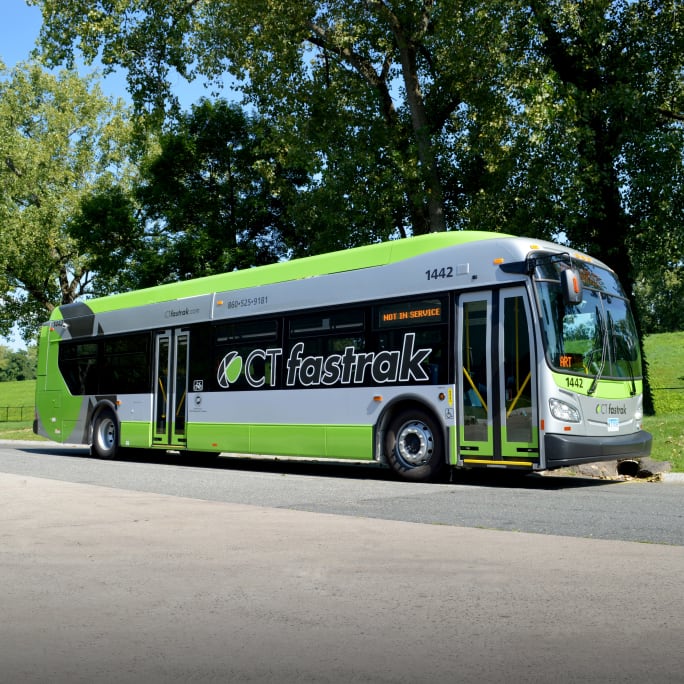
The automated buses will operate through a technology called Lidar, which measures distances and determines through wavelengths of light what the digital representation of the object that is sensed.
Project goals
Aside from demonstrating Level 4 autonomy, Solensky points out that there are two important goals being tested, including the use of automated technology to increase the accessibility of transportation to passengers with disabilities while also improving the efficiency and overall rider experience for all passengers. To do so, the project will use the automated docking of buses at CTfastrak stations to eliminate operator errors that can sometimes result in wide platform gaps and other potential unsafe situations, ensuring ADA compliance.
“We have platforms on our guideway like you would see at a train station. While our drivers do a great job, every driver that pulls up to those platforms does so at different speeds and approach angles,” explains Solensky. “So, we feel having the technological ability for the bus to control the docking procedure will ensure the distance between the bus and the platform, which is ideal for everyone, especially our passengers who require help with accessibility.”
The second aspect of the project will demonstrate platooning capabilities to maintain more efficient headways between buses. CTfastrak currently runs a mix of 40-foot buses and 60-foot articulated buses to carry an average of 10,628 passengers per weekday in 2019. Platooning will also allow additional flexibility by eliminating the need for the larger 60-foot buses to serve high ridership routes, Solensky explains.
“Some of the buses we operate on the service are 60-feet and they are crowded during our peak hours. However, during non-peak times they are not as busy and this often leads to the public questioning why we are running large, half-empty buses,” Solensky says. “Platooning would allow us to potentially have two smaller buses running back to back during peak demand, with the hope that eventually the first unit would provide the propulsion for the second. When peak service is over, we would have the flexibility to take the second vehicle off that route and possibly use it on another route.”
The pilot project is set to be completed by the end of 2022 and hopefully not only accomplishes its set of goals to improve accessibility and increase service efficiencies, but also opens the door for autonomous heavy-duty buses to be part of the next-generation of vehicle technologies. New Flyer’s Warren explains that the road ahead for full autonomy, in general, is still a ways away but is accelerating quicker than expected.
“Overall, I think it will continue to be a slow climb, but whether it’s in California, Pittsburgh, or Michigan, the pace at which automated technologies are evolving is far greater than we all predicted a few years ago, which opens the doors for more advanced testing in the future” he says.
“I think we are really just scratching the surface, and because of that, the potential of automation is limitless,” Solensky adds. “It is up to all of us to continue to evolve the technology, implement it, and use it to the public’s benefit.”
More Technology

From Hardware to Digital Partner: Luminator Charts Its Next Chapter
CEO Magnus Friberg discusses Luminator’s shift toward becoming a digital partner, the growing importance of software and interoperability, and how AI can help agencies improve operations and passenger experience.
Read More →
Beyond the Checklist: A Structured Approach to Transit Maintenance
Reliability-Centered Maintenance helps transit agencies move beyond routine checklists to focus limited resources on the assets and failures that have the greatest impact on safety, reliability, and service.
Read More →
NJ TRANSIT Advances Bus Technology Upgrades Across Statewide Fleet
More than 1,500 buses now feature upgraded technology designed to improve arrival predictions and provide free Wi-Fi, with deployment expected to reach nearly 2,000 buses by the end of 2026.
Read More →

Building a Flexible Path to Transit Electrification
John Hroncich discusses BAE Systems’ modular and scalable approach, lessons learned from decades of real-world operations, and how agencies can identify electrification strategies that fit their fleets.
Read More →
Biz Briefs: Alstom Lands Canadian Contract, LYT to Supply California TSP, and More
In METRO's latest installment, we take a look at recent news from Complete Coach Works, Beep, FlixBus, and more partnerships making headlines across the transportation sector.
Read More →
From Legacy Silos to Conversational Intelligence
What if transit leaders could ask any operational question and get a trusted answer in seconds? Conversational AI is transforming how agencies use their data.
Read More →
USDOT Announces Rail Vehicle Replacement Grants, Chattanooga AV Shuttle Funding
More than $191 million in federal funding will help three transit agencies replace aging rail vehicles and support a new autonomous shuttle service in Chattanooga.
Read More →
Bus Tech Talk: Keeping Transit Technicians Ahead of the Technology Curve
LA Metro’s Obed Mejia discusses technician training, evolving maintenance technology, fleet replacement, and strategies for getting the most out of today’s transit fleets.
Read More →
Biz Briefs: RIPTA Unveils New Frontrunners, Clevland RTA Adds New Siemens, and More
In METRO's latest installment, we take a look at recent news from Siemens, Prevost, Dodge, and more partnerships making headlines across the transportation sector.
Read More →
Why Simulating Pedestrian Movement Has Become Essential for Modern Rail Stations
Pedestrian microsimulation is helping rail planners identify bottlenecks, test station designs, and prepare complex transit hubs for growing passenger volumes.
Read More →