



Finding a Niche for Transit Bus Contracting
Once all but dead, the privatization of fixed-route transit service has been on a steady incline since the mid-'80s. Will the trend of steady growth continue?
As a trend, privatization in the U.S. transit market has seen its share of peaks and troughs over the years. When the privately operated transit properties of the early 20th century went bankrupt, contracted public transit quickly became a thing of the past.
Today, as both small and large agencies use limited resources to deal with an ever-swelling demand for transportation options, outsourcing, with its flexibility and cost savings, is again testing the paradigm. In fact, since the mid-1980s, public dollars spent on private bus contracts have steadily grown.
But resistant transit boards, labor parties and questions over proper usage of public funding pose limitations. With billions of dollars and countless riders at stake, where does bus contracting belong in the transit picture?
The obvious attraction: savings
Most people in public transit will tell you that the number one reason to contract transit services is cost savings. Frankly, privatized operations are more likely than their publicly run counterparts to follow the model of the American free economy.
In fact, says David Hines, regional vice president for First Transit, multiple studies have shown that privately supplied transit services can reduce operating costs by 20% or more. The reasons for this are manifold, but one of the major motivators is very basic — competition.
"Having a privately contracted portion of service introduces a level of competition and establishes a benchmark that general managers can use to their advantage to challenge both portions of their service to improve performance," says Hines. "Just as low-cost air carriers like Southwest and Jet Blue have shown that they can hire competent pilots for less than $200,000 a year, contractors have shown that you don't have to pay $20 per hour with tremendous benefits to hire good bus drivers."
Of course, the airline analogy invokes the commonly held presumption that contractors often cut and control costs by paying employees low wages, utilizing inferior equipment and generally cutting corners. In some cases, particularly in the past, there may have been some truth to this. But contractors of today are quick to dispel this theory of cheapness.
"The fallacy and myth has been that the lower costs come from the private sector paying a lot less than the public sector," says Irwin Rosenberg, vice president of government relations and business development for Laidlaw Transit. "But when you truly look at it, the margins have narrowed significantly, and really the savings come from the private sector doing a better job of negotiating labor agreements and operating more cost-efficiently."
While much of the evidence points to the contrary, there are many very efficient transit agencies that do not contract bus services. But for many operations, the inherent qualities of a privately run business offer a welcome opportunity to save money without having to sacrifice service.
Howard Chapman, executive director of Charleston (S.C.) Area Regional Transportation Authority (CARTA), which contracts the operation of 55 fixed-route buses with ATC, touts the cost-efficiency of contracting in an agency short on funding. "It allows us to run CARTA much like a corporation that outsources a number of business functions. We just make sure to have good contracts with incentives and disincentives and we get the most for our money."
A spread of wealth
Naturally, the low-cost philosophy makes contracting fixed-route services attractive to operations lacking financial resources, such as small agencies and regions looking to add new services. According to Hines, private contracting is perfect for start-up transit systems because it allows a bypass of all the red tape involved in using state and federal funds. And there are a slew of other advantages to contracting in the arena of small-town public transit.
Robert Hoffman, managing director of River Valley Metro (RVM) in Kankakee, Ill., says the spread of knowledge, capital and expertise are the biggest assets a contractor brings to the table, especially in a small operation. "The maintenance, consulting and value-added services are the things you just can't get on your own in a 15-bus operation," he says. "For example, company-wide, our contractor (First Transit) runs every type of vehicle imaginable so they have someone who's an expert on all of them."
RVM is currently making plans to offer evening service, which would expand operations and staff by at least one-third. "To do that in-house would be a huge undertaking, both financially and logistically," says Hoffman. "But not with the assistance of a contractor."
In addition to experience and know-how, private bus contractors, namely the large ones, also offer the sharing of risk and purchasing power. Says Rosenberg, "Contracting provides risk-sharing and more control on escalating labor costs, while isolating the public entity from the dangers of labor negotiation." The lower costs attained through large-scale nationwide buying, he adds, also result in economic benefits.
Unexpected advantages
Sometimes, the advantage to privatizing bus services comes from a contractor's past successes in a variety of projects and environments. The trial and error of a particular management technique or technology at one operation may reap rewards in a completely foreign area.
The Fairfax (Va.) Connector, a regional bus service that supplements the Washington Metropolitan Area Transit Authority, has gained from the breadth of experience of its contractor, Connex. As the largest bus contractor in Europe, says Fairfax Connector Chief Thomas Black, Connex often gives presentations on strategies that have worked abroad but are relatively unknown or untested in the U.S.
For example, Fairfax recently adopted a European program to provide shuttle bus services and alleviate parking demand levels. The results have been generally successful, says Black. "Fairfax County anticipates that its contractor will continue to bring new ideas and innovations, proven elsewhere, to its attention," he says.
Yet another contracting positive manifests in the form of troubleshooting. "If I've got a question on something, [the contractor] has locations all over the nation that I can contact through a feature on their Website," says Hoffman. "There are very few issues in this business where you won't find at least one or two people who have the answer."
And if the problem gets really bad, most contractors also provide the benefit of having high-quality professional services available for consultation. "They have a team of corporate lawyers and consultants who they can afford by spreading the overhead costs over numerous contracts, and they are ready to help," Hoffman adds.
Performance standards
While it's tough to argue with the wide range of resources available to agencies that contract bus services, the most important aspect in public transit is getting the job done safely and on time. So how do contracted services measure up in terms of performance? That probably depends on whom you ask.
"We make three different peer group comparisons with other bus operators — both public and privately contracted — in the greater Washington area, with those of similar fleet size and with those who have comparable economic characteristics to Fairfax County," says Black. "In general, the three peer group comparisons indicate that we are better than the average of the peer groups in cost efficiency, and they are better in service effectiveness measures as reported in the National Transit Database."
Laidlaw's Rosenberg says that good contracts have good incentives and disincentives that lead to better performance and more accountability. "Have you ever seen a public agency liquidate themselves for running less than 90% on time? It doesn't happen because there is no penalty or loss of federal funds," he says. "The reality is when you look at private operating service side-by-side with public service within an agency, the private sector contractor is held to standards that are higher than those the agency holds for itself."
Still, many feel that, ultimately, the success of an operation, private or public, comes down to who is operating it and how. "Privately and publicly run transit operations compare favorably in performance," says Joyce Olson, CEO of Snohomish County (Wash.) Community Transit, which runs both types of service. "If you manage the contract appropriately, you'll get the same level of service."
But Olson notes that good management doesn't require constantly looking over the shoulders of the private employees. Contractors, she says, are held to performance standards in order to keep the contract and thus are typically very good about operating independently of the public agency.
What the future holds
It's clear that agencies have something to gain from looking at privatizing transit. Outsourcing can stimulate productivity through competition for large properties, while smaller systems find that contracting brings them a workable economy of scale. Why, then, don't more operations contract?
The answer is complicated, as publicly run services have become the established norm, and the general tendency has been toward conservatism. Rosenberg thinks that, in some ways, general managers are resistant to contract because it's chic to keep responsibility in the public's hands and there is a sense of greater job security in the public sector.
But in most cases, it's more complicated than that. With powerful unions commonly preferring the labor contracts they can procure through the deep pockets of government and the political vulnerability of transit boards, collective bargaining units have become a nearly archetypal adversary to contracting.
Furthermore, based on deals with labor unions, state laws often dictate limits on the amount of services that can be bid out to the private sector. Only in states where employee bargaining units are prohibited does privatization have the capability to grow unchecked. But in those states, contracted employees may be forced to endure turbulence in wages and benefits when contracts switch hands.
Despite the obstacles, there is a contention that private contracting of bus transit will expand — to the benefit of everyone — if the right buttons are pushed.
"There is a lack of direction and incentive from the federal government for more public entities to outsource services," says Rosenberg. "The government says it encourages the use of the private sector, but there needs to be more enforcement and incentive offered by the current administration."
For now, it looks like fixed-route bus contracting has a place where agencies are desperate for funding and where there is flexibility in union environments. In today's sluggish economy, those circumstances are common.
"Tight economic times at the city and county levels will require managers to take a hard look at services they are providing and look for lower-cost alternatives," says Hines of First Transit. "We think that privatization will actually increase in the short term." What happens after that is anybody's guess.
More Management

Public Transit Conference Returning to GFX in 2027, Call for Papers Now Open
The Call for Papers is now open, allowing transit agency professionals and industry experts to help shape the PTC educational program by submitting session ideas for consideration.
Read More →
Indian River Transit’s Community-Focused Approach Earns National Recognition
Named APTA’s 2026 Outstanding Public Transportation System in its size category, Florida’s Indian River County transit system continues to grow ridership through fare-free service and a focus on evolving community needs.
Read More →
ENC Lands MATA Contract and More in Biz Briefs
In this edition of Biz Briefs, we spotlight the latest developments shaping the future of mobility.
Read More →

From Surviving to Thriving: Building Stronger Transportation Organizations
Bus Business Consultants founder Brian Dickson shares lessons on leadership, organizational health, and creating options for long-term success in a changing transportation industry.
Read More →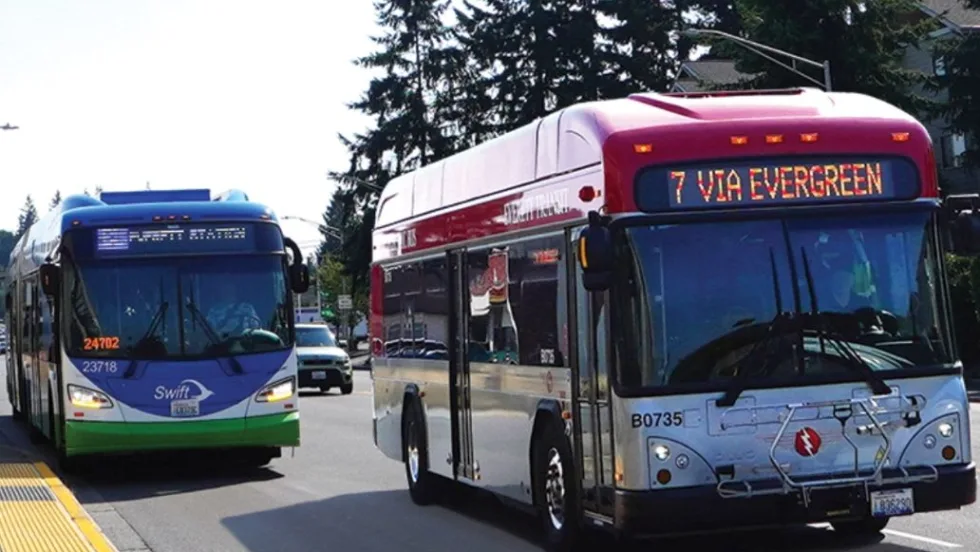
Everett Transit, Community Transit Outline Consolidation Agreement
The proposed agreement calls for a 50% increase in bus service in Everett, a new microtransit zone, continued paratransit service, and the transfer of Everett Transit operations to Community Transit.
Read More →
Strada360’s Steve Lassey on Turning Transit Data Into Better Decisions
From breaking down data silos to preparing for AI, Strada360 CEO Steve Lassey discusses how transit agencies can use technology to improve operations, customer information, and long-term decision-making.
Read More →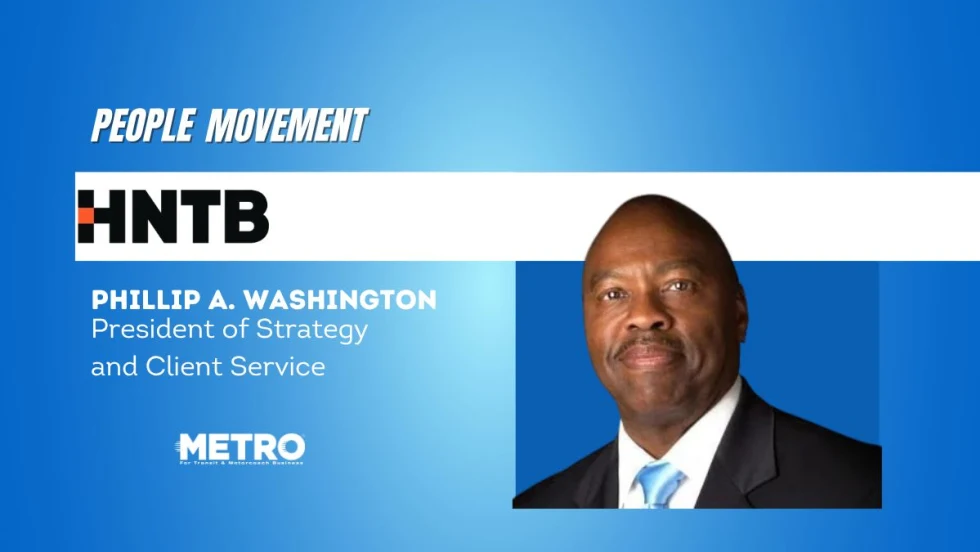
People Movement: Phil Washington Joins HNTB, Denver RTD Launches CEO Search, and More
In this edition, we also spotlight recent personnel moves at STV, the Eno Center for Transportation, and more, highlighting the people taking on new roles across the transportation industry.
Read More →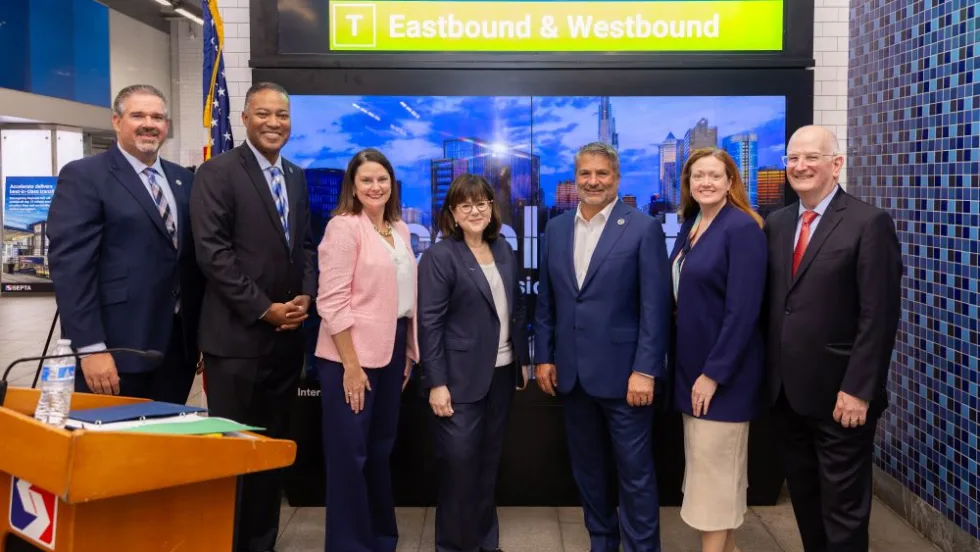
SEPTA Details Accelerate Vision for Transit System
The plan outlines investments in trolley modernization, new Metro and Regional Rail vehicles, accessible stations, and more frequent bus and rail service.
Read More →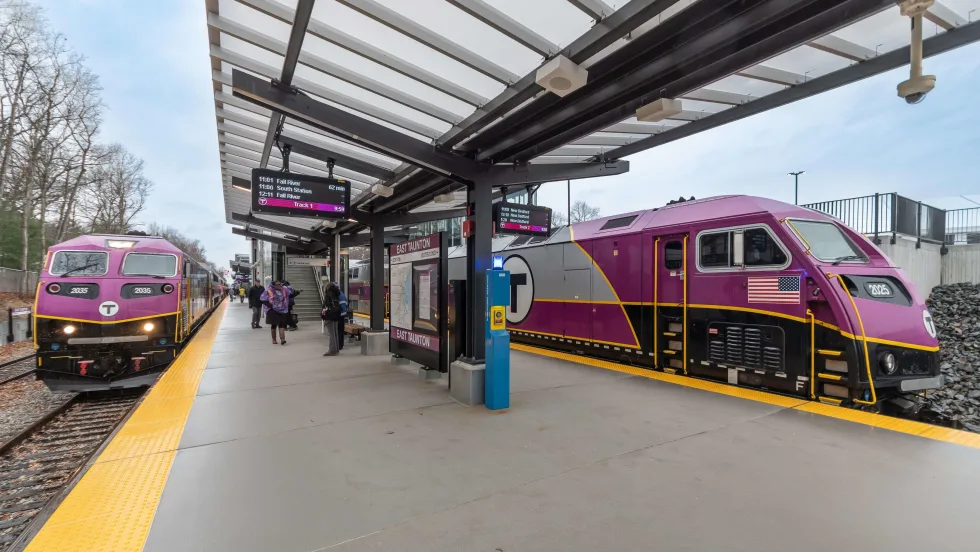
FTA Ends Direct Oversight of MBTA Safety Actions
The federal agency closed its remaining special directive to the Massachusetts Department of Public Utilities following a safety review that began in 2022.
Read More →
Report: Transit Bus Manufacturing Supports 34,100 Jobs, $5.1B in GDP
The “Buses Mean Business” report examines the transit bus manufacturing industry’s economic footprint, supply chain, and rising demand for vehicle replacements.
Read More →