How Advanced Content Management Systems Can Enhance Transit Hub Experiences, Capabilities
CMSs are making it possible to centrally control content, power, and emergency broadcast capabilities for virtually every type and size of digital screen from flight information displays and overhead banners to direct-view LED video walls and menu boards.
Dan Verbsky・Sr. Key Account Manager at LG Business Solutions USA
Some leading display manufacturers are now integrating system-on-a-chip hardware across their entire product catalogs, empowering users to install easy-to-use CMS solutions and combine virtually any size or type of display on a single content network.
Photo: LG
5 min to read
In a fast-paced, captive-audience environment like a transit hub, the advantages of CMS solutions, such as LG webOS, can deliver massive benefits for both internal operations and customer experiences.
Photo: LG
Digital displays are found almost everywhere these days, and whether they are providing information, advertisements, or entertainment, they generally require constant monitoring to ensure reliable operation and manage content, which can include real-time data.
In the transportation industry, where an airport or transit hub may deploy hundreds of screens across miles of real estate, the latest easy-to-use content management systems (CMSs) are making it possible to centrally control content, power, and emergency broadcast capabilities for virtually every type and size of digital screen from flight information displays and overhead banners to direct-view LED video walls and menu boards.
Ad Loading...
For airports, bus depots, and train stations, these advanced solutions can simplify the technology design of new terminals, reduce the labor burden on IT staff, enable instant network-wide updates across multiple digital screens and, depending on the system design, even reduce components and energy use.
The Power of Total Control
A digital signage network is only as good as the content it presents. Even though modern digital displays have evolved to support a multitude of functions, many users and operators are still stuck using antiquated content delivery methods, such as manually loading content items onto each display via USB sticks.
In a fast-paced, captive-audience environment like a transit hub, the advantages of CMS solutions, such as LG webOS, can deliver massive benefits for both internal operations and customer experiences.
Some leading display manufacturers are now integrating system-on-a-chip hardware across their entire product catalogs, empowering users to install easy-to-use CMS solutions and combine virtually any size or type of display on a single content network. Since transit centers often utilize a wide variety of display types for different needs and locations, the benefits of these new displays that all work together can be significant.
With the right content management system, IT staff can update hundreds of displays all at once, schedule different content for different displays, and immediately broadcast prepared emergency messages for incidents such as evacuations, weather events, or other active dangers. They can also make updates to wayfinding directions based on real-time information and present various interactive or experiential content based on time of day or location.
Ad Loading...
Equally important, screens can be used for numerous purposes, such as an overhead banner showing a terminal name when it’s open and animated videos when it’s closed. This allows the facility to put the right message at the right place and the right time without restrictions or obstructions.
Better Content Boosts Guest Experiences
One of the most popular modern discussions in transit in the post-pandemic world is about delivering positive experiences that drive repeat visits and word-of-mouth promotion. This can mean different things for different locations, such as content to keep families entertained while waiting in a security line, advertisements for restaurants, or local services along hallways, and important info about maintenance, closures, terminal changes, and more.
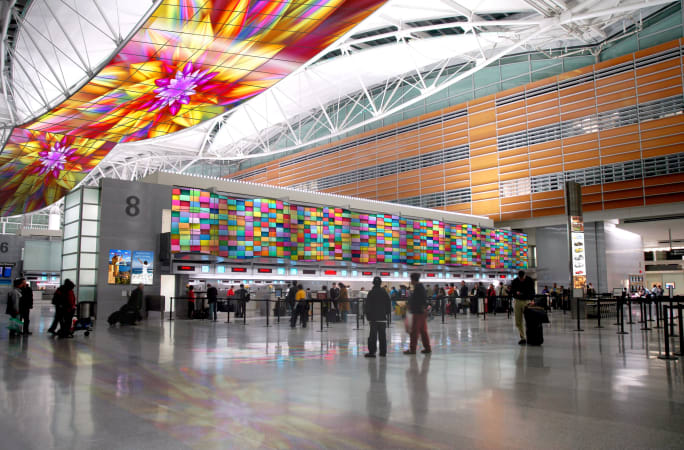
For airports, especially ones where contracts require investment in local art and culture, cutting-edge installations featuring fine-pitch DVLED or Micro LED, interactivity, and unique shapes can also enhance visitor experiences. Those that can be integrated with the CMS then become additional controllable surfaces, extending communication options even further.
Some locations are also expanding their multilingual signage capabilities, which is much easier to attain with digital signage than printed signage. Staff can choose which language to display on each screen, making it easy to welcome travelers from international flights no matter what gate, terminal, or lane they arrive in. This is also vital for FIDs or flight information displays, which can rotate between languages, as well as touchscreen signage displays.
Depending on the CMS system and display capabilities, operators may also be able to see a full overview of network activity, including which displays are on and off, and even enable the IT staff to turn displays on and off remotely. This info and ability to act quickly helps eliminate the issue of inoperative displays that can detract from customer experiences and make an area seem unfinished or under-maintained.
Ad Loading...
For airports, especially ones where contracts require investment in local art and culture, cutting-edge installations featuring fine-pitch DVLED or Micro LED, interactivity, and unique shapes can also enhance visitor experiences.
Photo: LG
The Right CMS Saves Time, Energy and Money
Every institution today needs to be aware of its energy usage, material waste, and overall sustainability for reasons that include budget, public perception, and even adherence to new regulations. Display manufacturers have already dramatically reduced power consumption compared to a decade ago, but there are always more ways to increase efficiency.
Digital signage displays that use system-on-a-chip designs, for instance, can eliminate the need for external media player boxes that require their own power supply and typically end their lifecycle as e-waste. Since this design change can simplify installation for workers and remove the need for dozens or even hundreds of devices, both the energy and financial savings can be significant.
This can even apply inside buses and trains, where digital displays with full-time internet connection are increasingly replacing static printed signage.
In addition to providing all the same content benefits as in transit centers, this immediately reduces physical waste costs for production and dissemination. Updating content across an entire fleet of buses can now be done in seconds instead of hours, enabling much more impactful opportunities to sell ads, deliver information, and provide memorable experiences for travelers.
The advancements made in the latest digital displays are changing how operators deliver content to visitors as they explore transit centers and embark on a uniquely complex customer journey.
Ad Loading...
Centralized content distribution, instant emergency communications, and greater multilingual flexibility all serve to enhance customer experiences while reducing costs and complexity. It’s more important than ever before to research and choose the right displays to ensure the entire digital signage network is reliable, flexible, easy-to-use, and delivers all the functions to improve experiences for both operators and customers.
CEO Magnus Friberg discusses Luminator’s shift toward becoming a digital partner, the growing importance of software and interoperability, and how AI can help agencies improve operations and passenger experience.
Reliability-Centered Maintenance helps transit agencies move beyond routine checklists to focus limited resources on the assets and failures that have the greatest impact on safety, reliability, and service.
More than 1,500 buses now feature upgraded technology designed to improve arrival predictions and provide free Wi-Fi, with deployment expected to reach nearly 2,000 buses by the end of 2026.
John Hroncich discusses BAE Systems’ modular and scalable approach, lessons learned from decades of real-world operations, and how agencies can identify electrification strategies that fit their fleets.
In METRO's latest installment, we take a look at recent news from Complete Coach Works, Beep, FlixBus, and more partnerships making headlines across the transportation sector.
What if transit leaders could ask any operational question and get a trusted answer in seconds? Conversational AI is transforming how agencies use their data.
More than $191 million in federal funding will help three transit agencies replace aging rail vehicles and support a new autonomous shuttle service in Chattanooga.
LA Metro’s Obed Mejia discusses technician training, evolving maintenance technology, fleet replacement, and strategies for getting the most out of today’s transit fleets.
In METRO's latest installment, we take a look at recent news from Siemens, Prevost, Dodge, and more partnerships making headlines across the transportation sector.
Pedestrian microsimulation is helping rail planners identify bottlenecks, test station designs, and prepare complex transit hubs for growing passenger volumes.