



RELATED "How to Develop a Successful Transit Facility Project."
How to Develop a Successful Transit Facility Project (Part II)
The final installment of the two-part series will focus on two significant decisions: selecting a contracting method and choosing an ideal design team.
by Fred Gilliam and Ken Anderson
June 26, 2013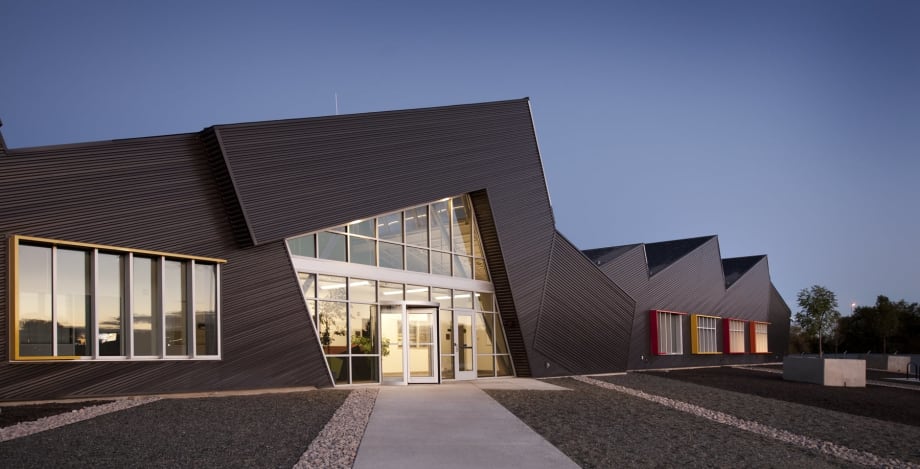
The Denver Central Platte Campus is very visible, making design aesthetics as key as functionality. The project was designed to a LEED Gold certification level, featuring extensive photovoltaics, daylighting, solar orientation and water-saving strategies.
6 min to read
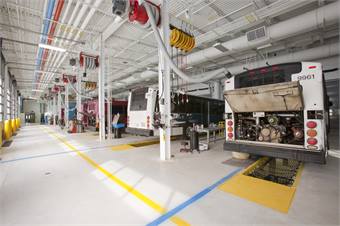
South Bend, Ind.-based TRANSPO’s Emil “Lucky” Reznik administration, maintenance & operations facility.
As discussed in Part I of “How to Develop a Successful Transit Project,” (METRO June 2013) planning for new, expanded or renovated transit facilitates can begin years before an agency issues a request for proposal (RFP). Although there are countless factors to consider before an owner-agency issues an RFP, this article will focus on two significant decisions: selecting a contracting method and choosing an ideal design team.
In today’s transit environment, owner-agencies typically choose one of four contracting models: design-bid-build, design-build, construction manager at risk, or a form of public-private partnership. Each has advantages and disadvantages and most can be customized to fit a particular agency or project’s needs; however, it is important to remember that the method chosen will set the tone for the project by establishing the parameters of the owner-agency’s relationship with the design team.
Selecting a contracting method
Design-bid-build. In a design-bid-build (D/B/B) model, the owner-agency contracts with an architect to develop a project through the complete design process. The owner then uses that design product to engage a contractor for construction under a separate contract. A D/B/B contract can allow the client more control over a project’s design as well as construction cost if a competitive bidding process is utilized. This process is popular with agencies that are in a position to take advantage of the current, favorable competitive bidding environment.
Design-build. The design-build (D/B) process necessitates that the architect and the contractor form one team under one procurement contract to develop both the project’s design and construction in tandem. Due to the restrictions of Federal funding, D/B in the transportation realm can be preceded by the development of bridging documents, which provide the D/B teams with a design that is 20% to 30% complete. D/B can offer up-to-the-minute costing information, including increases in material/installation costs that, in turn, enable architects to make appropriate changes to the design without adversely affecting a project’s delivery date. D/B contracts may call for an owner’s representative to help maintain a horizontal relationship between the owner-agent and the architect, contractor and other project vendors.
At the Denver Central Platte Campus (design-build team: RNL-Pinkard Construction), Michael Sheehan, senior engineer and design-build project manager, was engaged by the City and County of Denver to navigate through Denver’s first contractor-led design-build project. According to Sheehan, “because of the critical nature of Central Platte’s tight schedule, the design-build delivery method was the city’s best option for success. The City and County was impressed with the way a professional and committed team with the right delivery method can streamline the design and construction process.”
Construction manager at risk. A construction manager at risk (CM@R) contract can feel similar to D/B but in fact the architect and the contractor are procured under separate contracts. Although CM@R requires that the owner-agency issue and manage two procurement contracts, it also provides the owner with more control over management and decision-making during both the design and construction phases of the project.
Public-private partnership. Finally, public-private-partnership (PPP), a procurement model that has become more prevalent in recent years, requires bidding teams to provide some level of private equity or financing in addition to design and construction services. Although this model is more complicated than traditional procurement methods, it can be effective for a project that is not currently in an agency’s capital improvement plan or capital budget.[PAGEBREAK]
The Denver Central Platte Campus is very visible, making design aesthetics as key as functionality. The project was designed to a LEED Gold certification level, featuring extensive photovoltaics, daylighting, solar orientation and water-saving strategies.
Select optimal design team
Whichever contracting method an owner-agency chooses, the process should be used to help select an optimal design team. That team will develop a project that focuses on stakeholder input, end-user involvement and project site attributes. The ideal team will also avoid mistakes that can negatively affect project cost, functionality and lifecycle.
Involving stakeholders early in the design process can avoid costly redesigns that are the result of lack of communication. One option is an intensive, multi-day, process called a design charette. The design charette process was used successfully on the South Bend Public Transportation Corporation’s (TRANSPO) Emil “Lucky” Reznik Administrative, Maintenance, and Operations Facility (RNL-designed, with Forum Architects & Maintenance Design Group, South Bend, Ind.). The design team came to the charette with five to six different concepts that reflected various levels of cost and utility. This give-and-take communication allowed the client to make the best possible decisions based on their schedule, cost, and the value provided. When stakeholders are involved, the charette process can create “buy-in” while improving the overall quality of the facility.
Understand end-user operation
Understanding an agency-owner’s operation is vital to creating innovative and practical solutions. A design team should work with the end users to ask questions and listen to the answers. For example, how are maintenance and the service cycle separated? What type of fueling is currently in use and are there plans for alternative fueling methods in the future? Is cash handled on site? Are there particular security concerns that would require out-of-the-box thinking? Will a portion of the building be open for various community group uses? These and many other concerns are unique to each facility and can only be meaningfully addressed through end-user interaction.
A valuable design team will also provide a detailed evaluation of the project’s site. This evaluation should include a sun and wind analysis, circulation assessment, operational flow analysis, and other adjacency appraisals that aid in creating efficiencies. A site analysis also provides insight into the viability of photovoltaics, wind or thermal energy for a given project, which, combined with other design features, can help a project achieve LEED (Leadership in Energy and Environmental Design), or simply improve energy efficiencies to reduce costs. Miriam Mulder, American Institute of Architects, city architect, Santa Monica, shared that this type of analysis was one factor, along with a highly effective design-build process, that helped, "the Big Blue Bus maintenance facility (designed by HOK, constructed by Morley Builders) incorporate eco-friendly and energy efficient features which provided a portion of the savings needed to purchase 80kw of PV panels.”
Finally, from a contracting and design perspective, energy monitoring devices are important for validating design decisions, monitoring equipment efficiencies and providing benchmarks for future projects. Some agencies may also choose to include post-occupancy surveys, which establish avenues for continuous process improvement. Experienced design/construction teams can address economical methods of gathering useful feedback from equipment and users alike.
Choosing a right-sized contracting method and project-appropriate design team will go a long way toward producing a successful project that is delivered on time and on budget. A process that allows the owner-agency to gather a collaborative, experienced team will provide solutions that best serve the agency, the end-user and the public.
Fred M. Gilliam, RNL’s Transportation Group business development lead is a 48-year transportation-industry veteran. He retired as president/CEO of Capital Metropolitan Transportation Authority in Austin, Texas, in 2009.
Ken J. Anderson, AIA, LEED AP BD+C, associate principal and Washington, D.C., office lead, has been with RNL for more than 12 years. As a project manager and architect he leads transportation work for the East Coast and Southwest regions.
Subscribe to Our Newsletter
More Bus

New York MTA Plans Largest Bus Fleet Upgrade in More Than a Decade
The agency is seeking manufacturers for 650 new CNG buses to replace aging vehicles, improve reliability, and advance its broader fleet modernization strategy.
Read More →
Building a Flexible Path to Transit Electrification
John Hroncich discusses BAE Systems’ modular and scalable approach, lessons learned from decades of real-world operations, and how agencies can identify electrification strategies that fit their fleets.
Read More →
Bus Tech Talk: Keeping Transit Technicians Ahead of the Technology Curve
LA Metro’s Obed Mejia discusses technician training, evolving maintenance technology, fleet replacement, and strategies for getting the most out of today’s transit fleets.
Read More →
Biz Briefs: RIPTA Unveils New Frontrunners, Clevland RTA Adds New Siemens, and More
In METRO's latest installment, we take a look at recent news from Siemens, Prevost, Dodge, and more partnerships making headlines across the transportation sector.
Read More →
People Movement: Holly Arnold Joins Transdev and More
In this edition, we also cover recent appointments and announcements at Pace, CamTran, MCI, and more, showcasing the individuals helping to shape the future of transportation.
Read More →
The High Cost of Transit Buses: Industry Leaders Look to Procurement Reform
Transit leaders and policymakers examine how standardized bus designs, streamlined procurement, and predictable funding could help agencies stretch budgets and deliver better service.
Read More →
The Business Voice Behind Public Transportation
As chair of APTA’s Business Members Board of Governors, Ray Melleady explains how more than 850 business members are partnering with transit agencies to advance funding, innovation, and industry-wide collaboration.
Read More →
From Surviving to Thriving: Building Stronger Transportation Organizations
Bus Business Consultants founder Brian Dickson shares lessons on leadership, organizational health, and creating options for long-term success in a changing transportation industry.
Read More →
Finding the ‘Happy Medium’: Optimizing Maintenance Without Sacrificing Reliability
The key to maintenance optimization isn’t doing less work—it’s doing the right work at the right time on the right assets.
Read More →
LA Metro, City of West Hollywood, and Partners Advance Smarter Bus Lane Enforcement
The award-winning partnership combines AI-powered detection with human oversight to improve bus reliability, accessibility, and enforcement efficiency.
Read More →