



Inside May Mobility's Detroit AV Deployment
The “Accessibili-D” service aims to improve the quality of life for Detroiters who live with disabilities or are age 65 and older. The service will be available to select residents of Detroit starting June 20 and extending through 2026.

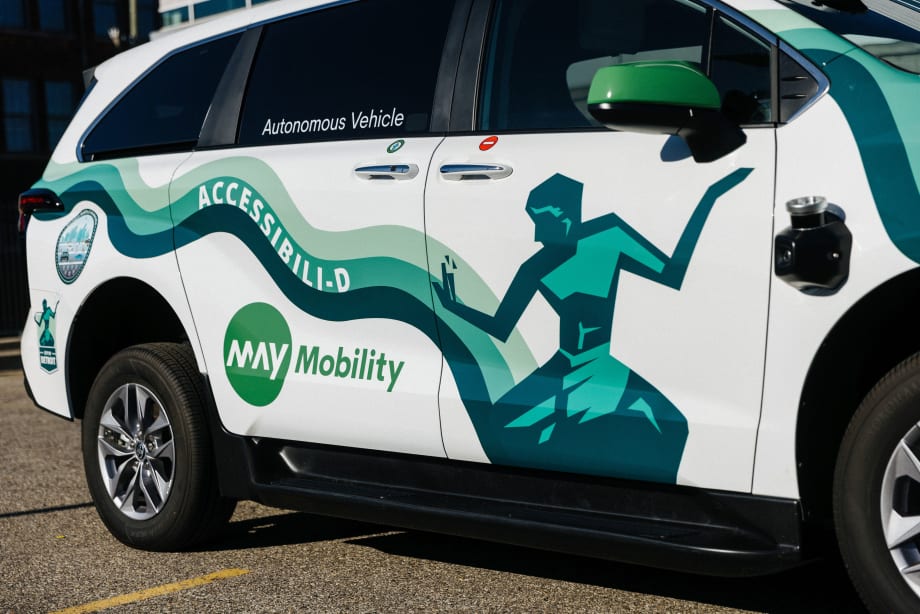
May Mobility performed extensive vehicle testing with the University of Michigan’s Mcity and the American Center for Mobility in preparation for launch.
Photo: May Mobility
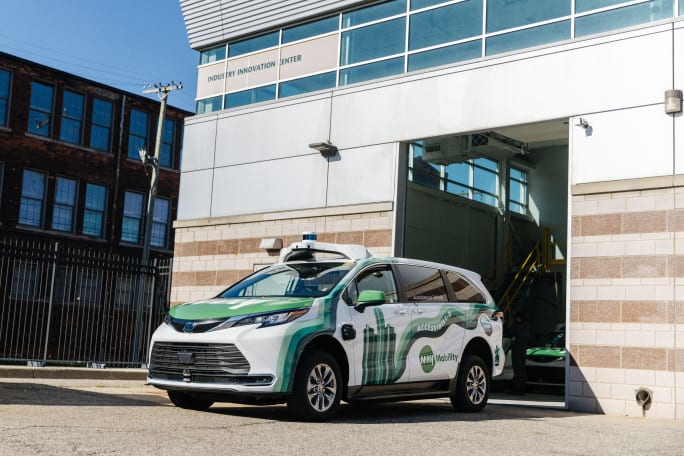
May Mobility will deploy three AVs, including two wheelchair-accessible vehicles, to help participants achieve greater access to healthcare facilities, shopping centers, jobs, and social and recreational activities.
Photo: May Mobility
May Mobility, in partnership with the City of Detroit’s Office of Mobility Innovation (OMI) and the Michigan Mobility Collaborative (MMC), is launching the Detroit Automated Driving Systems (ADS) pilot.
The “Accessibili-D” service aims to improve the quality of life for Detroiters who live with disabilities or are age 65 and older. The service will be available to select residents of Detroit starting June 20 and extending through 2026.
“Many Detroiters struggle with transportation due to the high costs of car ownership or mobility issues related to age or disabilities,” Edwin Olson, CEO and co-founder of May Mobility, told METRO Magazine. “This pilot program with the City of Detroit is designed to address those transportation challenges and improve accessibility for the community.”
Detroit’s New AV Service
May Mobility will deploy three AVs, including two wheelchair-accessible vehicles, to help participants achieve greater access to healthcare facilities, shopping centers, jobs, and social and recreational activities.
The free service will operate across 68 stops in 11 square miles of downtown Detroit Monday and Wednesday through Friday from 8 a.m. to 6 p.m., and on the weekend from 8 a.m. to 1 p.m.
Those interested in riding the service need to first submit an Expression of Interest form. After they are contacted and enroll, they can book a ride through a mobile app or by contacting a call center.
Olson explains the service area was determined through community engagement initiatives and research, conducted by May Mobility, in association with OMI and the MMC.
“The stops and locations for the service were chosen based on the importance to the community,” he explains. “Riders will be able to participate in these activities more conveniently with our service than with traditional ridesharing or public transit services. With 68 stops across an 11-square-mile area of downtown Detroit, users can easily access a variety of essential destinations.”
Olson adds May Mobility plans to further expand the service zone over the coming months with additional stops and vehicles based on rider feedback.
The Road to Greater Accessibility
Last July, the Detroit City Council unanimously approved a $2.4 million contract with May Mobility to provide the Accessibili-D service.
May Mobility performed extensive vehicle testing with the University of Michigan’s (U-M) Mcity and the American Center for Mobility (ACM) in preparation for launch.
“We began working with U-M researchers in November 2023 where our vehicles went through the MCity Safety Assessment Program — a two-part test developed by MCity,” Olson says about the testing process. “In March 2024, our vehicles began a month-long safety testing program at ACM in Ypsilanti. Here, our vehicles were tested to ensure the safety, reliability, and efficiency of our technology. The testing with MCity and ACM replicated real-life deployment scenarios and ensured optimal performance for our official deployment in Detroit.”
Testing protocols also included the Mcity Safety Assessment Program, made up of a Driver’s License Test and Driving Intelligence Test.
“Vigilance and communication skills are paramount for May’s Autonomous Vehicle Operators (AVOs),” says Olson about the vehicle operator program. “With thorough training and extensive experience on public roads, our AVOs become experts on vehicle behavior and use that knowledge to prioritize safety and the rider experience. AVO performance is regularly reviewed, and training updates are implemented to prepare them for future software updates.”
May Mobility’s Tech
May Mobility’s AVs use its Multi-Policy Decision Making (MPDM) technology to effectively navigate city streets.
Each vehicle is equipped with multiple lidar, radar, and cameras, which feed MPDM a 360-degree view of its surroundings.
Using the data collected from the AV’s sensor suite, MPDM is able to virtually simulate thousands of possible scenarios every second. As the AV detects vehicles, pedestrians, bikers, and pets, MPDM quickly analyzes the best maneuver to perform to efficiently and safely reach its destination, even in unencountered situations.
“With a deep understanding of commercialization challenges, the company’s proprietary MPDM technology can adaptively handle situations it hasn’t encountered before,” says Olson. “The technology’s ability to imagine thousands of scenarios every second enables May Mobility to scale to new markets and cities on a fraction of the capital required by other AV systems.”
The Detroit Automated Driving Systems pilot is May Mobility’s 14th deployment to date. The company currently operates in Ann Arbor, Mich.; Grand Rapids, Minn.; Miami, Fla.; Arlington, Texas; and Sun City, Ariz.
Olson says added deployments, like the one in Detroit, help May Mobility not only showcase its own expertise, but also the viability of autonomous vehicles in creating accessible transit options.
“This pilot will also provide valuable data and insights for operating autonomous vehicles in real-world settings,” he adds. “That data helps us to refine and improve our technology, advancing our goal of creating safer and more efficient autonomous transportation solutions.”
More Technology

From Hardware to Digital Partner: Luminator Charts Its Next Chapter
CEO Magnus Friberg discusses Luminator’s shift toward becoming a digital partner, the growing importance of software and interoperability, and how AI can help agencies improve operations and passenger experience.
Read More →
Beyond the Checklist: A Structured Approach to Transit Maintenance
Reliability-Centered Maintenance helps transit agencies move beyond routine checklists to focus limited resources on the assets and failures that have the greatest impact on safety, reliability, and service.
Read More →
NJ TRANSIT Advances Bus Technology Upgrades Across Statewide Fleet
More than 1,500 buses now feature upgraded technology designed to improve arrival predictions and provide free Wi-Fi, with deployment expected to reach nearly 2,000 buses by the end of 2026.
Read More →

Building a Flexible Path to Transit Electrification
John Hroncich discusses BAE Systems’ modular and scalable approach, lessons learned from decades of real-world operations, and how agencies can identify electrification strategies that fit their fleets.
Read More →
Biz Briefs: Alstom Lands Canadian Contract, LYT to Supply California TSP, and More
In METRO's latest installment, we take a look at recent news from Complete Coach Works, Beep, FlixBus, and more partnerships making headlines across the transportation sector.
Read More →
From Legacy Silos to Conversational Intelligence
What if transit leaders could ask any operational question and get a trusted answer in seconds? Conversational AI is transforming how agencies use their data.
Read More →
USDOT Announces Rail Vehicle Replacement Grants, Chattanooga AV Shuttle Funding
More than $191 million in federal funding will help three transit agencies replace aging rail vehicles and support a new autonomous shuttle service in Chattanooga.
Read More →
Bus Tech Talk: Keeping Transit Technicians Ahead of the Technology Curve
LA Metro’s Obed Mejia discusses technician training, evolving maintenance technology, fleet replacement, and strategies for getting the most out of today’s transit fleets.
Read More →
Biz Briefs: RIPTA Unveils New Frontrunners, Clevland RTA Adds New Siemens, and More
In METRO's latest installment, we take a look at recent news from Siemens, Prevost, Dodge, and more partnerships making headlines across the transportation sector.
Read More →
Why Simulating Pedestrian Movement Has Become Essential for Modern Rail Stations
Pedestrian microsimulation is helping rail planners identify bottlenecks, test station designs, and prepare complex transit hubs for growing passenger volumes.
Read More →