



Insurance premium crunch created by the ‘perfect storm’
Today, the bus insurance industry is in a peculiar situation: It can’t defend rising premiums without admitting to playing a large contributing role in creating the foundation for today’s “crisis” by underpricing its product for years.
“Those who cannot remember the past are condemned to repeat it.” — George Santayana For motorcoach operators and the insurance companies that insure them, Santayana’s quote has relevance that neither would have thought possible only 12 months ago. But, before looking at how we got to the point where an average liability premium of $6,500 per coach for a $5 million policy should be the going rate, it’s very instructional to see where we’ve been. When Lancer wrote its first bus insurance policy in 1985, there were only two or three other insurance companies with a specialization in passenger transportation even willing to issue quotes to bus companies — at any price. The industry was still feeling the aftershocks of the demise of the undisputed industry leader, Transit Casualty Co., which had been shut down months earlier by the Missouri Insurance Department because of its inability to meet current and future claims obligations. The Missouri regulator’s decision was an easy one because, quite simply, Transit Casualty’s math just didn’t work anymore; its liabilities (claims costs and expenses) clearly outweighed its assets (premiums and investments). A rude awakening Transit Casualty’s demise was a rude awakening for bus operators who found themselves not with a pricing problem but knee deep in an availability crisis. Those “lucky” enough to convince an insurer to issue them the required $5 million liability policy for each of their buses were paying $10,000 or more per bus. The unlucky ones were laying up their equipment trying to hold on until the insurance market recovered and expanded. Eventually, the market did loosen up a bit in the late 1980s and premiums began to drop to more competitive levels as the number of insurers “discovering” the bus market expanded from two or three to 20 in the early 1990s. Some long overdue tort reform designed to curtail frivolous lawsuits also played a role in encouraging insurers to venture back into the market. Economics 101 was in full bloom and market forces took hold as insurance executives who hadn’t considered buses since waiting for a yellow one in their formative years became instant experts at underwriting them. Many bus operators were benefiting from this reckless, cut-throat insurance pricing demonstrated by the fact that, in some cases, dollar for dollar they were paying less to insure their quarter-million-dollar coach on a per-vehicle basis than they were paying to insure the family SUV. The perfect storm Throughout the 1990s, insurance companies were facing the same dilemma bus operators faced after Transit Casualty’s meltdown the previous decade: if they priced their product properly they’d surely watch their market share evaporate. They couldn’t fault the bus operators who were enjoying all of the mindless competition — and absurdly low premiums — because it was a crisis of their own making. The bus insurance companies certainly weren’t disciples of George Santayana because they obviously didn’t remember the past (i.e., Transit Casualty) and were indeed repeating it. And the results were fairly predictable — and devastating. But there were other forces at work that were not only bringing premium pricing into question, they were demanding a significant premium increase —and quickly. Several factors severely impacted bus insurers:
The emergence of the consolidators whose acquisitions effectively eliminated about $20 million to $25 million in premium and put a serious crimp in the industry’s ability to effectively spread risk.
The worst driver shortage in memory, leading to a sharp increase in claim frequency and severity as inexperienced drivers were literally learning (and crashing) on the job.
Skyrocketing medical costs. What was once a $5,000 whiplash claim became a $500,000 one- to two-day spinal surgery/loss of income claim.
An almost total deterioration of the tort reform gains from the last insurance crisis in the late 1980s. Finally, companies were operating equipment with values that had conservatively tripled in a decade, driving more miles to pay their new found leasing companies. All the conditions for the bus insurance industry’s version of the “perfect storm” were in place — and about to converge. Finally, the late 1990s saw the economic chickens come home to roost as insurers were either slipping into insolvency (e.g., Reliance, Home State, Acceleration) or withdrawing from the bus insurance market altogether (e.g., Clarendon, Firemen’s Fund, CIGNA, Legion, USF&G). Not surprisingly, the insurers still standing began to demonstrate behavior that properly reflected their economic reality: Properly price your product to pay claims and expenses — or disappear. Guilty as charged Today, the bus insurance industry is in a peculiar situation: It can’t defend rising premiums without admitting to playing a large contributing role in creating the foundation for today’s “crisis” by underpricing its product for years. Most insurance companies writing bus insurance throughout the 1990s were simply asleep at the wheel and were pricing their product completely oblivious to the changes going on in the bus industry they were insuring. As with all trips “through the looking glass,” this fantasy had to end. As Transit Casualty found out 15 years earlier, if it doesn’t make sense, it can’t last. And charging 80% less in 2001 for the same product sold in 1986 doesn’t make sense. Now what? While not as dramatic as the premium adjustments in the 1980s, today’s premium increases are necessary if the motorcoach industry is to have a reliable and financially solid insurance industry to which it can turn to transfer its substantial risks. It may also be a good time for long-term thinkers in the bus industry to strongly consider working with their insurers not as “necessary evils,” but as financial service providers, like banks, accounting firms and leasing companies, that can help them through the rough spots — like today. Otherwise, somewhere down the road, someone will dust off George Santayana’s painful quote when the next “hard” market hits.
More Management

Bus Tech Talk: Keeping Transit Technicians Ahead of the Technology Curve
In this episode of Bus Tech Talk, Complete Coach Works’ Business Development Manager Mark Hollenbeck and METRO’s Executive Editor Alex Roman sit down with Obed Mejia, Senior Technical Trainer for Bus Maintenance, at LA Metro to discuss how rapidly evolving bus technology is changing the maintenance shop — and the skills technicians need to keep pace.
Read More →
Michael Schneider Joins Paslay Group to Expand Transportation Practice
The longtime transportation executive will help Paslay Group grow its advisory and program management work across transit, highway, and other infrastructure sectors.
Read More →
People Movement: Connectpoint Expands Leadership Team, Stadler Names New Group CEO, and More
In this edition, we also spotlight recent personnel moves at Burns, UZURV, and more, highlighting the people taking on new roles across the transportation industry.
Read More →
More Than a Summer Job: Building the Next Generation of Transit Talent
The Delaware River Port Authority and PATCO have transformed their internship program into a hands-on professional development experience that introduces students to the breadth of transportation careers — and creates a pipeline for future employees.
Read More →
LA Metro Board Awards 220 Battery-Electric Bus Contract to ENC
The contract, which is the largest base award of battery-electric buses by a U.S. transit agency, will be built in Southern California, sustaining good jobs as LA prepares to welcome the world in 2028
Read More →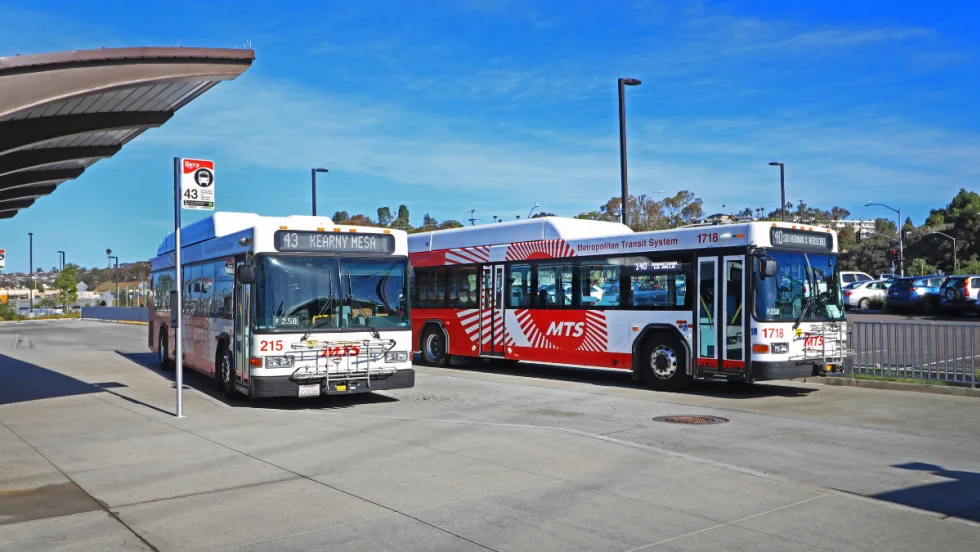
What’s Behind San Diego MTS’s Award-Winning Transit Strategy
Named one of APTA’s 2026 Outstanding Public Transportation Systems with 50 million or more annual passenger trips, California’s San Diego Metropolitan Transit System points to gains in ridership, safety, technology, and reliability as foundations of its success.
Read More →
Public Transit Conference Returning to GFX in 2027, Call for Papers Now Open
The Call for Papers is now open, allowing transit agency professionals and industry experts to help shape the PTC educational program by submitting session ideas for consideration.
Read More →
Indian River Transit’s Community-Focused Approach Earns National Recognition
Named APTA’s 2026 Outstanding Public Transportation System in its size category, Florida’s Indian River County transit system continues to grow ridership through fare-free service and a focus on evolving community needs.
Read More →
ENC Lands MATA Contract and More in Biz Briefs
In this edition of Biz Briefs, we spotlight the latest developments shaping the future of mobility.
Read More →From Surviving to Thriving: Building Stronger Transportation Organizations
Bus Business Consultants founder Brian Dickson shares lessons on leadership, organizational health, and creating options for long-term success in a changing transportation industry.
Read More →