




Related: Paratransit on an Island: Oahu Transit Rolls with LiquidSpring
NCRTD, LiquidSpring Win Innovative Solutions Award for Vehicle Technology
N.M.’s North Central Regional Transit District (NCRTD) partnered with LiquidSpring to test its Compressible Liquid Adaptive Suspension System (CLASS).
November 8, 2021
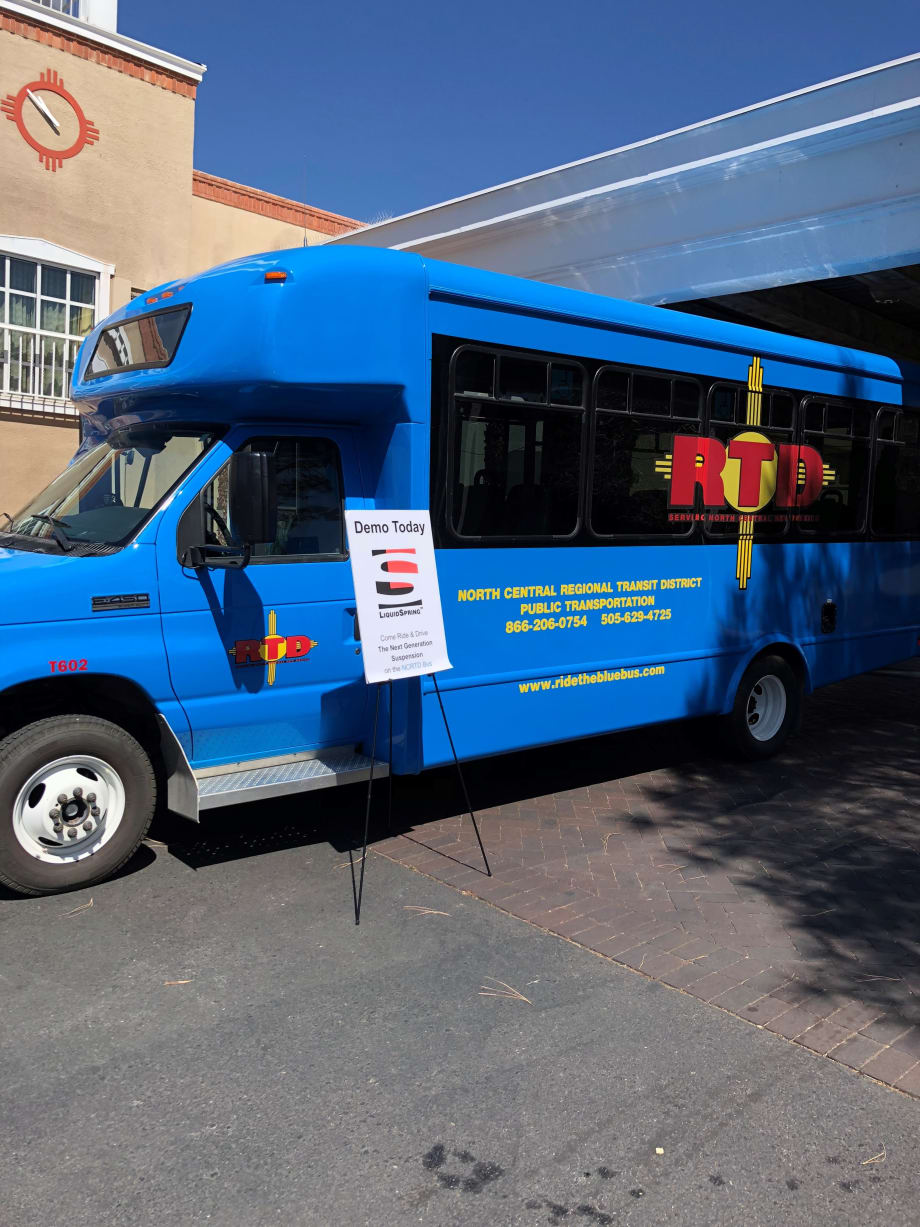
The patented suspension system is designed to replace conventional suspension systems (steel or air), with shock absorbers, and stabilizer bars by utilizing a compressible liquid.
Credit:
LiquidSpring
3 min to read
Now in its seventh year, the Innovative Solutions Awards honors bus operations and their supplier partners who have implemented initiatives that helped them save money, run more efficiently, streamline operations, increase safety, improve customer satisfaction, increase ridership, and more.
METRO’s staff would like to thank everyone who applied, and congratulations again goes to all our winners.
With hopes of finding a better ride on its cutaway buses, Española, N.M.’s North Central Regional Transit District (NCRTD) partnered with LiquidSpring to test its Compressible Liquid Adaptive Suspension System (CLASS).
The patented suspension system is designed to replace conventional suspension systems (steel or air), with shock absorbers, and stabilizer bars by utilizing a compressible liquid. The compressible liquid provides the spring and damping. CLASS connects a first liquid volume (strut/damper) and a second volume (liquid only) with a hydraulic line and valve. The volumes are filled with a compressible liquid and pressurized, which serves as the spring. When the secondary volumes rate valve is open, all the liquid is available to compress, providing the lowest spring stiffness; when the rate valve is closed, only the liquid in the first volume (strut/damper) is available to compress, thereby providing the highest spring stiffness.
When the valve is Pulse Width Modulated (PWM), there is a seamless spring stiffness change. This configuration enables CLASS to change the spring rate and damping at each wheel independently, reducing harshness while increasing roll and pitch control.
Operationally, the system works by monitoring the vehicle’s steering, speed, braking, and the tide height at each wheel. This information is processed by an on-board microprocessor using its preprogrammed eight-degree-of-freedom vehicle and non-linear fluid models. The microprocessor instructs the corner valve for each strut/damper module to adjust the effective liquid volume, thus changing the stiffness and damping as required to minimize transmitted power and resonant vibrations from the suspension to the chassis, which cause a harsh ride.
CLASS includes a leveling system that maintains a pre-set “proper” ride height, regardless of load, or as the passenger load on the vehicle changes.
“[Our system] is unique [because] we can instantaneously change the suspension spring rate on a vehicle to go from super soft to super firm in fractions of a second,” explains Travis Ward, national sales at LiquidSpring. “All of our suspensions work the same, but as the GAWR changes per vehicle so does the perceived softness.”
In addition to a noticeable improved ride quality and handling, NCRTD has seen a decrease in suspension-related expenses when comparing two identical buses — E-450 cutaways — with the only difference being its previous suspension system on one bus and the CLASS system on the other bus, says David Funck Sr., fleet/facilities maintenance manager at NCRTD.
With the LiquidSpring-equipped bus, the agency is running about .031 cents per mile in suspension-related expenses, compared to its old suspension system where they were running .067 cents per mile. From increased tire life to a reduction in tightening of screws, nuts, and bolts on the chassis/body, the vibration reduction provided by CLASS is proving to be a cost savings in addition to improving rider/driver experience.
NCRTD currently has the CLASS suspension system on the rear axle of about 16 of its buses and hopes to install it on both the front and rear of its buses in the future.
Subscribe to Our Newsletter
More Technology

From Hardware to Digital Partner: Luminator Charts Its Next Chapter
CEO Magnus Friberg discusses Luminator’s shift toward becoming a digital partner, the growing importance of software and interoperability, and how AI can help agencies improve operations and passenger experience.
Read More →
Beyond the Checklist: A Structured Approach to Transit Maintenance
Reliability-Centered Maintenance helps transit agencies move beyond routine checklists to focus limited resources on the assets and failures that have the greatest impact on safety, reliability, and service.
Read More →
NJ TRANSIT Advances Bus Technology Upgrades Across Statewide Fleet
More than 1,500 buses now feature upgraded technology designed to improve arrival predictions and provide free Wi-Fi, with deployment expected to reach nearly 2,000 buses by the end of 2026.
Read More →

Building a Flexible Path to Transit Electrification
John Hroncich discusses BAE Systems’ modular and scalable approach, lessons learned from decades of real-world operations, and how agencies can identify electrification strategies that fit their fleets.
Read More →
Biz Briefs: Alstom Lands Canadian Contract, LYT to Supply California TSP, and More
In METRO's latest installment, we take a look at recent news from Complete Coach Works, Beep, FlixBus, and more partnerships making headlines across the transportation sector.
Read More →
Sponsored•September 8, 2026
From Legacy Silos to Conversational Intelligence
What if transit leaders could ask any operational question and get a trusted answer in seconds? Conversational AI is transforming how agencies use their data.
Read More →
USDOT Announces Rail Vehicle Replacement Grants, Chattanooga AV Shuttle Funding
More than $191 million in federal funding will help three transit agencies replace aging rail vehicles and support a new autonomous shuttle service in Chattanooga.
Read More →
Bus Tech Talk: Keeping Transit Technicians Ahead of the Technology Curve
LA Metro’s Obed Mejia discusses technician training, evolving maintenance technology, fleet replacement, and strategies for getting the most out of today’s transit fleets.
Read More →
Biz Briefs: RIPTA Unveils New Frontrunners, Clevland RTA Adds New Siemens, and More
In METRO's latest installment, we take a look at recent news from Siemens, Prevost, Dodge, and more partnerships making headlines across the transportation sector.
Read More →
Why Simulating Pedestrian Movement Has Become Essential for Modern Rail Stations
Pedestrian microsimulation is helping rail planners identify bottlenecks, test station designs, and prepare complex transit hubs for growing passenger volumes.
Read More →