



New Technology Raises the Bar for Digital Signage
From clearer and brighter screens that adapt upon light exposure to multi-functional devices that reduce cost and effort, innovative operational ideas for the transit industry have emerged.
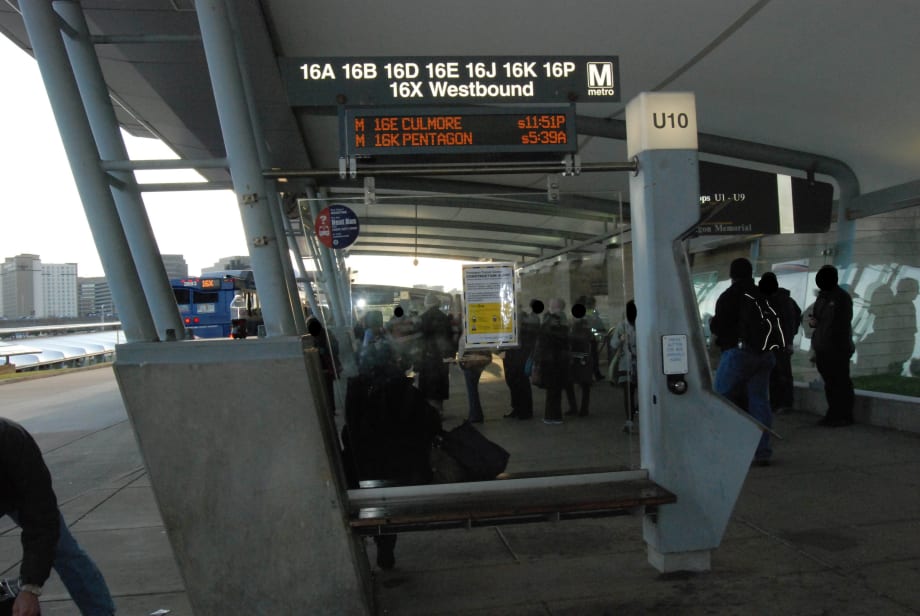
Luminator has installed 450 LED displays that provide arrival prediction at bus stops for the Chicago Transit Authority and are currently installing 170 for WMATA.
Luminator has installed 450 LED displays that provide arrival prediction at bus stops for the Chicago Transit Authority and are currently installing 170 for WMATA.
As technology advances, it becomes easier for consumers to access the next big thing. And as transit agencies strive to keep up with the trends, digital signage manufacturers continue to integrate them into its offerings.
The quality in which information, both on-board and on the ground, is distributed is advancing to meet the expectations of a 21st century-savvy ridership. From clearer and brighter screens that adapt upon light exposure to multi-functional devices that reduce cost and effort, innovative operational ideas for the transit industry have emerged from the luxury of newer technology.
Quality Improvement in Display
With rapidly advancing technology available at consumers’ fingertips, it’s no surprise higher quality screens are in great demand this year. Manufacturers are reporting requests for higher resolution, full-color displays, especially in the LED and LCD markets.
Screens and displays backlit with LEDs are more commonly used for exteriors, such as on the outside of vehicles or at outdoor transit spaces. And LCDs, which can be designed specifically for bus or rail application, are better for interior environments not subjected to harsh weather conditions.
Whether it’s a map of the next stop, advertisements or alerts, LCD signs on board or within stations can deliver rich information to passengers. New technology features complex graphic representation and audio features. Its contrast and brightness capabilities are a major benefit to agencies as well. Peerless-AV, a Illinois-based manufacturer, recently integrated screen sensor technology that adjusts a display’s brightness based on how much light the device is exposed to, reducing glare for ideal clarity.
LED lights, on the other hand, are now mounted closer together, providing a higher resolution image. While LEDs aren’t new, they continue to thrive as a main offering for manufacturers. Jack McKeague, GM/VP of sales, display division, for Peerless-AV, calls LED integration one of the company’s “biggest transformations.” Exterior LED signs mounted to the outside of buses can function as more of an interactive billboard for riders. LEDs require less energy than when they first debuted as well and can be equipped with wireless technology.
“All back lights were done with mercury when we first started,” says McKeague. “Tubes would take longer to come on even though we had a good heating and cooling system. But LED gives you a fast brightness factor much better than before.”
According to Paul Fleuranges, senior director, corporate and internal communications, at the New York Metropolitan Transportation Authority and a member of the Digital Signage Federation, more companies are inspired by what’s possible today. This includes the large-scale screens seen in advertising, such as the billboards in the heart of Times Square.
“The quality of the images on those screens are phenomenal,” says Fleuranges. “Not that we’ll see exact replicas around the country, but it shows just how dynamic screens can be, especially at that grand size. In transit, size and resolution still matter, hence the popularity of 4K resolution [4,000 pixels] plus in new product rollouts.”
The future of screen development includes installing more LED and LCD technology in bus stops and shelters. Currently, more than 60% of bus shelters in North America don’t have power, says Dan Kelleher, VP, sales and marketing, for Luminator Technology Group. Concurrently, there is an expanding focus on solar solutions to provide power to those signs.
Luminator has installed 450 LED displays that provide arrival prediction at bus stops for the Chicago Transit Authority and they are currently installing 170 for WMATA in bus shelters in the Washington, D.C. area.
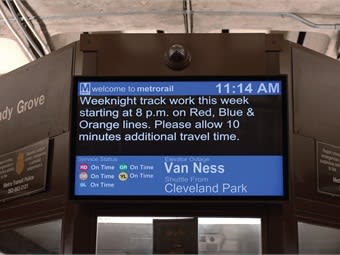
Peerless-AV recently integrated screen sensor technology that adjusts a display’s brightness, thus reducing glare.
In development
A decade ago, the three devices people couldn’t live without were cell phones, palm pilots and mp3 players. However, their functions now exist in one streamlined gadget: the smartphone. This trend of technology integration is making its way into digital signage. Multifunctionality is key for new products entering the market.
Luminator will begin offering backup cameras as part of its Destination Sign System. The sign displaying the route at the rear of a transit vehicle can have a camera built into it. The camera, protected from the elements inside the sign, kicks into gear when the vehicle is in reverse. Real-time footage then appears on a four-inch LCD ODK4 touchscreen that currently controls the sign system and is mounted in view of the driver. This new feature was launched at the APTA EXPO last October — the company expects to start installation mid-2015.
Enhancing standard products with multiple functions has advantages for both the manufacturer and the customer. Redundancy in the marketplace is reduced, and companies like Luminator maintain a competitive edge. On the other end, customers can reduce the number of vendors associated with their vehicles’ operations, making equipment maintenance both simpler and more cost-effective.
“Our goal is to continue integrating more features into our system,” says Kelleher. “Cameras are fairly straightforward and have irreplaceable safety benefits, so it’s a good place to start.”
According to Dale Storhaug, mass transit market manager for Daktronics, the same rings true about a digital sign’s content. Currently, with advancing technology, customer requests are gravitating toward programmable signs that can serve several different purposes.
With Daktronics’ signage system, transit agencies have the ability to change a sign’s message at any point in time. Daktronics’ AF-6400 digital signage product line is also equipped with a spectrum of colors to choose from as well as motion graphics capabilities. Therefore, a sign can be used for anything from delivering updated passenger information to displaying an advertisement or promotional to communicating safety alerts.
“When you talk about media consumption, ridership — or the masses that use public transit — depends on public information and tends to have different ways in which they feel more comfortable receiving their information,” says Storhaug.
Having changeable signs allows for the dissemination of accurate, updated information that corresponds with the real-time information riders are generating through their smartphones. Storhaug says there’s no better way of increasing ridership than by building trust from customers.
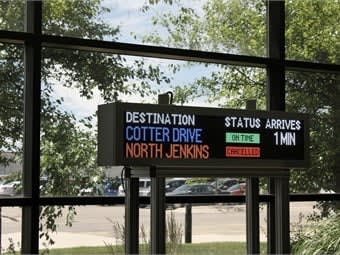
With Daktronics’ signage system, transit agencies have the ability to change a sign’s message at any point in time.
Living in Color
Manufacturers are promoting a full-color, high-resolution model of signage for more diverse color usage.
Luminator is in the process of supplying New York City Transit with full-color destination signs for placement on their New Flyer and Nova buses. The signs provide over 4,100 color variations and will be used to help designate special express routes. Luminator believes color-coding transit to differentiate between lines via a vehicle’s sign, rather than having to have different color buses, provides agencies with more flexibility.
“It keeps the fleet mobile and gets rid of the older method of painting buses or trains different colors,” says Kelleher. “Your routes are more easily identified for riders with color and it enables the agency to segment out for premium services.”
Full color signs can also be utilized for public service announcements or in-house messaging. Agencies can communicate which type of message a rider is viewing by using different colors opposed to the monochromatic limitations of digital signage past. Letters and symbols can also appear atop an attention-grabbing background or in bold font for greater emphasis.
The Luminator INFOtransit system provides internal high resolution LCD screens inside the vehicle providing visual next stop and public service information. In addition to internal messaging, advertising on the system is also becoming more popular. “Agencies are recognizing that they can create a return on investment model that will provide a new source of income,” says Kelleher. “INFOtransit can offset some of the cost of system ownership and the cost of the vehicle itself.”
More Security and Safety

Transit Agencies Highlight Safety Gains at National Summit
Leaders from 15 major transit systems shared crime-reduction results and safety initiatives while discussing the role of continued federal support.
Read More →
DART Launches Major Security, Fare Enforcement Initiative
The 90-day demonstration will deploy coordinated security teams at five light rail stations while testing controlled access and gathering data to guide future investments.
Read More →
RTD Launches NextRide App to Consolidate Trip Planning, Fares, Security Reporting
The app expands on RTD’s existing NextRide web application and allows customers to view real-time vehicle locations and service alerts, purchase and store digital fares, and access customer support.
Read More →

TAPTCO Updates OSHA Compliance Training for Transit Maintenance Operations
The revamped program addresses 26 OSHA standards for maintenance facilities, with TAPTCO pointing to training, documentation, and everyday shop hazards as continuing challenges for transit operations.
Read More →
How VaporVision Adds Value to Transit Door Systems
Wabtec engineers explain how the system improves doorway detection, strengthens diagnostics and gives transit agencies and OEMs greater operating flexibility.
Read More →
FRA Announces $5.3B in Rail Investments, Including $2B for Amtrak
Funding will support grade-crossing improvements, infrastructure upgrades, and new Amtrak equipment in 23 states.
Read More →
Chicago, Maryland Expand Non-Law-Enforcement Safety, Rider Support
The CTA and MTA are launching new programs aimed at de-escalation, crisis response, rider assistance, and greater transparency.
Read More →
LA Metro, City of West Hollywood, and Partners Advance Smarter Bus Lane Enforcement
The award-winning partnership combines AI-powered detection with human oversight to improve bus reliability, accessibility, and enforcement efficiency.
Read More →
LA Metro Reports 57% Decline in Homelessness on Transit System Since 2024
The agency's latest homelessness count offers new data on how care-based services and cross-sector partnerships can complement traditional transit security strategies.
Read More →
FTA Launches 'Transit Moves America' Dashboard to Highlight Agency Safety and Performance
The online dashboard transforms National Transit Database information into a public-facing resource that allows users to compare transit agencies on key operational and safety metrics.
Read More →