



Opportunities Arrive to Realign Transportation Program
Proposed goals for securing transit's future include raising and indexing the gasoline tax, implementing sustainable funding sources, investing in cleaner, more efficient technology and capturing future climate change revenues.
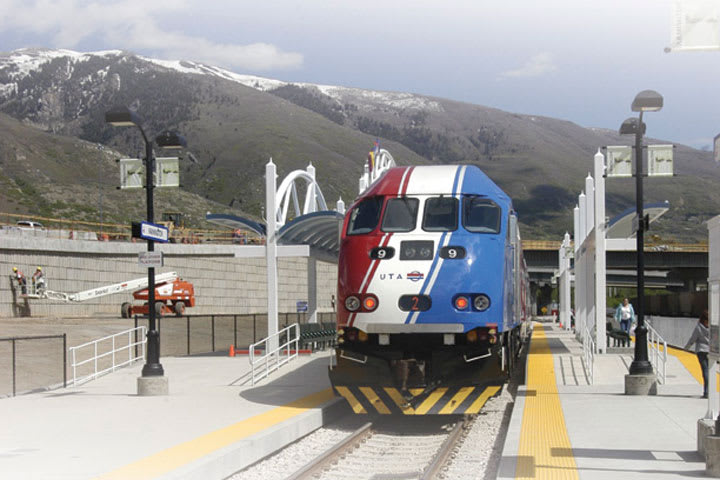
[IMAGE]MET8p36large.jpg[/IMAGE] The next surface transportation bill is rushing headlong into the proverbial “perfect storm.” The winds that are threatening the Federal transit program are coming from so many different directions that it is difficult to know where to start in order to chart a course toward safer seas.
Stormy seas
Understanding the current state of the Federal transit program is
crucial to charting a course to a different future. Thus, outlining some of the
challenges that are roiling the seas is crucial to tacking to a different
direction for the transit program. What are those challenges?
▶ Economic Competitiveness– The nation is in danger of lagging far behind other rapidly growing nations, such as China and India, in our surface transportation systems. While they have not yet caught up to the U.S., they recognize that the sustained growth of their countries hinge on a modern and efficient surface transportation system. To remain competitive, we must invest in the nation’s transit systems, roads, ports and intercity rail systems.
▶Highway Trust Fund– The Federal gasoline tax has not been raised since 1993 and remains at 18.4 cents, of which 2.5 cents is allocated to the Mass Transit Account (MTA) of the Highway Trust Fund (HTF). The average price of gasoline was $1.00 per gallon in December 1993 when the last gasoline Federal tax increase was approved and it was $2.50 per gallon in August 2005 when the Safe, Accountable, Flexible, Efficient, Transportation Equity Act: A Legacy for Users (SAFETEA-LU) was signed into law. It has now risen to more than $4 per gallon in most communities.
Significant efforts were made by the House Transportation and Infrastructure Committee during consideration of SAFETEA-LU to raise the gasoline tax and then index it to inflation. However, these efforts were blocked by the Bush Administration and Congress lacked the political will to overcome the President’s opposition. Consequently, the Congress is now faced with the need to fill an $8 billion to $9 billion gap in FY 2009 and a nearly $20 billion gap in FY 2010 between receipts in the HTF and authorized levels for the highway program.
▶Escalating Capital and Operating Costs– Construction and operating costs are escalating at a rapid pace with little modulation projected for the future. The American Association of State Highway and Transportation Officials (AASHTO) estimates that construction costs increased nearly thirty percent between 1993 and 2006 and are projected rise to 47.9 percent by 2010. Rising fuel prices are only exacerbating this price escalation for construction. Moreover, the rapid increase in fuel costs is also dramatically affecting operating costs for transit authorities.
▶Greenhouse Gas Emissions– The transportation sector is responsible for 33 percent of the nation’s annual CO2 emissions, and those emissions are projected to grow due to rising travel demand. Passenger vehicles and trucks contribute 60 percent of the CO2 emissions in the transportation sector, which is the second largest and fastest growing contributor of greenhouse gases. Since 1980, the number of miles that Americans drive has grown three times faster than the U.S. population and almost twice as rapidly as vehicle registrations.
▶ Energy Independence and National Security– The nation’s land use patterns and increase in driving not only impact greenhouse gas emissions but also result in an increase in the consumption of oil. The Energy Information Agency issued a report in June, which found that world energy demand will grow by 50 percent over the next two decades, resulting in an increase of oil prices to $186 per barrel. Some argue that this estimate is too conservative since oil was approaching $150 per barrel by mid-summer. The transportation sector heavily relies on oil with 95 percent of the U.S. transportation system petroleum-based. More than 60 percent of that oil is imported, with a substantial portion of those imports coming from countries that represent potential national security concerns for the U.S., such as Iran, Venezuela, Saudi Arabia and Nigeria.
▶Changing Demographics– The nation’s population is expected to grow by 50 percent by 2050. The nation’s population will be older, more diverse and comprised of more single than married people. These people will drive less and have a greater need to be closer to necessary services. A surface transportation system that fails to recognize this transition and the impact it has on housing and transportation services will not adequately serve the nation’s population.
[PAGEBREAK]Redefine federal purpose
Congress sought to grow funding
in SAFETEA-LU on the basis of more money for jobs, the need to raise the
gasoline tax and project earmarks for Senators and House members. In the end,
it took seven extensions of the Transportation Equity Act for the 21st Century
(TEA-21) and more than 21 months past the September 30, 2003 expiration date of
TEA-21 before SAFETEA-LU was adopted. There was no increase in the gasoline
tax, modest growth in the Federal program, but underlying purpose of the
program was lost as the principal focus became earmarks, e.g., the “Bridge to
Nowhere.” Clearly, the traditional focus on money and jobs, as well as seeking
to secure support for individual member projects didn’t work, nor will it work
in the future.
While the challenges facing the surface transportation sector and transit industry are certainly daunting, they do represent an opportunity to grow Federal transit funding and expand transit service.
First, we can’t build our way out of congestion. The past two decades have been devoted to transportation investment decisions that have been focused on “managing,” “reducing” or “alleviating” congestion, but congestion has gotten worse. We can’t divorce transportation investment decisions from their impact on land use and development. The effect of these investment decisions has been to lengthen commutes, consume land three times as fast as population growth, and move more and more Americans away from reasonably available transportation alternatives.
Second, the public concern about gasoline prices will not abate. The public is frustrated over the lack of transportation choices. They are very concerned about the declining value of their homes, especially in those suburbs they moved to, thinking it would be cheaper to live there. Now, their out-of-pocket expenses for housing and transportation severely threaten their household budgets. They do not understand that only 18.4 cents of the more than $4 per gallon they are paying is going to the HTF. They only understand it costs them more than twice what it did last year to fill their gasoline tank. Any increase in taxes to support the next surface transportation bill must be linked to clear commitments of an improved transportation system that offers expanded transportation choices.
Third, the price of oil per barrel will only be increasing over time. While we may see some reduction in the cost of oil at the end of the summer driving season, the trend line is only up for the price of oil and the cost of gasoline. Former Bush Administration policy advisor Matthew Semmons made a presentation to the Department of Defense on February 18, 2008 regarding the availability and supply of oil worldwide. His conclusion was that the nation is not at the point where consumption and availability are now at equilibrium (e.g. “peak oil”) and, in the absence of policy changes, the nation would face a future with less oil, causing the need to make choices regarding the use of oil supplies, requiring the need to find alternatives to oil, to pursue ways to conserve the oil that we do have and to “drive less.” Future surface transportation decisions must address how those decisions will reduce the nation’s reliance on oil, especially oil imported from overseas.
Fourth, the growth of greenhouse gas emissions (GHGs) is very real and already impacting our lives through changing weather patterns. The past emphasis on building roads toward the objective of building our way out of congestion has only exacerbated the challenge facing the nation as we seek to reduce the contribution to GHGs made by the transportation sector. Decisions regarding capacity expansions to the nation’s surface transportation system must demonstrate how they will curb the growth in GHGs and reduce travel demand, i.e., vehicle miles traveled (VMT). Further, any future funding source must reward reducing GHGs and VMT. The current gasoline tax is dependent upon consumption and as we transition to a new tax to support the surface transportation system it must encourage conservation.
How do we make the case?
As a board member of the Center for Transportation Excellence, I believe that we must learn from the successes of local referenda, which transit is winning more than 70 percent of the time over the past five years, and realize that the public needs to understand what they are getting from any increases in the taxes they pay. To articulate the goals and purposes, as well as the set of investments that will be made, we need to develop a National Purpose Statement that articulates a clear national purpose for the Federal surface transportation program with a set of performance-based objectives to measure success. If we don’t know where Federal policy is headed, how are we ever going to know if we achieved our goals?
For transit, those goals should be as follows:
▶ Maintain Current Transit Assets– The nation has already invested billions of dollars in our transit systems and those assets must be maintained so that any expansions don’t exacerbate the problem for the future. However, the responsibility for maintaining the nation’s rail and bus systems is not solely a Federal responsibility. While the Federal formula programs must significantly grow to meet this need, State and local governments have an obligation to sustain and grow funding sources as well. We must seek no diminution of local and State funding if Federal funding grows, and should expect non-Federal funding to grow commensurate with the growth in Federal funding.
▶ Provide High Quality Transit Service Within One-Half Mile of All Persons Living Within a Metropolitan Area of 200,000 or More in 20 Years– As household budgets are suffering from a rapid run-up in gasoline prices, the public is also living with local land use and development decisions that don’t provide affordable housing close to job sites and rely on development patterns that promote sprawl. Consequently, when faced with rising gasoline prices the public lacks an alternative form of transportation in many communities.
We must seek Federal policy that expands the investment in transit so that the public is within one-half mile of a bus route that runs with at least 15 minute headways during peak hour, commuter rail service that offers no less than 30 minute headways during peak hour and mid-day service, light rail service that offers at least ten minute headways during peak hour and heavy rail service that operates with at least three minute headways during peak hour. However, to accomplish this, we must reduce the length of the project development and procurement process so that transit systems can actually buy the buses and build the systems to meet this goal. The New Starts program in 2006 took nearly ten years from initiation of alternatives analysis to initiation of construction when it took only five years in 1991.
▶Reduce the Nation’s Consumption of Foreign Oil and Contribute to a Substantial Reduction in GHGs– While increasing transit service will reduce GHGs and VMT by getting people out of their cars and into more energy efficient and environmentally friendly transit service, the full benefits will not be realized until those investments are integrated into regional land use and development decisions that examine the impact of those investments on energy consumption, GHG emissions and reducing travel through changing trip patterns. We must seek to work with local governments to communicate the importance of linking land use decisions with transit investments to ensure that the public has choices and the nation realizes the benefits of reduced energy consumption and a better climate.
▶Demonstrate Energy Savings Through Investment in Cleaner Technology and More Efficient Systems– Many transit authorities have already begun to purchase cleaner buses to respond to the non-attainment status of their community under the Clean Air Act. We must continue that effort. Many transit properties have undertaken examinations of their “carbon footprints.” We must pledge to use the growth in Federal funding to undertake similar examinations in all transit systems and pledge to reduce our “carbon footprints” by at least five percent by the end of the six-year authorization period.
[PAGEBREAK]Expanded transit investment
There is a need for major investment in the nation’s transit systems to reduce our dependence on foreign oil, slow the growth of VMT, reduce GHGs and provide transportation choices to the public. It can’t be accomplished in the absence of significant increases in Federal funding, but we need to grow the number of funding options in the Federal toolbox. To achieve a more than doubling of the size of the transit program in the next authorization bill, we need to examine all of the funding options, including:
▶Raise and Index the Gasoline Tax– The most immediate means to provide the infusion of necessary funding is to raise the gasoline tax by ten cents a gallon and then index it to inflation. However, over time the ability of the gasoline tax to generate the necessary revenues will decline as vehicle fuel economy improves and people drive less in response to rising gasoline prices.
▶Implement Sustainable Funding Sources– Any funding source must capture both the impact of driving on the nation’s roads, while also incentivizing a change in driving patterns. One way that these goals can be accomplished is through an annual national vehicle registration fee that sets the tax based on the weight of a vehicle and the number of miles driven.
▶Capture Future Climate Change Revenues– The 110th Congress is unlikely to adopt legislation to address climate change. However, the 111th Congress is likely to adopt either a cap and trade system, whereby permits to emit various pollutants declines over time and polluters must purchase permits to pollute or seek offsets to their pollution. The auction of these permits will generate funds that will then be distributed into the economy to offset the impact of increasing energy costs and help reduce emissions of GHGs. Since the transportation sector contributes 33 percent of all GHGs and 60 percent of those emissions are from trucks and automobiles, a strong case can be made to invest in transit to help mitigate increasing energy costs and reduce GHGs. Transit must be at the table making a strong case for these revenues, which will most likely not be available until, at the earliest, the very end of the next surface transportation authorization bill.
▶Public-Private Partnerships- Public-private partnerships may generate some additional monies, but they will only supplement the Federal funding needed. Value capture at station areas should be encouraged through tax incentives and enhanced project ratings where transit systems financially benefit from the increase in property values adjacent to stations. Finally, more and more areas are exploring tolls or congestion pricing, but it is essential that transit service be enhanced on toll roads and that transit systems receive a portion of the revenues generated.
Timetable for action
SAFETEA-LU expires on September 30, 2009. This does not give the 111th Congress much time to act. However, with a new President this makes enactment of the next surface transportation bill by the expiration of SAFETEA-LU unlikely. Further, the need to pass some kind of tax increase to ensure expansion will require educating the public over the importance of expanded investment. The hope is that an educated public will create political pressure on the President and Congress to avoid partisan rancor and demonstrate the necessary political courage to create and fund a 21st century surface transportation program that addresses the challenges of the present and the future.
Jeffrey F. Boothe is a partner with Holland & Knight LLP and is chair of APTA’s New Starts Working Group.
More Management

ENC Lands MATA Contract and More in Biz Briefs
In this edition of Biz Briefs, we spotlight the latest developments shaping the future of mobility.
Read More →
From Surviving to Thriving: Building Stronger Transportation Organizations
Bus Business Consultants founder Brian Dickson shares lessons on leadership, organizational health, and creating options for long-term success in a changing transportation industry.
Read More →
Everett Transit, Community Transit Outline Consolidation Agreement
The proposed agreement calls for a 50% increase in bus service in Everett, a new microtransit zone, continued paratransit service, and the transfer of Everett Transit operations to Community Transit.
Read More →
Strada360’s Steve Lassey on Turning Transit Data Into Better Decisions
From breaking down data silos to preparing for AI, Strada360 CEO Steve Lassey discusses how transit agencies can use technology to improve operations, customer information, and long-term decision-making.
Read More →
People Movement: Phil Washington Joins HNTB, Denver RTD Launches CEO Search, and More
In this edition, we also spotlight recent personnel moves at STV, the Eno Center for Transportation, and more, highlighting the people taking on new roles across the transportation industry.
Read More →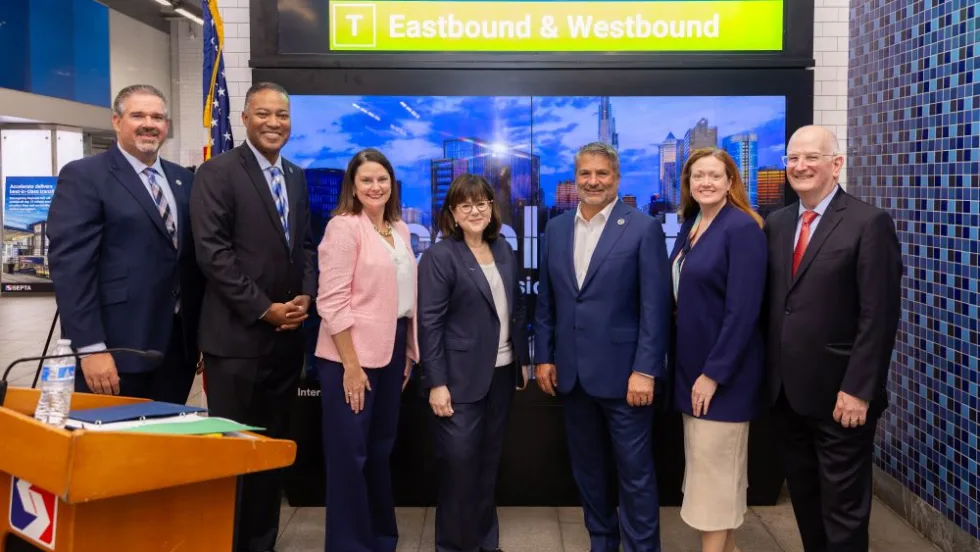
SEPTA Details Accelerate Vision for Transit System
The plan outlines investments in trolley modernization, new Metro and Regional Rail vehicles, accessible stations, and more frequent bus and rail service.
Read More →
FTA Ends Direct Oversight of MBTA Safety Actions
The federal agency closed its remaining special directive to the Massachusetts Department of Public Utilities following a safety review that began in 2022.
Read More →
Report: Transit Bus Manufacturing Supports 34,100 Jobs, $5.1B in GDP
The “Buses Mean Business” report examines the transit bus manufacturing industry’s economic footprint, supply chain, and rising demand for vehicle replacements.
Read More →
LIT Marks 10-Year Milestone at Annual Summit
Hosted by the COTA from September 10 to 13, the Summit carried the theme “Celebrating 10 Years of Excellence, Leadership, and Impact,” with every part of the program honoring the people, agencies, and partners who built LIT over its first decade.
Read More →
People Movement: Dan Dipert Coaches Adds Third-Generation Leader, Keolis Names New Valley Metro VP/GM, and More
In this edition, we also cover recent appointments and announcements at the Wabtec, SilverRide, HNTB, and more, showcasing the individuals helping to shape the future of transportation.
Read More →