



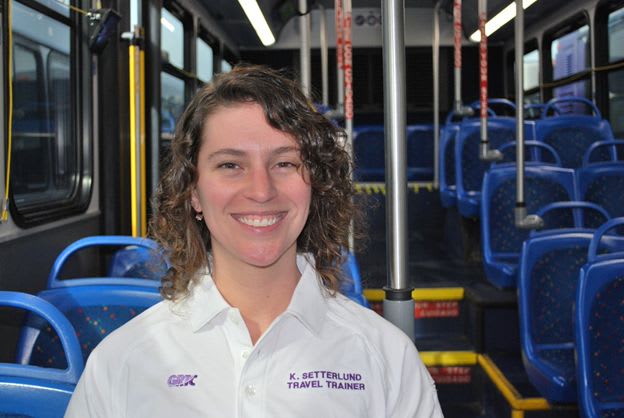
Q&A with Greater Richmond Transit's travel trainer Kelsey Calder
The most important lessons I have learned are how to listen and how to trust.
This article was originally published November 12, 2018.
Travel training is traditionally associated with fixed-route public transportation, but times are changing, and travel training can also benefit passengers using paratransit services for the first time or for travelers who would like to integrate their transit trips with bike-share or ride-hailing services. Travel trainers need skills in understanding human development and behavior and must have the ability to teach the concepts of interaction with the natural and built environment, including interaction with traffic and other travelers.
In this feature, we talk with Kelsey Calder, a professional travel trainer at the Greater Richmond Transit Co. (GRTC) in Richmond, Va. Calder recently received her Travel Training Instructor Certification through Easterseals and the University of South Florida’s Center for Urban Transportation Research, becoming the first nationally certified travel trainer to do so. We asked Kelsey her thoughts on what it takes to get into the travel training field, how travel training helps potential riders, and how transit systems can promote professional development for their staff.
How did you first learn about the career of travel training instructor and what drew you to the field?
At the time, I was teaching in Fairfax County, Va. It was my job to teach work awareness and transition skills to my middle school students in special education. The Washington Metropolitan Area Transit Authority (WMATA) offered a bus and metro orientation, so I signed up all my 30 students. WMATA’s travel training instructors brought a bus out to our school, took us to a metro station, helped us board the metro, and then brought us back to the school. Later, when I saw the job posting appear for the Greater Richmond Transit Company, I knew what a difference the role could make, and I applied immediately.
What were the most important topics you learned while working on your professional certification?
Street crossing. As a special education teacher, I’m familiar with running task analyses, but the number of skills it takes to cross a street is huge. Only after taking my certification courses did I realize how much I took for granted the skill it takes to correctly cross a street. I also learned that the travel training field has been around for more than 40 years. There are many transit systems, public school systems, areas on aging, and more that have been training for many years. In my professional certification courses, I met travel trainers with many more years of experience and had the opportunity to see how travel training works in their areas.
Your job is to assist others learning how to use transit, but what lessons have you learned from your trainees?
I’m lucky to be able to offer travel training services to not only people with disabilities and seniors, but also to anyone in the Richmond area over the age of 15. My trainees are diverse and come with many ability levels. The most important lessons I have learned are how to listen and how to trust. Travel training is designed to truly help the trainee, so it’s important that I make sure the trainee will use the route, which includes making sure he or she feels safe and comfortable. I also need to trust that my trainees know when they are ready to travel independently. When I first started training, I was extremely hesitant to let go of control and trust my trainees, even when they consistently demonstrated the needed skills. Now I’m more willing to trust my trainees when they say they are ready to travel independently.
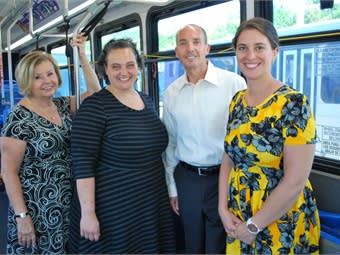
L to R: Roberta Yegidis, Center for Urban Transportation Research (CUTR); Kristi McLaughlin, Easterseals Project Action Consultant; David Green, former GRTC CEO; and Kelsey Calder, GRTC Travel Training Instructor.
What practical advice do you have for people who are considering getting into the travel training field?
You don’t have to be a public transit expert to enter the field, instead you can learn by doing. When I started my job, I was aware of GRTC but rarely used it. I had used other transit systems throughout world, but I had never really used the one in my own backyard. Because I had to learn how to use the bus in my area, I had many of the same questions as my trainees and it made it easier to connect with them. Now that I am very familiar with the GRTC system, I use the bus frequently for work and personal use and encourage all my friends and family to do the same.
How can transit system managers best support their travel trainers from a professional development practice?
Particularly in the travel training field, I believe in-person professional development opportunities are the most beneficial. While they can be costlier and require travel, they are often the most educational and impactful. When in-person opportunities are not available, webinars can serve as an alternative because they cost less and are sometimes free. When I first started, I signed up for every free webinar that resembled something close to travel training. Even though those were not in-person professional developments, webinars often offer a comment box that allows for communication and comradery. I would also suggest that transit system managers allow their new travel trainers to visit an established program (maybe another transit system or a local agency providing training) to see how they work and to meet at least one experienced travel trainer.
Any final thoughts on the role of transit travel trainers in the next five years?
The demand for transit travel trainers is growing and will continue to increase as people age in place, the number of group homes increase, and as the public increasingly opts for alternative transit versus driving a car. The various ability levels of each transit riders will determine what type of training is needed, but demand for training overall will increase. When I first started I was focused mainly on serving adults with disabilities and seniors. Within my first year, I noticed how many other people in Richmond would take the bus but needed assistance, which is why we opened the program up to anyone 15 or older. With the transit system providing travel training, it also alleviates the burden of other local agencies to provide travel training to their clients in addition to all the other services those agencies provide. The program is providing an incredible service to city, the community and the people of Richmond, and I’m honored to be a part of it.
Rachel Beyerle is the Communications Director, Transportation Group for Easterseals.
More Paratransit

Biz Briefs: RIPTA Unveils New Frontrunners, Clevland RTA Adds New Siemens, and More
In METRO's latest installment, we take a look at recent news from Siemens, Prevost, Dodge, and more partnerships making headlines across the transportation sector.
Read More →
King County Metro Makes ADA Paratransit Easier to Navigate
METRO's Innovative Solutions Award winner replaces complex service-area descriptions with an accessible, interactive map that puts paratransit information directly in customers’ hands.
Read More →
Jacksonville’s NAVI Project Charts a New Course for Autonomous Public Transportation
Through its NAVI program, JTA is showing how autonomous vehicles, intelligent infrastructure, and coordinated operations can work together to deliver everyday public transportation.
Read More →
Driving Smarter Paratransit
John Hanlon shares how AlphaRoute is leveraging AI-powered technology to help paratransit providers optimize operations, support frontline staff, and enhance the rider experience.
Read More →
METRO Magazine Announces 2026 Innovative Solutions Awards Winners
Projects Recognized for Advancing Mobility Through Technology, Accessibility, Workforce Innovation, and Operational Excellence
Read More →
Biz Briefs: STV teams with Amtrak, Motorcoach Operators Boost Fleet and Land Contracts, and More
From manufacturers and suppliers to transit agencies and motorcoach operators, these updates offer a snapshot of the projects, partnerships and business moves driving the industry forward.
Read More →
Biz Briefs: Masabi Teams with St. Louis Metro and More
In METRO's latest installment, we take a look at recent news from Transdev, Hitachi, and more partnerships making headlines across the transportation sector.
Read More →
New York MTA Leverages Zoning Program to Advance Station Accessibility
Accessibility enhancements at Nevins St Station will be financed through a development agreement tied to the MTA's Zoning for Accessibility initiative.
Read More →
Reinventing Fleet Maintenance with Real-time Visibility and AI
Transit leaders need to know what needs fixing, where to look, who is responsible, when work is completed, and what it costs without having to chase information across disconnected systems.
Read More →
SamTrans Sets Priorities for Potential Connect Bay Area Revenue
The board-approved framework allocates future funding to maintaining service, rider improvements, equity initiatives, and infrastructure repairs.
Read More →