Simplifying your Bike Transport Program through Ever-Evolving Bicycle Trends
As trends in consumer bicycles continue to evolve, so does the importance of adapting bicycle transport to support these new, innovative designs.
by April Johnson, VP of Sales & Marketing, Sportworks
May 16, 2024
Weight, size, and tire widths are all variables that are critically important to consider for efficient and safe transport of bicycles on transit buses and railcars.
Photo: Sportworks
4 min to read
More than 30 years ago, Sportworks pioneered the inaugural “bike rack for buses” — a groundbreaking solution enabling a seamless journey between bike and bus.
As trends in consumer bicycles continue to evolve, so does the importance of adapting bicycle transport to support these new, innovative designs.
Ad Loading...
Weight, size, and tire widths are all variables that are critically important to consider for efficient and safe transport of bicycles on transit buses and railcars.
In this equation, the selection of bike racks becomes crucial. It's not merely about facilitating transportation for the first and last mile while prioritizing rider and bike safety; it's also about streamlining the responsibilities of operators.
Ultimately, a versatile bike rack alleviates the constraints and regulations operators need to manage.
We've gathered some frequently asked questions to help you better understand the changing landscape of bikes and how to create an optimal journey for transport.
Q1: Why are E-bikes suddenly so popular?
Americans spent over one billion dollars on E-bikes last year. E-bikes have quickly gained popularity as a practical and efficient mode of transportation, contributing to reduced traffic congestion and improved air quality, among other benefits.
Ad Loading...
The electric-assist features of E-bikes empower riders with diverse athletic abilities to easily conquer hills and cover longer distances at increased speeds.
In some instances, riders can reach their destination faster than by car — all without breaking a sweat. This not only makes cycling a viable mode of transportation for a broader demographic but also promotes sustainability, contributing to the reduction of carbon footprints.
Q2: Do traditional bus bike racks support E-bikes?
Given the electric components, E-bikes often weigh more than their non-electric counterparts, typically ranging from 35 lbs. to 65lbs. In comparison to the standard road bike weight of 18 lbs. to 25lbs. — it's crucial to ensure that the bike rack can support the additional weight. While many older racks accommodate bikes up to 55lbs., this may not be sufficient.
Sportworks' Apex rack is the only transit bike rack rated to carry bikes up to 75lbs. This weight limit applies to each position, allowing a three-position rack to carry up to three bikes, each weighing 75lbs. This capability simplifies bike-on-bus rules and facilitates the hassle-free transport of E-bikes.
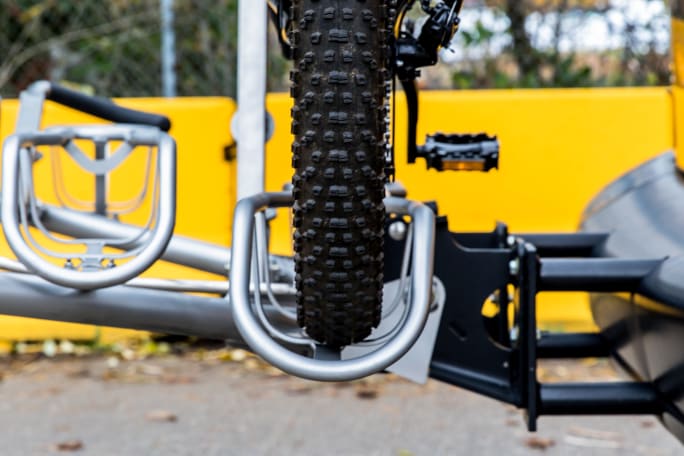
To support the additional weight, E-bikes often feature wider tires compared to non-electrified bicycles. It's common to find E-bikes with tires ranging from two to three inches wide, or even wider, with some being categorized as “fat bikes,” due to tires measuring four inches or more.
Ad Loading...
Addressing these broader tire dimensions, the Apex rack comes equipped with standard trays capable of accommodating up to 3.2-inch wide tires. For those with even wider tires, optional Fat Tire trays and arms are available, designed to carry bikes with tires up to 5.5-inches wide.
A versatile bike rack alleviates the constraints and regulations operators need to manage.
Photo: Sportworks
Q3: Are longer bikes supported?
The trend toward longer bikes, known for providing enhanced stability, is also on the rise. Full suspension bikes, often reaching lengths of up to 51 inches, are gaining popularity.
Electric bikes, with wheelbases typically ranging from 46 inches to 48 inches, and electric mountain bikes, often full-suspension and measuring 47 inches to 51 inches, also contribute to the demand for longer bike racks.
Apex racks are meticulously designed to accommodate these varying lengths. The standard trays can carry wheelbases up to 48 inches, suitable for road, gravel, hardtail mountain bikes, many full-suspension bikes, and the majority of electric bikes.
For the longest bikes, including larger full-suspension bikes, both electric and non-electric, the fat-tire trays and support arms are available, allowing secure transport of bikes with wheelbases up to 51 inches.
Ad Loading...
Q4: We are considering increasing capacity through interior racks; what factors should we consider specifically for accommodating E-bikes?
Interior racks, much like their exterior counterparts, often come with weight limits. It's crucial to consult the manufacturer's specifications and provide clear guidelines for riders, if necessary.
For seamless stowing of E-bikes, a roll-in and roll-out design is recommended. Racks with this design usually lack a strict weight limit, accommodating various bike types effectively. This style is particularly advantageous when maximizing capacity in confined spaces.
Take, for instance, the SpinLock, which features a range of risers and ramps, enabling compact placement while ensuring sufficient clearance to prevent handlebar and pedal interference between bikes.
Q5: Why do riders choose mountain or fat-tire bikes?
Mountain bikes are versatile over any terrain, taking in the bumps and rougher roads — making them a lot of fun off-road and when tackling the curbs and potholes of the asphalt jungle.
“Fat bikes” have tires four inches in width or wider. These bikes, often equipped with low-pressure tires, gracefully glide over soft sand and snow, unlocking new cycling terrain, especially in mountain and beach communities.
Ad Loading...
Initially designed to accommodate large hub-drive motors, some early electric bikes adopted the four-inch tire style, reminiscent of a "monster truck." Modern trends, however, reveal a shift towards narrower tire widths as electric motors become more compact.
In urban settings, heavier E-bikes tend to accelerate faster, posing challenges in avoiding potholes and uneven surfaces. To enhance comfort in such conditions, wider tires are favored. These bikes have gained popularity for commuting, cargo transport, and family rides.
Given the advantages they offer, wider tires are emerging as a popular choice for both commuting and recreational cycling, catering to a diverse range of riders and riding preferences.
CEO Magnus Friberg discusses Luminator’s shift toward becoming a digital partner, the growing importance of software and interoperability, and how AI can help agencies improve operations and passenger experience.
Reliability-Centered Maintenance helps transit agencies move beyond routine checklists to focus limited resources on the assets and failures that have the greatest impact on safety, reliability, and service.
More than 1,500 buses now feature upgraded technology designed to improve arrival predictions and provide free Wi-Fi, with deployment expected to reach nearly 2,000 buses by the end of 2026.
John Hroncich discusses BAE Systems’ modular and scalable approach, lessons learned from decades of real-world operations, and how agencies can identify electrification strategies that fit their fleets.
In METRO's latest installment, we take a look at recent news from Complete Coach Works, Beep, FlixBus, and more partnerships making headlines across the transportation sector.
What if transit leaders could ask any operational question and get a trusted answer in seconds? Conversational AI is transforming how agencies use their data.
More than $191 million in federal funding will help three transit agencies replace aging rail vehicles and support a new autonomous shuttle service in Chattanooga.
LA Metro’s Obed Mejia discusses technician training, evolving maintenance technology, fleet replacement, and strategies for getting the most out of today’s transit fleets.
In METRO's latest installment, we take a look at recent news from Siemens, Prevost, Dodge, and more partnerships making headlines across the transportation sector.
Pedestrian microsimulation is helping rail planners identify bottlenecks, test station designs, and prepare complex transit hubs for growing passenger volumes.