



States ‘Up Their Game’ with Enhanced Intercity Bus Offerings
Testing new reservation options, improving apps and text alerts, strengthening links to Amtrak, and devising creative campaigns to boost traffic are just some of the ways operations like Colorado’s Bustang, Oregon’s POINT, and Virginia Breeze are finding success in the market.
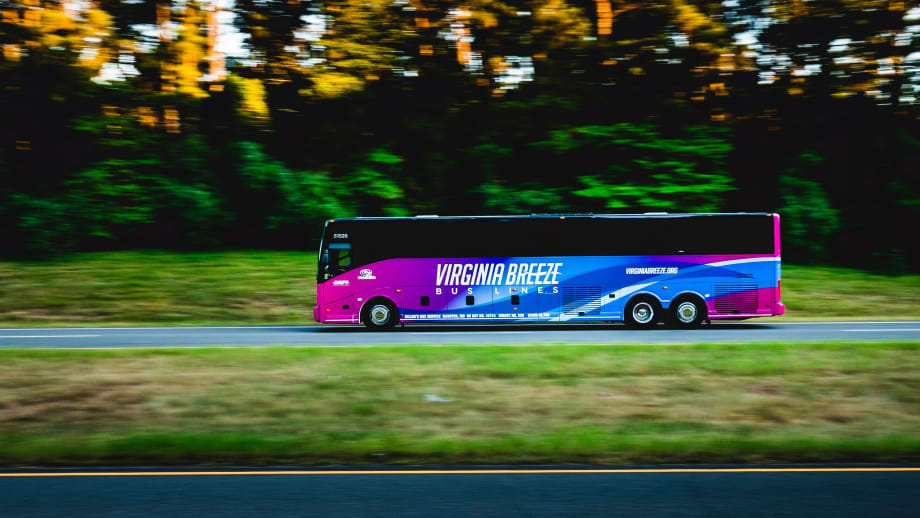
Regional networks rely on state and federal financial support and cooperation from private bus lines that often operate the service under contract.
Photo: DPRT
- Operations like Bustang, POINT, and Virginia Breeze are enhancing intercity bus services by testing new reservation systems and improving mobile apps.
- These services are strengthening their connections with Amtrak to offer more integrated travel options.
- Creative campaigns are being developed to increase passenger traffic and improve service visibility.
*Summarized by AI
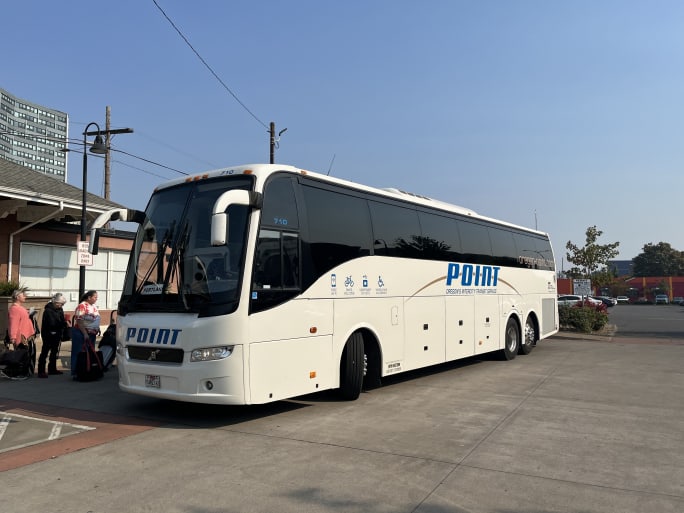
Public funding for the Oregon POINT bus service has allowed for strategically filling gaps in the Portland –Eugene, Ore., train schedule, creating eight daily options.
Photo: ODOT
Gone are the days when schedules, stop locations, and promotional practices were frozen mainly in place from year to year. Instead, state-run bus lines are mixing it up, testing new reservation options, improving apps and text alerts, strengthening links to Amtrak, and devising creative campaigns to boost traffic.
“The expanding bus systems of state governments deserve more attention than they are receiving for their innovation and adept marketing,” noted Mark Szyperski, CEO of On Your Mark Transportation LLC, a bus-travel consultancy. “So much is happening that it can be hard to keep track.”
These stepped-up efforts pay off for large, branded bus systems like Colorado’s Bustang, Oregon’s POINT, and the Virginia Breeze.
Each has seen traffic rebound sharply since the pandemic and has cultivated public support to allow for ambitious expansions. State networks are also instrumental in assuring that bus passengers have access to terminals with indoor waiting, off-street boarding and aligning, and other amenities.
“State-run bus systems are helping the entire intercity bus system gain more visibility among travelers who aren’t accustomed to riding scheduled motorcoaches,” according to Brian Antolin, an intercity bus expert and CEO of CoTo Travel, echoing a theme in our DePaul University 2025 Outlook for the Intercity Bus Industry report.
These regional networks rely on state and federal financial support and cooperation from private bus lines that often operate the service under contract.
Federal support comes primarily from the USDOT’s 5311f program, which is designed to support linking cities with populations below 50,000 to the national bus network, which is widely known for such brands as Greyhound, Trailways, and Jefferson Lines. This long-overlooked program has generated much attention recently due to the federal policy's unpredictable ebb and flow.
Funding in fiscal year 2024 was just under $141 million, according to Fred Fravel, VP at KFH Group. The firm is exploring the state role in intercity bus service in a project for the Transit Cooperative Research Program.
Branded State Systems “Up Their Game”
The Virginia Breeze, a four-route system centering on Washington Union Station, captured the spotlight last year for its ridership gains. However, the line’s success is due to far more than offering comfortable and reliable service.
Several needs assessments laid the groundwork for success with ridership projections, estimated costs per bus mile, and community surveys, helping evaluate potential routes. The state’s Department of Rail and Passenger Transportation (DRPT) continuously tracks traffic trends and operational challenges.
Such planning is paying dividends: Virginia Breeze is set to launch its fifth route, its first east-west offering, this summer. The new Tidewater Current will connect Harrisonburg and Virginia Beach with stops in Norfolk, Newport News, Williamsburg, Richmond, and Charlottesville.
Moreover, a new program with North Carolina’s Department of Integrated Mobility allows passengers to make interline connections for tickets purchased on megabus.com. Customers can travel between North Carolina, Virginia, and Washington, DC on a single ticket by connecting on a new, twice-daily connecting route, the Triad-Danville Connector, supported by North Carolina.
The Connector, operated by Sunway Charters, links Winston-Salem, N.C., to Danville, Va., the southernmost point on Virginia’s system, and offers well-timed transfers at Danville, sometimes as short as 15 minutes.
The expansion of Colorado’s state-operated Bustang, which now crisscrosses the Centennial State at high frequency, is also the product of much technical analysis.
Comprehensive statewide studies have evaluated opportunities to improve travel in the congestion-ridden I-70 mountain corridor. These favorable critiques set into motion last year’s tripling of Bustang service on its West Line between Denver and Vail and Grand Junction.
The service skyrocketed from four to 15 trips daily. (Our review found that this is the greatest frequency by any bus line on any long-distance route outside the U.S.’s coastal regions) — Doubling from six to 12 weekday trips on the North Line between Denver and Fort Collins and the South Line between Denver and Colorado Springs. Similarly, weekend service on both these routes grew from two to six.
The expansion necessitated large-scale investment and fleet expansion.
Bustang’s operator, ACE Express Coaches, part of All Aboard America Holdings, reportedly hired 50 employees while the state procured 25 new motorcoaches to facilitate this expansion. Bustang’s app was improved, and multi-ride tickets (for up to 40 riders) were offered to encourage traveler loyalty.
The state also built a new “Mobility Hub” on I-25 near Longmont and Loveland. The center-loading hub allows buses to make stops without time-consuming diversions from the expressway and is designed to reduce traffic congestion and pollution. It was installed as part of the I-25 North Express Lanes Project.
These services are in addition to Bustang Outrider, Pegasus, and Snowstang services, which generally run with vans and other smaller vehicles. Bustang handled 290,700 passengers during the 12 months ending in June 2024 and is projected to hit 325,600 this year — the 10th anniversary of its operations.
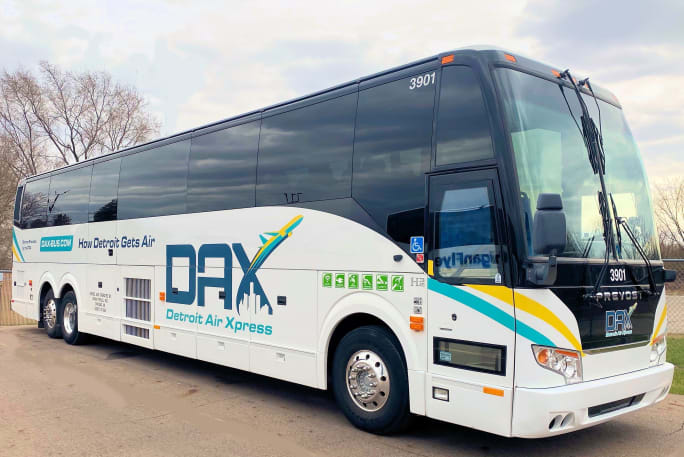
Another notable airport example is Michigan’s publicly supported motorcoach shuttle pilot, Detroit Air XPress, between downtown Detroit and the Detroit Metro International Airport.
Photo: Michigan Flyer
Buses, Trains, and Planes
“Opportunities to connect to trains and planes are growing but still underdeveloped in many parts of the country,” noted Szyperski.
Oregon and Washington State, however, point the way to better bus-rail integration. In late 2023, Amtrak Thruway bus service on the Seattle—Vancouver route grew from two to four, supplementing the two daily trains.
“The hallmark of this schedule is attractively spaced options throughout the day, something lacking on many major routes,” noted Zaria Bonds, co-author of our 2025 Outlook for Intercity Bus Industry report.
Oregon uses a similar strategy on the Cascade corridor’s southern end. Public funding for the Oregon POINT bus service has allowed for strategically filling gaps in Portland – Eugene, Ore., train schedules, creating eight daily options. This route accounts for about 70% of POINT ridership and has seen dramatic increases in bus ridership, now approaching record levels.
Similarly, bus lines in the Northeast, including Adirondack Trailways and Vermont Translines, which connect with Amtrak at various Upstate New York stations, are seeing strong ridership on buses that provide timely train connections.
Antolin noted that efforts to use state-supported bus lines to expand airport access haven’t gained as much traction, despite the absence of scheduled intercity bus service at many airports. Recently, however, the tide appears to have turned.
Bustang launched the Denver International Airport service last year. GoBus recently stepped up service to Columbus, Ohio’s international airport, and Virginia Breeze buses stop at either Washington Reagan or Dulles International airports.
“These states are running with the precedent established by Massachusetts with their BusPlus program in prioritizing multimodal connections at airports," Antolin adds.
Another notable airport example is Michigan’s publicly supported motorcoach shuttle pilot, Detroit Air XPress, between downtown Detroit and the Detroit Metro International Airport. Operated 16 times daily by Indian Trails, the service pilot complements the state-funded Michigan Flyer service linking the airport to Ann Arbor, East Lansing, and other points.
“DAX is a game changer for travel to Metro Detroit,” noted Claude Molinari, president of Visit Detroit.
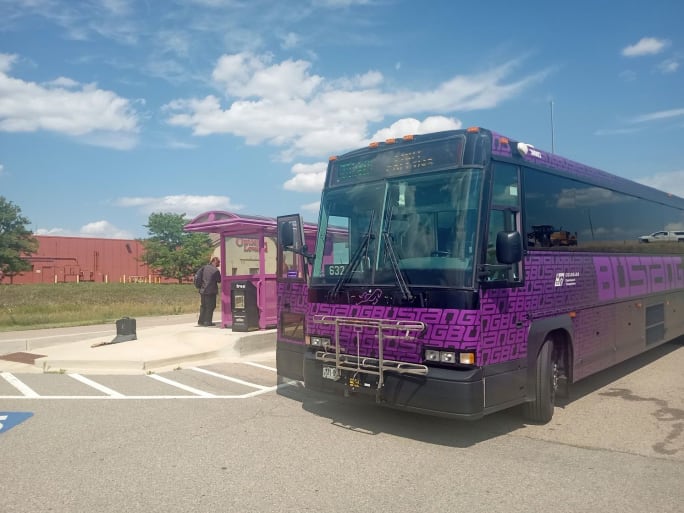
The expansion of Colorado’s state-operated Bustang, which now crisscrosses the Centennial State at high frequency, is a product of much technical analysis.
Photo: Joseph P. Schwieterman
Solutions for Stations
Like their commercial counterparts, state-supported bus lines continue to grapple with the closing of traditional intercity bus stations. Traffic can suffer after shifting operations to curbside stops.
FlixBus, Greyhound, Trailways, and other commercial providers are searching for solutions to festering terminal issues, hoping to find attractive and affordable alternatives when stations can’t be saved.
Bus lines have successfully moved to downtown transit centers in some cities, including Austin, Texas; Richmond, Va.; and Tampa, Fla. Critical questions remain, such as the future of Chicago’s intercity bus (Greyhound) station, used for commercial services and publicly supported routes serving Illinois, Indiana, and Iowa.
Fortunately, more state and local governments are assisting in solving the problem. Some notable examples:
- In Ohio, Barons Bus and Greyhound plan to relocate from the historic Cleveland Greyhound Station to the Brookpark Transit Station on the city’s Red Line transit route near its international airport. A high-quality Cleveland facility is critical to Ohio’s GoBus system, which Barons operates.
- Georgia’s state government facilitated the construction of a new Atlanta Greyhound Station, which opened in phases in 2023 and boasts natural light from its large windows, a food stand with a grill, spacious restrooms, and a digital departure board. Airport-style seating with power outlets, USB chargers, armrests with cupholders, and cushioning add to passenger comfort.
- In Massachusetts, state agencies support major improvements to the Boston South Station Bus Terminal, a project linked to a new office building built over railroad platforms. This will expand the terminal’s footprint by 50% and allow for improved transit connections at South Station. After some delays, completion is expected this year.
- Michigan’s state government stands out for investing in stations jointly used by buses and trains. Attractive multimodal facilities in Battle Creek, Grand Rapids, and Kalamazoo benefit bus and train riders, and planning continues for a new multimodal station in Detroit.
“Intrastate bus systems are having success building the political support needed to avoid the pitfalls of unpredictable budget cycles,” concluded Antolin.
Although funding is never certain, these systems have the advantage of being less affected by the impending “fiscal cliff” that seems destined to create significant hardship for urban transit networks due to the end of pandemic-era federal funds.
“As more customers gain familiarity with all the new services, the possibility of more traffic growth will make the next several years an exciting time,” Szyperski added.
Joseph P. Schwieterman, Ph.D., is the director of the Chaddick Institute for Metropolitan Development at DePaul University and author of the 2025 Outlook for the Intercity Bus Industry. Readers can sign up for his free Intercity Bus E-News newsletter at chaddick@depaul.edu
Quick Answers
States are enhancing intercity bus services by testing new reservation options, improving apps and text alerts, strengthening links to Amtrak, and implementing creative campaigns to boost traffic.
*Summarized by AI
More Motorcoach

METRO Opens Submissions for 2026 Motorcoach Awards
Nominations are now being accepted for METRO Magazine’s Operator of the Year and Innovative Operator of the Year awards.
Read More →
Biz Briefs: Alstom Lands Canadian Contract, LYT to Supply California TSP, and More
In METRO's latest installment, we take a look at recent news from Complete Coach Works, Beep, FlixBus, and more partnerships making headlines across the transportation sector.
Read More →
Biz Briefs: RIPTA Unveils New Frontrunners, Clevland RTA Adds New Siemens, and More
In METRO's latest installment, we take a look at recent news from Siemens, Prevost, Dodge, and more partnerships making headlines across the transportation sector.
Read More →
People Movement: Holly Arnold Joins Transdev and More
In this edition, we also cover recent appointments and announcements at Pace, CamTran, MCI, and more, showcasing the individuals helping to shape the future of transportation.
Read More →
ABA Report: Motorcoach Travel Generates $161.6B Economic Impact
The 2025 analysis finds motorcoach travel supported nearly 900,000 jobs and generated $28 billion in federal, state, and local taxes.
Read More →
CharterUP’s Armir Harris on Technology, AI, and the Future of Group Mobility
In a recent episode of METROspectives, CharterUP Founder/CEO Armir Harris discussed the company’s evolution from an online charter bus marketplace into a technology platform supporting public- and private-sector mobility and much more.
Read More →
People Movement: ABC Names John Walsh as Chief Commercial Officer
In this edition, METRO also covers recent appointments and announcements at the DART, STV, and more, showcasing the individuals helping to shape the future of transportation.
Read More →
From Surviving to Thriving: Building Stronger Transportation Organizations
Bus Business Consultants founder Brian Dickson shares lessons on leadership, organizational health, and creating options for long-term success in a changing transportation industry.
Read More →
Biz Briefs: Luminator Marks Milestone and More
From manufacturers and suppliers to transit agencies and motorcoach operators, these updates offer a snapshot of the projects, partnerships and business moves driving the industry forward.
Read More →
ABAF Study Reveals Growing Insurance Crisis for Motorcoach Operators
Preliminary findings show 98% of operators faced premium increases over the past five years, while shrinking insurer participation is putting added pressure on businesses and customers.
Read More →