



Streetcar Projects Continue Breaking Ground Despite Uncertain Federal Future
Federal officials look at new rules to make streetcars more eligible — but overall funding may be cut in budget battles.
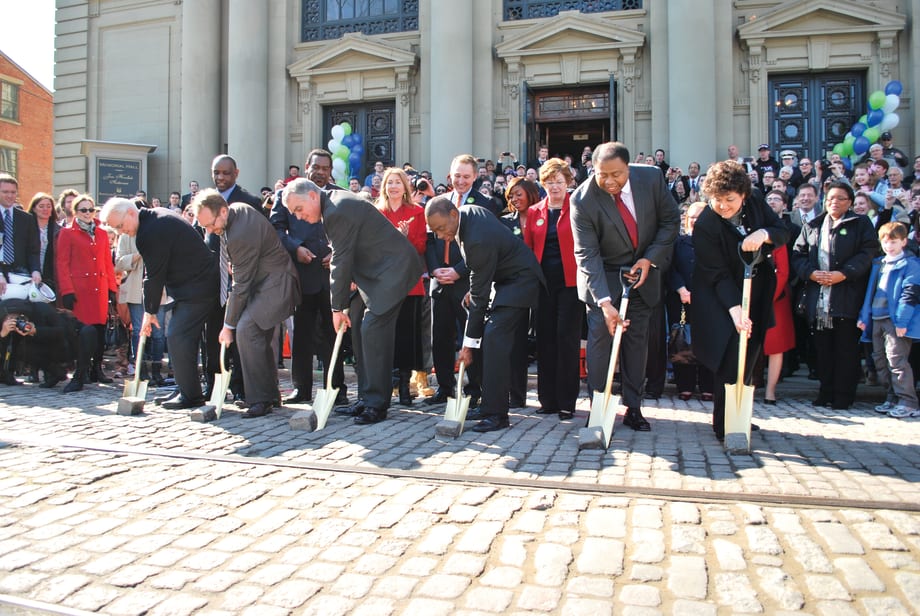
The progress of Cincinnati's streetcar project could be viewed as a microcosm of the re-emergence of the oldest mode of urban rail service.
After rejection of state funding by Ohio Gov. John Kasich as one of the first acts of his new administration, the ensuing re-scoping of the project and a defeat of a local ballot initiative to kill it completely, construction of the starter segment of the Cincinnati Streetcar is finally under way. The local water utility, Greater Cincinnati Water Works, is relocating the water mainline so that the shallow-trench track construction can begin.
Overcoming opposition
The project was much bigger at the time that the U.S. Department of Transportation (U.S. DOT) awarded the project a $25 million Urban Circulator grant in 2009, part of the FTA's, EPA's and U.S. Department of Housing and Urban Development's Liveability Initiative. Some observers believe that Gov. Kasich, elected in the conservative backlash that swept the 2010 elections, singled out the streetcar project for cuts because of its high profile in the Obama Administration's Livability policy. After all, it was given the highest rating of all transportation projects in the Buckeye State by a nonpartisan panel charged with evaluating projects for state funding.
However, it is also worth pointing out that the recently defeated referendum attempting to kill the project was also supported by the local chapter of the National Association for the Advancement of Colored People (NAACP), not exactly a right-wing interest group. The NAACP was against it due to some concerns about gentrification that might be brought about by the urban renewal that is expected to result.
Once the referendum was defeated, U.S. DOT officials supplemented the earlier Urban Circulator Grant with a Transportation Investment Generating Economic Recovery (TIGER) grant. This one was for $10.9 million. The rest of the $110 million project cost will be city municipal bond proceeds, some in-kind, and cash private sector contributions as well as a Congestion Mitigation and Air Quality grant from the federal highway program.
As with most modern streetcar projects, construction is proceeding one city block at a time and will be completed quickly, which generates a catalyst for economic development that is faster and often far greater than with other modes, according to several studies of streetcar systems in the U.S. Vehicular and pedestrian traffic will be maintained during construction in each block, because both a lane of traffic and the sidewalk remain open. Revenue service is anticipated to begin in 2014.
First segment
The first segment consists of five modern streetcars operating along a couplet (circulator route) configuration, comprising four miles of single track in one direction. This starter segment includes 18 stops. The schedule will involve 10-minute headways at morning and afternoon peaks and 20-minute headways during off-peak times. The operating schedule is 16 to 18 hours per day, seven days per week.
Future extensions will include a connection and circulator through Cincinnati's Uptown area, the region's second largest employment center and home to the University of Cincinnati, Cincinnati Children's Hospital and the Cincinnati Zoo.
Although the City of Cincinnati is the project sponsor and owner, the Southwest Ohio Regional Transit Authority (SORTA) will operate the system through an Intergovernmental Agreement. SORTA is also the FTA grantee that received the Urban Circulator grant and will manage both that and the other federal grants, including the TIGER grant and the flexible funds from the highway program being used to fund the first segment.
"From day one, the Cincinnati Streetcar has been the little engine that could, and I am so proud of the community and its leaders for standing up on behalf of this important project and shepherding it through to this critical milestone." says Secretary of Transportation Ray LaHood. "The story in Cincinnati is about a community coming together, setting its priorities, and not being dissuaded by the naysayers or those who don't want progress."
LaHood and others supporting streetcar projects do so as investments in the future of cities, accelerating development and revitalizing the urban core of cities that undertake them. They look to the billions of dollars in economic development accelerated around the streetcar lines built in such diverse places as Portland, Ore.; Seattle; Little Rock, Ark.; Kenosha, Wis.; and Tampa, Fla. Moreover, they also look at the attraction redeveloped urban neighborhoods have in a changing economy, particularly to young professionals desiring a more walkable, diverse lifestyle. Because of this latter point, many cities see streetcars and the attendant urban redevelopment strategies as part of their overall economic strategies to attract industries looking to hire younger, more educated populations.[PAGEBREAK]
Breaking ground
Cincinnati's streetcar is not the only such system breaking ground this year. The St. Louis Loop Trolley is another Urban Circulator grant recipient, and it will also do so this year. Project officials there also expect to open in 2014.
Seattle's second line, the 2.2-mile First Hill Streetcar, is another streetcar breaking ground in 2012, though it is scheduled to open a year earlier, in 2013. However, this line is funded entirely with local funds, part of the ST2 referendum that voters approved in 2008. The Emerald City's first modern streetcar line, the South Lake Union project, was also funded virtually entirely with nonfederal funds, save for a small federal earmark it got in the days when those were still politically possible in Congress.
In addition, Atlanta's 2.3-mile Downtown Streetcar, from Martin Luther King Jr. National Historic Site to Centennial Olympic Park also began construction. It is also scheduled for revenue openings next year.
Three other streetcar projects that benefitted from TIGER grants are Tucson's 3.9-mile Modern Streetcar from the University of Arizona's campus to Downtown Tucson; Salt Lake City Sugar House Streetcar (2-mile system); and the 2.5-mile French Quarter Expansion Project in New Orleans, from Canal Street to Esplanade Avenue. The Tucson and New Orleans projects are also expected to open next year, while the Sugar House Streetcar is slated for a 2014 debut.
Many other streetcar projects are in varying stages of development. They include a downtown streetcar in Los Angeles; a circulator service Tyson's Corner in Northern Virginia, another circulator in Providence, RI; two streetcar projects in Dallas; and streetcar projects in Ft. Lauderdale, Fla., and Santa Ana, Calif. In addition, four other projects in the greater Washington, D.C., area are in development, two in the District itself (part of a larger network that is envisioned) as well as two other projects just outside D.C. in the Northern Virginia suburbs of Arlington. While all of these will require some federal funding assistance, another, the project for downtown Oklahoma City, may be able to be funded entirely with local funds thanks to a referendum voters passed in the city in 2010.
Cloudy picture
Like most major capital investment projects in public transportation, the full expansion of streetcar investments throughout the country will require policies to fund them. Unfortunately, the highly divisive political climate in Washington, D.C., may actually eliminate all discretionary transit funding, let alone an expansion, if conservatives in the House of Representatives have their way. Many of them question the rationale for a federal role in urban transportation funding. Even the Urban Circulator Program, started by the FTA using the exempt projects section of existing law in the Major Capital Investment Program, is under threat in this climate.
More Rail
Amtrak, CN Reach Agreements to Strengthen Passenger Rail Service, Safety
The agreement resolves a more than decade-long proceeding before the Surface Transportation Board concerning the terms and conditions for Amtrak services, such as the City of New Orleans, Illini/Saluki, and Wolverine.
Read More →
New York MTA Advances Final Contract for Second Avenue Subway Expansion
Contract Four is the largest in the Second Avenue Subway Phase 2 project and includes construction of station infrastructure, tracks, and signals for the subway expansion, MTA officials said. Work on Contract Four will begin in 2027.
Read More →
San Diego MTS Breaks Monthly Trolley Ridership Record
Agency officials said July’s ridership indicates MTS’s continued recovery from the pandemic.
Read More →
Report Examines NJ TRANSIT Reliability, Funding Challenges
The Garden State Initiative analysis examines the roles of Amtrak infrastructure, fleet management, and agency operations while recommending a more performance-based approach to improving reliability.
Read More →
Stadler, CapMetro Sign Long-Term Rail Fleet Support Agreement
Beginning in 2027, Stadler will provide on-site technical expertise, spare parts support, training, and obsolescence management to help extend the reliability and longevity of CapMetro’s GTW fleet.
Read More →
Biz Briefs: Alstom Lands Canadian Contract, LYT to Supply California TSP, and More
In METRO's latest installment, we take a look at recent news from Complete Coach Works, Beep, FlixBus, and more partnerships making headlines across the transportation sector.
Read More →
CATS Gold Line Marks 5 Years of Service, 2.8M Passenger Trips
With a six-mile expansion planned, the Charlotte streetcar is positioned to connect more neighborhoods and major transit hubs across the region.
Read More →
Why Simulating Pedestrian Movement Has Become Essential for Modern Rail Stations
Pedestrian microsimulation is helping rail planners identify bottlenecks, test station designs, and prepare complex transit hubs for growing passenger volumes.
Read More →
Amtrak Begins Major Construction at New York’s Sunnyside Yard
The new maintenance facility will support Amtrak’s Airo trainsets while improving maintenance efficiency and turnaround times in New York.
Read More →
Chicago Leaders Unveil Plans for O’Hare Airport Express Train
The privately developed project would offer a 15-minute trip between downtown and O’Hare’s Terminal 2, with trains operating every 15 minutes on a dedicated track. The service would use battery-electric trains and three existing freight rail rights-of-way.
Read More →