



The Race for Better Stopping Performance
New federal limits for stopping distance are scheduled for 2007, but brake manufacturers are already hard at work developing the technology.
Brake performance isn’t a big conversation starter for most bus fleet owners, but that could change when the National Highway Traffic Safety Administration (NHTSA) announces its new limits for vehicle stopping distances. The rules, which won’t take effect until 2007, are already a hot topic among vehicle and component manufacturers because they must spend months developing and testing the technology needed to meet the anticipated targets. For these companies, time is running short. “Our component drawings must be released a full year ahead [of the deadline],” says Don Just, chief engineer of brake systems at Navistar International. “And the drawings are based on designs that must first be field-tested for a couple of years. By now, people should have their initial testing well under way.” Unfortunately, Just and his colleagues are trying to aim for targets that don’t officially exist. “NHTSA hasn’t yet published its Notice of Proposed Rulemaking,” Just says. “Without that, it’s tough to convince upper management that this is a priority in need of money and manpower.” Stopping shorter Regulators have hinted that they want to cut 30% from current medium- and heavy-vehicle stopping distances, which vary by vehicle weight and configuration. At present, lighter commercial vehicles must stop within 215 feet when traveling 60 mph. Buses moving the same speed must stop within 280 feet. Straight trucks weighing more than 33,000 pounds must stop within 310 feet, and tractor-trailers within 355 feet. The shorter distances will improve highway safety, but meeting that goal requires advanced brake systems, likely resulting in higher prices and fewer options for buyers. “I think NHTSA’s intent is admirable,” says Tony Moore, director of axle and brake systems at Freightliner Custom Chassis Corp. “But [the objectives] won’t be achieved without adding cost and complexity to vehicles.” In the near future, Moore says, brakes might become weight specific. Class 4 vehicles (14,001 to 16,000 pounds) will have one system, while Class 5 (16,001 to 19,500 pounds) and Class 6 (19,501 to 26,000 pounds) will each have their own. Class 7 (26,001 to 33,000 pounds) might endure the biggest change. Moore thinks air brakes will be mandated for the heaviest medium-duty chassis. “We now have air brakes for Class 8 and hydraulic brakes for lighter classes,” Moore says. Although there is some crossover of air brakes, “a definite line exists between medium and heavy duty. Soon that line will move lower.” Big switch to air brakes? Such a change would affect operators using hydraulic brakes on larger buses. A switch to air brakes would mean more, and entirely different, components and changes in maintenance requirements. Of course, this wouldn’t be the first radical shift in medium-duty braking systems. In the mid-80s, North American chassis builders ditched hydraulic drum brakes in favor of hydraulic disc, a conversion that initially flustered more than a few shop managers. It is unclear whether mandated air brakes for Class 7 vehicles would mean a return to drums for that weight group. The alternative would be air discs, a technology that’s popular in Europe but as rare as whitewall tires on North American buses. The slow adoption of air disc here can be blamed on several factors. Chief among them are price and weight, at least when compared with hydraulic disc and air-powered drum brakes. The main benefit of air disc systems is greater stopping power in severe-duty applications, such as fire trucks, which are often driven at breakneck speeds by people who ride the brake pedal with their left foot. Prakash Jain, director of international business development for ArvinMeritor, says air disc doesn’t yet offer advantages that fleet owners are willing to pay extra for. Until sales volume increases, the prices will remain relatively high. That’s where the government comes in. “Safety agencies would rather have air-disc brakes than drums on heavy vehicles,” Jain says. “However, they cannot mandate a particular type of brake. They can only mandate brake performance.” Jain and his colleagues believe the upcoming changes in stopping distances will be designed around the known capabilities of air discs. That would nudge the vehicle and component industries in the direction preferred by regulators. But Jain warns against writing the obituary for air-powered drum brakes just yet. “Shorter stopping distances alone won’t achieve the [air disc] goals officials have in mind,” he says. Tests make a point Last December, ArvinMeritor brought a group of journalists to a research test track in Ohio where the company demonstrated that drum brakes could outperform discs in a 60-mph emergency stop if they were fitted with more powerful air chambers and larger friction material. “We were just trying to show that air disc isn’t the only alternative for better braking,” Jain says. ArvinMeritor manufacturers both drum and disc brakes. Ron Bailey, technical sales manager for air disc at Bendix Commerical Vehicle Systems, acknowledges that drum brakes can be made more muscular, but he questions the safety of doing so. Larger drum brakes on a front axle can adversely affect driver control, he says. That’s why front-axle drum brakes are typically smaller than those on the rear axle. Bendix has done a considerable amount of comparison testing on the two systems. Company engineers shod a school bus with air discs to determine their effect on stopping distances. “The results were pretty dramatic,” Bailey says. “Conventional drum brakes available today [will stop] a bus in about 252 feet, 10% shorter than the current requirement. When we changed the vehicle to air disc, we cut the stopping distance to 208 feet — 72 feet (or 26%) shorter than the current requirement.” Bailey says disc brakes are mechanically preferable to drums because they can deliver consistently shorter stopping distances, in all conditions, without fading or overheating. He blames the market’s lack of interest in air disc on the soiled reputation of earlier designs. “It’s a shame we didn’t come up with a new name for today’s products, something other than air disc brakes,” he says. “The current generation of product is [completely different] from its predecessors.” Higher costs expected It is doubtful that a name change alone would boost sales much. As mentioned above, air disc brakes are still more expensive than hydraulic disc or air-powered drum, and few buyers are willing to pay extra for just greater stopping power — that is, unless they regularly travel over mountainous terrain. Component manufacturers, though, have been looking for ways to advance brake systems beyond their traditional job description. Traction control and stability control, both widely available these days, are two of the additional roles for brakes. Meritor Wabco, a joint venture between ArvinMeritor and brake manufacturer Wabco, recently introduced a rollover prevention device that uses the vehicle’s anti-lock brake system and its engine’s electronic control module to help keep all wheels on the ground, should a driver enter a curve or corner too fast. Called “roll stability control,” the unit is basically a computerized gyroscope that senses unusual lateral forces and electronically slows the vehicle by decelerating the engine, igniting the compression brake or applying the foundation brakes. Many of these new-fangled devices work with today’s standard brake systems. Others, some of which are being developed, require the magic of electronic braking, a technology that’s almost common in Europe but is still being tested here. Electronic alternative? Electronic braking, known as EBS or ECBS, does for brakes what ECMs do for engines: convert pedal position to an electronic signal, which is then zapped to wheel-end solenoids that apply the precise amount of brake pressure needed. Experts say the system has many benefits. It can automatically ratchet up power on under-performing brakes, resulting in more stable braking and even wear. It can also trigger an engine retarder and dial in the proper amount of braking assistance. The elapsed time between pedal movement and brake actuation is about two-tenths of a second, roughly half the time of air and hydraulic systems. Warning lights immediately alert drivers if a brake becomes disabled, and malfunctions can be quickly and easily diagnosed, with a computer and the correct software. “Electronic braking is attractive because it packages well and enables you to interface with other vehicle systems much more efficiently,” says Dave Tarrant, a chief for medium-duty vehicles at Ford Motor Co. “The big issue is cost. It’s a classic chicken-and-egg scenario: costs won’t come down until volume rises, but volume won’t rise until costs come down. In the long term, I think EBS will catch on because, as vehicles become more and more electronic and sophisticated, [the system] will have benefits that make the transition worthwhile.” It’s impossible to predict when EBS will reach bus fleets, but it will happen soon after vehicle builders believe its features offer greater value, safety and efficiency. In the meantime, bus buyers will adjust to the new air and hydraulic systems that meet the forthcoming changes in NHTSA stopping-distance standards.
More Management
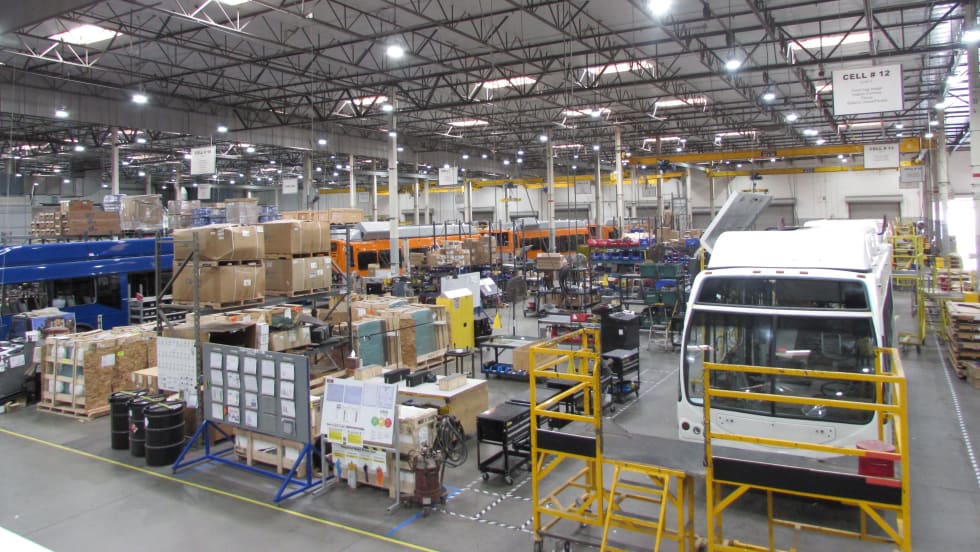
LA Metro Board Awards 220 Battery-Electric Bus Contract to ENC
The contract, which is the largest base award of battery-electric buses by a U.S. transit agency, will be built in Southern California, sustaining good jobs as LA prepares to welcome the world in 2028
Read More →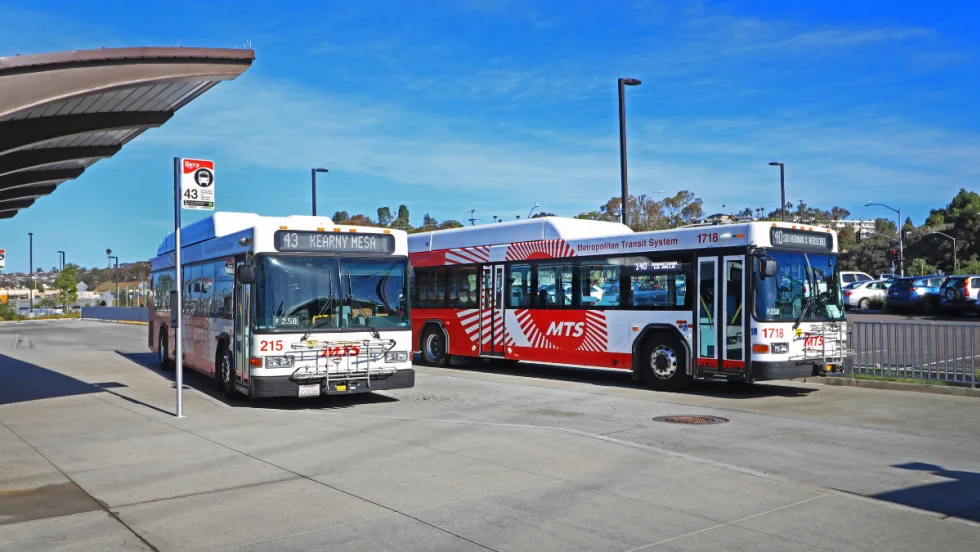
What’s Behind San Diego MTS’s Award-Winning Transit Strategy
Named one of APTA’s 2026 Outstanding Public Transportation Systems with 50 million or more annual passenger trips, California’s San Diego Metropolitan Transit System points to gains in ridership, safety, technology, and reliability as foundations of its success.
Read More →
Public Transit Conference Returning to GFX in 2027, Call for Papers Now Open
The Call for Papers is now open, allowing transit agency professionals and industry experts to help shape the PTC educational program by submitting session ideas for consideration.
Read More →
Indian River Transit’s Community-Focused Approach Earns National Recognition
Named APTA’s 2026 Outstanding Public Transportation System in its size category, Florida’s Indian River County transit system continues to grow ridership through fare-free service and a focus on evolving community needs.
Read More →
ENC Lands MATA Contract and More in Biz Briefs
In this edition of Biz Briefs, we spotlight the latest developments shaping the future of mobility.
Read More →
From Surviving to Thriving: Building Stronger Transportation Organizations
Bus Business Consultants founder Brian Dickson shares lessons on leadership, organizational health, and creating options for long-term success in a changing transportation industry.
Read More →
Everett Transit, Community Transit Outline Consolidation Agreement
The proposed agreement calls for a 50% increase in bus service in Everett, a new microtransit zone, continued paratransit service, and the transfer of Everett Transit operations to Community Transit.
Read More →
Strada360’s Steve Lassey on Turning Transit Data Into Better Decisions
From breaking down data silos to preparing for AI, Strada360 CEO Steve Lassey discusses how transit agencies can use technology to improve operations, customer information, and long-term decision-making.
Read More →
People Movement: Phil Washington Joins HNTB, Denver RTD Launches CEO Search, and More
In this edition, we also spotlight recent personnel moves at STV, the Eno Center for Transportation, and more, highlighting the people taking on new roles across the transportation industry.
Read More →
SEPTA Details Accelerate Vision for Transit System
The plan outlines investments in trolley modernization, new Metro and Regional Rail vehicles, accessible stations, and more frequent bus and rail service.
Read More →