



The design measures identified in this article represent a compendium of potential actions available to transit agencies as outlined in a recent APTA whitepaper produced by HNTB architectural and ventilation experts in collaboration with the Technical Solutions sub-group of APTA’s Vision for Transit Post COVID-19 Research and Thought Leadership Workgroup. For a full list of references, supporting documentation and studies, see: APTA, Sept. 2020, “Transit Leadership in the Post-COVID-19 Mobility Landscape: Measures to Promote Safe Mobility.”
Tips for Raising Transit Pandemic Resiliency
While good personal hygiene, physical distancing, the use of personal protective equipment, and implementation of other conventional measures are important, there are also opportunities to influence the physical components of transit stations and vehicles and their ventilation systems via planning and design tools.
by Sanja Zlatanic, Dr. Bernd Hagenah, Thomas Grassi, and Jesse Harder
June 17, 2021
Even now that vaccines for COVID-19 have been developed, there remain vast numbers of potential infectious diseases found in nature with no vaccine that may cause the next devastating pandemic.
Credit:
HNTB
9 min to read
Throughout the COVID-19 pandemic, public transportation agencies have strived to provide safe and healthy transit mobility, as well as a high level of confidence among riders and employees. Appropriate safety measures, procedures, and protocols, if implemented, can promote safe public transit and increase the resiliency of systems during a pandemic, as well as readiness to face possible similar events in the future.
While good personal hygiene, physical distancing, the use of personal protective equipment, and implementation of other conventional measures are important, there are also opportunities to influence the physical components of transit stations and vehicles and their ventilation systems via planning and design tools. This includes the use of proper architectural and ventilation design elements to improve transit cars, stations, and employee facilities, making them more resilient with measures to control (limit) the spread of airborne pathogens such as coronavirus.
Even now that vaccines for COVID-19 have been developed, there remain vast numbers of potential infectious diseases found in nature with no vaccine that may cause the next devastating pandemic. Responsible professionals, including architects and engineers, must actively evaluate practical measures to prepare for such events, in support of safety of transit systems, especially underground, and their ability to quickly adapt to new conditions.
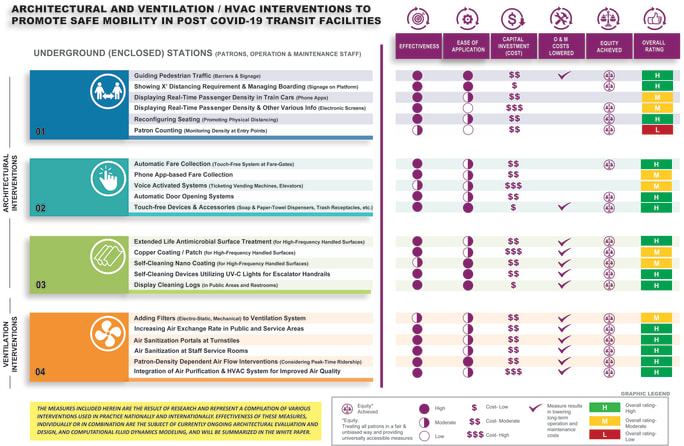
Evaluation matrices have been developed to assist transit facility owners and operators in evaluating their facility and vehicles in terms of their pandemic or post-pandemic resiliency.
Credit:
HNTB
Ventilation interventions
The design of ventilation (HVAC) systems for transit facilities and vehicles will need to be evaluated with new air quality guidance. In general, an increase in outside (fresh) air exchange comes at an increased cost compared to the cost of air conditioning, that provides adequate passenger comfort, as fresh intake air requires a greater level of conditioning than air that is recirculated within the interior environment. The level of fresh air intake can be managed through the HVAC control systems, but these systems must be evaluated for adequate intake and distribution of fresh air. Primarily due to energy consumption considerations, traditional HVAC system design has focused on minimizing fresh air intake and treating recirculated air as a means of achieving interior air comfort. The benefits of increasing the fresh air intake during a pandemic is leading engineers to reconsider this approach.
However, even with a high number of hourly air changes, there might be zones within an enclosed space where the air is stagnant or re-circulating locally and is not replaced sufficiently by the ventilation system. Computation Fluid Dynamics (CFD) simulations allow identification of these stagnant areas, which may have increased levels of pathogens. Improvements in air distribution are needed to improve passenger safety in the entire space. Also, the fresh air exchange rate should consider the volume of the enclosed space, its location, and the number of occupants. HVAC system design should aim to replace the total volume of air within an enclosed space six to eight times per hour.
There are many types of filtration now designed into HVAC systems, with more new technologies on the horizon due to increased visibility because of the COVID-19 pandemic. Most transit systems currently use air filters with a MERV (Minimum Efficiency Reporting Value) rating of 7-10, which is an adequate level of filtration to remove larger particles from the airflow. MERV filter ratings report a filter’s ability to capture particles between 0.3 and 10 microns (µm), a metric helpful in comparing the performance of different filters. To effectively capture airborne droplets and pathogen-carrying particles, the level of air filtration should be increased to MERV 13 or higher. This can be achieved in most systems through the exchange of air filters to this more restrictive type, but this does reduce airflow rates delivered to conditioned spaces. HVAC systems must be carefully evaluated when considering transitioning to higher MERV-rated filtration systems to ensure that equipment performance is maintained. Generally, air temperature ranges of 68 to 78 degrees Fahrenheit dry bulb with a minimum RH (relative humidity) range of 40% to 60% are recommended design parameters.
Air sanitization measures including UVGI (Ultraviolet germicidal irradiation) and BPI (Bipolar ionization) should be considered in addition to and/or in combination with air filtration, during and after facility use and for areas with limited fresh air or higher passenger density. Air ionizers measure and typically use high voltage currents to charge air molecules to generate positive and negative ions. Studies have shown that ionized air distributed by hospital air-conditioning systems can deactivate viruses. Even though the development of air ionizers accelerated during previous pandemics, standardization of this technology has not yet been established. The impact of these measures on air purification is highly dependent on the HVAC system design and other parameters including air temperature and humidity. Therefore, the integration of such measures into HVAC systems needs careful evaluation and testing.
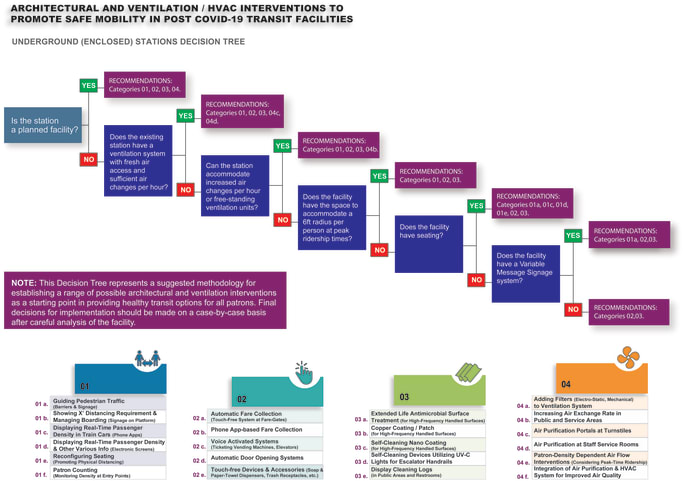
Once a matrix is completed for a given facility, feeding that information into an integrated decision tree will provide the transit agency with a direct guide as to the interventions that are most appropriate for that
unique situation.
Credit:
HNTB
Architectural interventions
The two primary ways a virus can spread are through close physical contact with an infected person and improper ventilation within a space. Simple, cost effective, and aesthetically appealing architectural interventions can readily be applied to mitigate those factors.
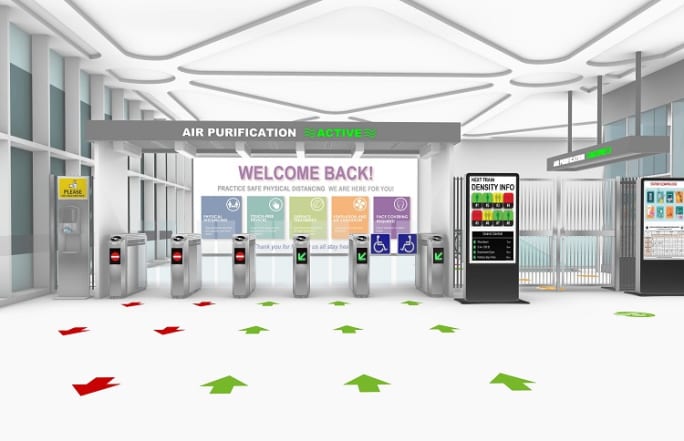
To keep transit services running while protecting the health and safety of riders, providing real-time data of how many riders are in transit facilities or on approaching trains/railcars can help riders make decisions on which stations to use and which trains/railcars to board, minimizing crowding and facilitating physical distancing. Integrating real-time information can enable seamless and just-in-time connections, eliminating unnecessary wait times and associated overcrowding situations. This data can be collected via sensors mounted on turnstiles and above vehicle doorways that would provide accurate passenger counts using a combination of infrared and 3D image pattern technologies. Providing this real-time data through mobile phone applications and dynamic signage would inform riders of the onboard densities of incoming vehicles and help them choose the car, train, or bus they would board.For instance, bold signage with unique messaging that encourages physical distancing is a simple and easy way to remind riders to keep a safe distance away from one another. Many transit agencies have already implemented floor decals in their transit facilities in a quick and temporary manner, given the situation. Moving forward, care and thought must be given to establishing consistent and effective national design standards regarding boarding, waiting, and distancing requirements, and accompanying graphics for ease of rider movement. Maintaining a safe distance is feasible in some situations, but during peak hours before the COVID-19 pandemic, passengers frequently had very little space between them on many transit lines, especially those in dense urban areas. Mitigation strategies then shift to other potential solutions.
Similar smartphone applications have already been launched and are being tested by numerous agencies, including the Metropolitan Transit Authority’s New York City Transit (NYCT) and the Taipei Rapid Transit Corporation (TRTC) in Taiwan. The TRTC’s mobile phone app assigns density information for each car according to a color code; for example, green symbolizes a “comfortable” number of riders in a vehicle, yellow an “average” density, orange “crowded,” and red “very crowded.”
Studies have shown potential connections between infection by airborne pathogens, riders’ physical distancing, and co-travel time. The risks of riders being infected while traveling together in the same vehicle is higher among individuals seated in the same row than among those seated in different rows. Therefore, retrofitting existing seating through the implementation of protective barriers made of transparent materials, introduction of reversible seating that can change direction, or seating with taller backs that can serve as barriers, can all be effective measures to assist physical distancing and minimize the spread of pathogens.
Implementation of a touch-free experience, to the greatest extent possible, can ease riders concerns and build their confidence in returning to transit. Among other implementations to achieve this goal is at the turnstiles. Instead of bar turnstile-type fare gates, swing gate-type fare gates can be installed to promote touch-free fare collection. Gates are in the closed position and automatically open when the fare is collected, allowing riders to pass through without contact. The gates close automatically after passage. Supplemented with the proper use of effective signage, this automatic fare gate can promote one-way passenger flows, avoiding bidirectional conflicts.Full-height platform screen doors (PSDs) can help to separate station air on the platform from the air coming from adjacent tunnels. PSDs help to reduce the amount of fresh air on the platform to be pulled into the tunnels by leaving or passing trains. PSDs can therefore help to maintain the quality of the air on the platform level, avoid or reduce rail dust and dirt entering the station which clogs HVAC filters, and reduce the energy needed to prepare and provide the required air quality.
Air sanitization interventions, outlined above, should be located strategically within stations, so that their protective capabilities are accessible to the maximum number of riders. Such appurtenances, in form of portals at faregates, stairs, and/or escalators, and ventilation ducts and associated electrical and mechanical equipment require proper architectural treatment that enhances the station’s aesthetics, maximizes their efficiency, and provides clear messaging and reassurance of active air treatment measures being implemented.
There are many types of filtration now designed into HVAC systems, with more new technologies on the horizon due to increased visibility because of the COVID-19 pandemic.
Credit:
HNTB
Evaluation matrices
Evaluation matrices have been developed for stations, railcars, buses, and employee facilities, to assist transit facility owners and operators in evaluating their facility and vehicles in terms of their pandemic or post-pandemic resiliency, for both passengers and employees. The various types of architectural and ventilation intervention measures were evaluated for the following criteria:
Effectiveness: Rated as high, moderate, or low.
Ease of application: Rated as high, moderate, or low.
Capital investment (initial cost): Rated as low, moderate, or high.
Lowering of operations and maintenance cost: Rated as to whether the measure will result in lowering long-term operation and maintenance costs (initial capital costs might be offset by lower operation and maintenance cost later; this would likely benefit the owner’s operating efficiency).
Achieving equity: Rated as to whether the measure will result in all riders and employees being treated in a fair and unbiased way while providing universal access.
After evaluation of all criteria, an overall rating was developed for each measure. No weightings were applied to the various criteria, although some criteria might be considered more important, or more practical, than others to various owners and operators with respect to their specific conditions, goals, and resources.
Once a matrix is completed for a given facility, feeding that information into an integrated decision tree will provide the transit agency and/or operator with a direct guide as to the interventions that are most appropriate for that unique situation.
By answering a series of customized, prioritized yes/no questions, agencies can determine the available measures that would be most suitable for promoting pandemic-safe mobility for their patrons and employees. These decision trees can be used to assist in initiating the process to find the most appropriate ways to deliver critical and healthy transit service to patrons and employees.
Sanja Zlatanic is national tunnels practice leader; Dr. Bernd Hagenah is principal engineer, tunnel ventilation; Thomas Grassi is architecture project director; and Jesse Harder is engineering department manager at HNTB.
Subscribe to Our Newsletter
More Security and Safety

Transit Agencies Highlight Safety Gains at National Summit
Leaders from 15 major transit systems shared crime-reduction results and safety initiatives while discussing the role of continued federal support.
Read More →
DART Launches Major Security, Fare Enforcement Initiative
The 90-day demonstration will deploy coordinated security teams at five light rail stations while testing controlled access and gathering data to guide future investments.
Read More →
RTD Launches NextRide App to Consolidate Trip Planning, Fares, Security Reporting
The app expands on RTD’s existing NextRide web application and allows customers to view real-time vehicle locations and service alerts, purchase and store digital fares, and access customer support.
Read More →

TAPTCO Updates OSHA Compliance Training for Transit Maintenance Operations
The revamped program addresses 26 OSHA standards for maintenance facilities, with TAPTCO pointing to training, documentation, and everyday shop hazards as continuing challenges for transit operations.
Read More →
Sponsored•August 18, 2026
How VaporVision Adds Value to Transit Door Systems
Wabtec engineers explain how the system improves doorway detection, strengthens diagnostics and gives transit agencies and OEMs greater operating flexibility.
Read More →
FRA Announces $5.3B in Rail Investments, Including $2B for Amtrak
Funding will support grade-crossing improvements, infrastructure upgrades, and new Amtrak equipment in 23 states.
Read More →
Chicago, Maryland Expand Non-Law-Enforcement Safety, Rider Support
The CTA and MTA are launching new programs aimed at de-escalation, crisis response, rider assistance, and greater transparency.
Read More →
LA Metro, City of West Hollywood, and Partners Advance Smarter Bus Lane Enforcement
The award-winning partnership combines AI-powered detection with human oversight to improve bus reliability, accessibility, and enforcement efficiency.
Read More →
LA Metro Reports 57% Decline in Homelessness on Transit System Since 2024
The agency's latest homelessness count offers new data on how care-based services and cross-sector partnerships can complement traditional transit security strategies.
Read More →
FTA Launches 'Transit Moves America' Dashboard to Highlight Agency Safety and Performance
The online dashboard transforms National Transit Database information into a public-facing resource that allows users to compare transit agencies on key operational and safety metrics.
Read More →