



Transit Implements Control Tactics to Combat Fare Evasion
Los Angeles, Boston, San Francisco and Atlanta are putting an end to ‘free rides’ with fare inspection crackdowns. L.A. Metro, like Atlanta, is locking its fare gates, ending the unofficial honor system.

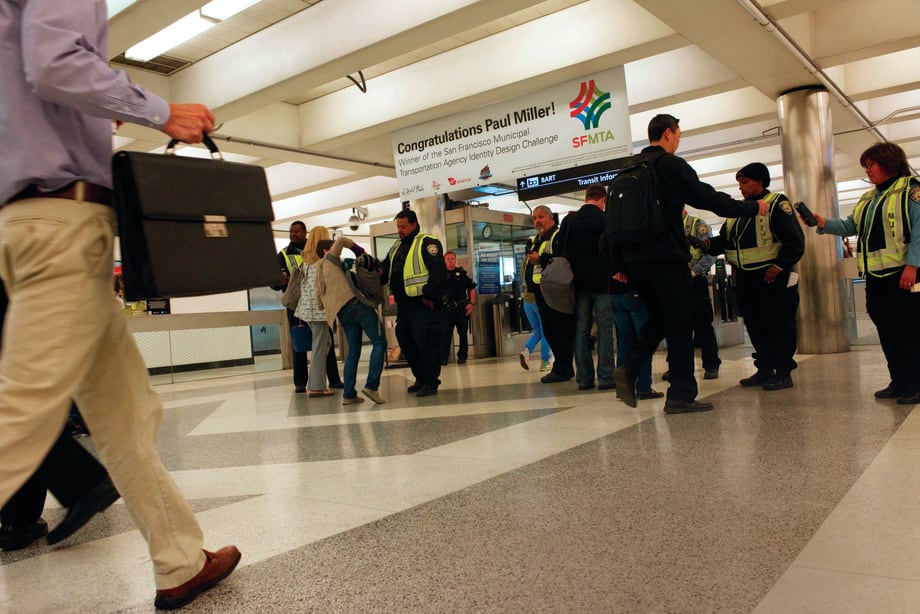
The most common fare evasion method, says Transit Police Chief Paul MacMillan, Massachusetts Bay Transportation Authority (MBTA), is piggy-backing or tailgating: following somebody who has paid the fare through the gates.
Photo: Metro File Photo
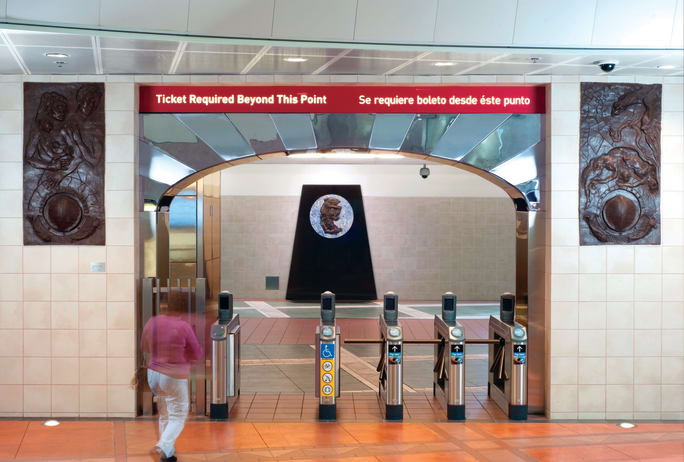
This fall, Los Angeles’ Metro will permanently lock the gates in its subway stations to prevent riders from skipping fare payments.
Photo: Metro File Photo
In June, the New York Metropolitan Transportation Authority (MTA) upped its estimate of what it loses in revenue each year from bus fare evasion from $14 million to $50 million and may increase police enforcement.
The Los Angeles County Metropolitan Transportation Authority (Metro) recently discovered that riders are often not tapping fare cards and moving ahead through the turnstiles without paying. An age-old problem, fare evasion prompts an ongoing struggle to stay ahead of people who are trying to beat the system, says Kim Green, president, GFI Genfare.
Fare Evasion Tactics
The most common fare evasion method, says Transit Police Chief Paul MacMillan, Massachusetts Bay Transportation Authority (MBTA), is piggy-backing or tailgating: following somebody who has paid the fare through the gates.
Other fare evasion tactics MBTA has encountered include jumping on the gates and climbing over them; pulling the gates apart; forcing them open and squeezing through, which often damages the gates; and blocking the outgoing sensor, causing the fare gate to open so people can slip through.
Assessment Challenges
What complicates the problem is that fare evasion is difficult to assess through data, since there’s not a reliable metric to adequately determine if you have a good fare evasion rate, Green adds.
“Does your [rate] look good if it’s based on total ridership divided by the number of people you issue citations to?” Green asks. “If that’s the case, all you have to do to have a low fare evasion rate is put one inspector on [one out of] your 200 trains. You haul 200,000 people, issue three citations a day. It will look like you had no fare evasion, but there are a lot of people on those other 199 trains that are riding for free. You just don’t know it.”
Green adds that there are also jurisdiction issues with proof of payment. Many cities treat fare violation the same way they handle unpaid parking tickets, which brings up the question of how to make them pay the fine.
“Let’s assume you catch an offender,” he explains. “What do you do with them? Across the nation they have all kinds of different laws, and some of the fines can be really high.”
Proof of payment generally is based on the honor system and overall works well for most transit systems, Green says. There may be occasional fluctuations in compliance rates because of increased ridership, but most people are honest and pay their fares. “There always has been debate about how much to spend and what kind of a system to [use] to make sure you get most of the people to pay most of the time,” Green says.
Locking Fare Gates
This fall, Los Angeles’ Metro will permanently lock the gates in its subway stations to prevent riders from skipping fare payments, Marc Littman, deputy executive officer, public relations, says. Only a few of the light rail stations will remain gated because of narrow platforms.
Metro will initially have passenger ambassadors on hand to assist people with using the TAP card, which will soon be the only way to pay their fare. All gates will be locked by winter 2013.
Metro held “demonstrations” last fall and winter, at about 10 stations each time, to see how people were paying their fares. Passenger ambassadors and law enforcement officers directed people to ticket vending machines (TVMs) and explained how to properly apply the TAP card to the fare card reader. Metro discovered that 59% to 75% of riders with TAP cards were not tapping, which meant fares weren’t deducted from their cards.
“If the gates are locked, you will have to tap,” Littman explains. “It’s a learning curve for everybody, but we’re getting there. People have to get used to doing it.”
However, in the most recent demonstration, Metro saw a significant increase in riders going straight to the TVMs, with transactions increasing from 18% to 22%.
Metro currently is in the process of converting the TVMs to TAP media only and is working with students and seniors to ensure that their discount passes are converted. Half of Metro’s riders are seniors, students, and Medicaid recipients, who often have special discount passes. The biggest challenge in this phase, Littman says, is connecting with multiple municipal bus operators who have different and incompatible fare media.
As part of the process, about a half dozen municipal bus operators have converted to TAP, including the Los Angeles Department of Transportation (L.A. DOT) and Metrolink.
“There are a lot of people [who use] Metrolink and transfer to the Metro system, particularly [at] Union Station, so we’re working with them to come up with TAP and enabled fare media,” Littman says.
However, that has taken some time, because there are 16 area bus operators, including Metrolink and Amtrak, that work with Metro as part of an integrated transit system.
Littman says that once the gates are locked the convenience of the TAP fare card will be more apparent, because riders won’t have to figure out which fare media to use, making it easier to ride multiple carriers, such as Metrolink and Metro, in one trip. Another convenience is if a customer loses their card, they get the fare value returned to them online.
However, locking the gates brings on other expenses, Littman points out, primarily monitoring them so they can be unlocked in case of an emergency.
When Metro started in 1990 with 4.4 miles of the Blue Line, the agency made the decision not to put in fare gates, but installed the infrastructure at the subway stations so they could add them later. Now, Littman says, Metro has close to 100 miles of track and is adding more lines. “We’ve gotten to the point [where we’re] too big to just go with the honor system,” he says.
Closing the System
Faced with an aging fare collection system, Metropolitan Atlanta Rapid Transit Authority (MARTA) implemented a new system in 2005 and made adjustments to help reduce fare evasion similar to Metro, including becoming a “closed system” — requiring riders to tap their cards for entry and exit — and increasing the height of the gates.
More recently, last year MARTA adjusted its gate speed as well, Davis Allen, assistant GM, finance, at MARTA, says.
One caveat was that MARTA’s wide fare gates initially did not require a customer to tap to exit. This allowed for its regional transit partners to fully transition to its Breeze fare media. As of October 2011, the gates require customers to tap to exit. Breeze media is used for exit and entry, and allows MARTA to better align exit and entry numbers to help determine ridership and fare evasion rates.
As a result of the change, MARTA experienced a clear reduction in fare evasion, Allen says. The evasion rate for Fiscal Year 2005 was 4.1% and 1.8% for Fiscal Year 2012.
“If nothing had been done to upgrade the fare collection system, the estimated loss for weekday rail fare evasion would have been $2.4 million,” he adds. “The measures have saved MARTA approximately $1.4 million in Fiscal Year 2012.”
Inspector Sweeps
Spurred on by a fare increase, MBTA kicked off “Operation Fare Game” in July and issued 636 tickets, explains Transit Police Chief Paul MacMillan.
The operation consisted of both uniformed and plainclothes officers monitoring the fare gates. Uniformed officers are sometimes used as a visible presence to deter riders from dodging fares. However, people will sometimes skip paying even with a uniformed officer there, MacMillan says.
Before the fare increase went into effect, the public asked the agency to step up its efforts to capture people who were not paying, MacMillan says. In response, MBTA started “Operation Fare Game” to conduct fare enforcement at some of its larger stations, where evasion was more likely to take place.
Citation Crackdown
On top of a fare hike, the fee for fare evasion increased from $15 to $50 on July 1. MBTA also asked the state legislature to increase the fine and shorten the time frame that someone who received a fare citation was able to pay. The old system required almost 18 months before payment was due.
“There was a notification period where we had to notify the Registry of Motor Vehicles that the [person’s] license could not be renewed and there was a time period that delayed the payment of the fine,” MacMillan explains. “We asked the legislature to shorten that. Now, you have to pay your fine in 30 days or we’ll notify the Registry of Motor Vehicles to not renew your license.”
The idea is similar to when a vehicle owner doesn’t pay a parking ticket: their vehicle registration won’t be renewed until they pay.
As a result of the sweeps, MBTA increased the number of fare citations for this year over last year, so far. In August, 2011, it issued approximately 2,000 fare evasions, and in August 2012, it gave out over 3,000 showing an increase of about 53%.
The next step, MacMillan says, is working with the state legislature on a sanction for fare evaders who don’t have a driver’s license.
Creative Deployment
The San Francisco Municipal Transportation Agency (SFMTA) has a limited number of fare inspectors, so it has to be creative in how it deploys them. When concentrating most of the inspectors in problem areas on the system wasn’t proving effective, Lea Militello, director of security, investigations, and enforcement, SFMTA, found a better way to stop fare cheats.
Militello says that the previous method was “singularly focused.” When she came on board about one year ago, Militello read several studies done on San Francisco’s municipal service and found that fare evasion was a problem system-wide.
Her solution was to have the fare inspectors operate by a deployment calendar. Every month the proof of payment manager produces a calendar that shows fare inspectors where they’re going to be in the system. They are now placed system-wide and rotate where they are and where they do saturations — boarding a bus and checking every passengers’ proof of payment — every day. By being everywhere on the system, SFMTA started to see a reduction in fare evasion.
“We’re not just randomly checking people,” Militello says. “The only way we’ll get an accurate percentage of fare evasion is if we’re checking 100% of the people on any given bus.”
FMTA reviews its statistics and real-time data daily and adjusts its deployment strategy accordingly.
“The feedback from people that ride our system regularly is, ‘This is the first time I’ve ever been asked for my proof of payment,’” Militello says. “Our citations are static, but in some instances we’re seeing more compliance. What that tells me is that what we’re doing and how we’re deploying our fare inspectors is working.”
Now, the public calls with tips on specific areas to check. Saturations are sometimes scheduled based on customer feedback.
“People who pay their fare don’t like when others [game] the system,” Militello says. “They expect everyone to pay.”
More Bus

Everett Transit, Community Transit Outline Consolidation Agreement
The proposed agreement calls for a 50% increase in bus service in Everett, a new microtransit zone, continued paratransit service, and the transfer of Everett Transit operations to Community Transit.
Read More →
SEPTA Details Accelerate Vision for Transit System
The plan outlines investments in trolley modernization, new Metro and Regional Rail vehicles, accessible stations, and more frequent bus and rail service.
Read More →
Report: Transit Bus Manufacturing Supports 34,100 Jobs, $5.1B in GDP
The “Buses Mean Business” report examines the transit bus manufacturing industry’s economic footprint, supply chain, and rising demand for vehicle replacements.
Read More →
Biz Briefs: New Flyer Delivers in Columbus, Houston, Beep and Freebee Merge, and More
In this edition of Biz Briefs, we spotlight the latest developments shaping the future of mobility.
Read More →
People Movement: Dan Dipert Coaches Adds Third-Generation Leader, Keolis Names New Valley Metro VP/GM, and More
In this edition, we also cover recent appointments and announcements at the Wabtec, SilverRide, HNTB, and more, showcasing the individuals helping to shape the future of transportation.
Read More →
New York MTA Plans Largest Bus Fleet Upgrade in More Than a Decade
The agency is seeking manufacturers for 650 new CNG buses to replace aging vehicles, improve reliability, and advance its broader fleet modernization strategy.
Read More →
Building a Flexible Path to Transit Electrification
John Hroncich discusses BAE Systems’ modular and scalable approach, lessons learned from decades of real-world operations, and how agencies can identify electrification strategies that fit their fleets.
Read More →
Bus Tech Talk: Keeping Transit Technicians Ahead of the Technology Curve
LA Metro’s Obed Mejia discusses technician training, evolving maintenance technology, fleet replacement, and strategies for getting the most out of today’s transit fleets.
Read More →
Biz Briefs: RIPTA Unveils New Frontrunners, Clevland RTA Adds New Siemens, and More
In METRO's latest installment, we take a look at recent news from Siemens, Prevost, Dodge, and more partnerships making headlines across the transportation sector.
Read More →
People Movement: Holly Arnold Joins Transdev and More
In this edition, we also cover recent appointments and announcements at Pace, CamTran, MCI, and more, showcasing the individuals helping to shape the future of transportation.
Read More →