



Valley Metro music video campaign educates, entertains riders
Valley Metro's online music video campaign, "Valley Metro Notes," consists of 11 songs from six local bands, showing in an entertaining way how to use the transit system. The campaign is geared toward high school, college students and older, with the caveat of not alienating any other demographic.

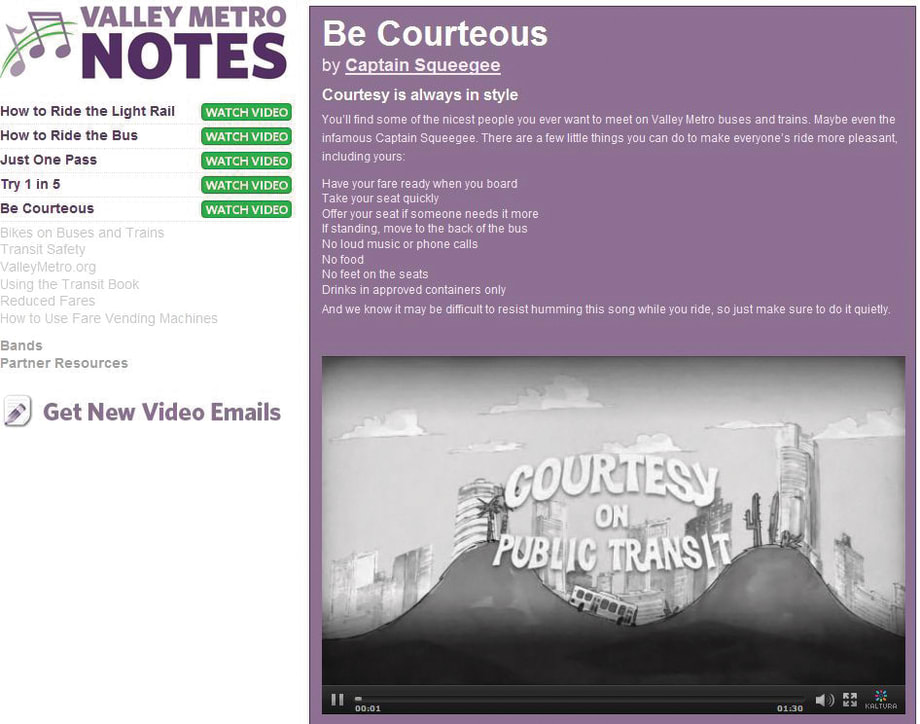
Valley Metro's online music video campaign, "Valley Metro Notes," consists of 11 songs from six local bands, showing in an entertaining way how to use the transit system. The campaign is geared toward high school, college students and older, with the caveat of not alienating any other demographic.
Valley Metro's online music video campaign,
Phoenix-based Valley Metro (Metro) is getting the word out to riders and potential riders by entertaining them with music videos that contain valuable how-to information on riding the system's bus and light rail services.
The "Valley Metro Notes" campaign, launched in November, consists of six local bands that have written and recorded 11 original songs about how to use public transportation. Metro is releasing the songs one at a time through fall 2011. The fifth video launched in March. Participating local bands are: Black Carl, Captain Squeegee, Elvis Before Noon, Mills End, Peachcake and What Laura Says.
The songs are set to animated video and are available 24 hours a day, seven days a week at www.ValleyMetro.org/Notes.
Engaging the public
Heidi Gracie, brand marketing and customer experience manager, says that the idea for the campaign came from the public. Valley Metro surveyed riders, non-riders, and people who used to ride transit, but don't anymore, in focus groups and through an annual rider satisfaction survey.
"We tried to understand the number one barrier to use and what would make it easier for them to ride transit," she explains.
In addition, the agency checked in with its customer service line, which gets 6,000 to 8,000 calls a day, says Mario Diaz, chief marketing officer.
"The focus groups were very direct about how we communicate, why they don't ride and how we should communicate with them. They told us, 'Talk to us in a fun and engaging way. Don't be stuffy about it, and sound like a public agency," he says.
Participants, Diaz adds, said they wanted to have information available wherever they were, 24-7.
The campaign is geared toward high school, college and above, with the caveat of not alienating any demographic, Gracie says.
"When people start to make decisions for themselves in life is where we'd like to be for them, so they don't need a car to get around," she says. "They can still have a varied and exciting life and use transit to get to wherever they need or want to go."
Gracie points out that the illustrations of the characters in the videos are not "Disney-eque or Sponge-Bob. They're a bit more timeless."
Metro chose the illustrator, AJ Bell, from its in-house ad agency, R&R Partners, for his hand-drawn watercolors and brought them into computerized bus images, to capture the look and feel of Phoenix, with the lighting, colors and the style of the characters.
Also important, Diaz notes, is gearing the message to people that don't use the system. The top reason they weren't taking transit was fear of the unknown, which can be intimidating.
"These animated videos with lyrics are painting the experience before one even has it," Gracie adds. "You have that familiarity, making it more comfortable to try."
[PAGEBREAK]
Smartphone users who don't know about the
Local Acts
In an effort to keep funding in the community, every band Metro selected is local. The marketing team searched Facebook and MySpace pages and chose about 100 different bands, eventually narrowing down the list to six. Criteria included the band's image and the clarity of its message. "Could you [understand] them, or were they screaming?" Diaz explains.
The agency sent letters to the musicians, outlining the program and asked them to participate. The participating bands sent demos. The agency paid $500 for each demo, and $1,000 per band for the buyout rights for the lyrics, music performances and likenesses.
Selecting the music was crucial, Gracie says, noting that each song and band is different and appeals to different audiences. The marketing team looked at rider demographics and the music genres they listen to. Connection with transit in the band members' daily life was important, too. Danny Torgenson, the lead singer for Captain Squeegee, who performed the song, "Be Courteous," used the bus to get to his music lessons growing up, since his mom didn't have a car.
The marketing team gave the bands 10 subjects they wanted to cover, based on the top issues that the customer service representatives heard from riders. Each band chose the topic that was most important to them. Mitch Freedom, one of the lead singers for What Laura Says, has a young son, so the band wrote the lyrics and performed the music to "Be Safe."
"He had the message to his son, don't mess around by the buses and trains," Gracie says. "It was really nice to hear the connection between the subject matter and why they chose it."
Spreading the word
What's unique about the campaign is the way it can be shared, Gracie explains, whether through the Metro website, YouTube, the bands' Facebook pages or anyone with access to the Internet. The marketing team placed a two-dimensional bar code — referred to as a quick response code — on posters and transit books. People who don't know to go to the Metro website can wave their Web-enabled phones over the code and the animations automatically come up, Gracie explains. The bar code also helps the team track how many people are taking transit and where they are located, which helps it figure out how to more carefully spend its dollars.
The team did not anticipate the power of using bands as spokespersons for transit. "They're [attracting] audiences we never would have reached," Diaz says.
As a result of the bands playing the songs on the road and posting them on their Web pages, Valley Metro has seen a 20-plus percent increase in website visits, with over 200,000 unique visitors a month. That's nearly 40,000-plus visitors per month who weren't visiting the site before, he adds. Web visitors are watching the videos, then clicking to other portions of the site to see schedules, routes and fares. That has boosted the website's click-through rate, Gracie adds, to 30 percent.
As Metro has launched new transit stations and a mobility center, the bands performed at the unveilings. At these events, attendees have told Diaz that even though they drive, they looked into using transit because of the campaign.
"[One rider] said, 'I'm a big Peachcake fan. I can't believe that a public agency would team up with a band like this. How cool is that? You guys really do care about us,'" Diaz recalls. "That is the message that I heard time and again in the last couple months: 'You care about the music we listen to and you're here where we are.'"
"If you're sitting at the bar and all of a sudden someone yells out, 'Play the bus song!' You're like, 'Wow, that's some cred for transit,'" Gracie adds.
Mining local talent is unifying riders, Diaz says. "People can identify with music more than a brochure. It's been much more popular and successful than we could ever dream."
Recently, the campaign won seven ADDY Awards.
More Rail

New York MTA Advances Final Contract for Second Avenue Subway Expansion
Contract Four is the largest in the Second Avenue Subway Phase 2 project and includes construction of station infrastructure, tracks, and signals for the subway expansion, MTA officials said. Work on Contract Four will begin in 2027.
Read More →
San Diego MTS Breaks Monthly Trolley Ridership Record
Agency officials said July’s ridership indicates MTS’s continued recovery from the pandemic.
Read More →
Report Examines NJ TRANSIT Reliability, Funding Challenges
The Garden State Initiative analysis examines the roles of Amtrak infrastructure, fleet management, and agency operations while recommending a more performance-based approach to improving reliability.
Read More →
Stadler, CapMetro Sign Long-Term Rail Fleet Support Agreement
Beginning in 2027, Stadler will provide on-site technical expertise, spare parts support, training, and obsolescence management to help extend the reliability and longevity of CapMetro’s GTW fleet.
Read More →
Biz Briefs: Alstom Lands Canadian Contract, LYT to Supply California TSP, and More
In METRO's latest installment, we take a look at recent news from Complete Coach Works, Beep, FlixBus, and more partnerships making headlines across the transportation sector.
Read More →
CATS Gold Line Marks 5 Years of Service, 2.8M Passenger Trips
With a six-mile expansion planned, the Charlotte streetcar is positioned to connect more neighborhoods and major transit hubs across the region.
Read More →
Why Simulating Pedestrian Movement Has Become Essential for Modern Rail Stations
Pedestrian microsimulation is helping rail planners identify bottlenecks, test station designs, and prepare complex transit hubs for growing passenger volumes.
Read More →
Amtrak Begins Major Construction at New York’s Sunnyside Yard
The new maintenance facility will support Amtrak’s Airo trainsets while improving maintenance efficiency and turnaround times in New York.
Read More →
Chicago Leaders Unveil Plans for O’Hare Airport Express Train
The privately developed project would offer a 15-minute trip between downtown and O’Hare’s Terminal 2, with trains operating every 15 minutes on a dedicated track. The service would use battery-electric trains and three existing freight rail rights-of-way.
Read More →
OCTA Maps Out 30-Year Strategy to Protect Coastal Rail Corridor
The draft feasibility report identifies strategies to protect the coastal rail line for decades as the agency continues near-term stabilization and sand placement efforts.
Read More →