



AT A GLANCE
During the study of the corridor and the impact of the BRT system, it is estimated that the area along the Route 1 Highway would grow from 15.8 million gross square feet, with 5,000 dwelling units and 30,500 jobs in 2015, to 35.4 million gross square feet, including 18,000 dwelling units and 47,000 jobs.
Virginia BRT System to Support Future Growth
Fairfax County’s Route 1 project will tie the region together, providing vital ties to job centers and WMATA’s rail system, as well as spur density growth through the implementation of TOD projects.
by Alex Roman, Managing Editor
January 3, 2019
The Richmond Highway Corridor BRT project is unique, because infrastructure is being implemented in advance of some of the region’s future densities.
DRPT Multimodal Alternatives Analysis
4 min to read
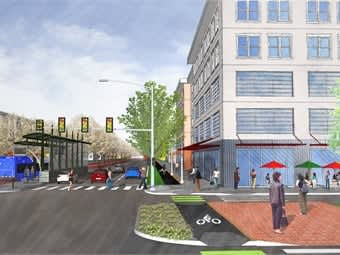
The Richmond Highway Corridor BRT project is unique, because infrastructure is being implemented in advance of some of the region’s future densities.
DRPT Multimodal Alternatives Analysis
After a significant study of the corridor by the Virginia Department of Rail and Public Transportation (DRPT), the Fairfax County Department of Transportation is in the process of planning, designing, and constructing a bus rapid transit (BRT) system for the Richmond Highway Corridor.
The DRPT Multimodal Alternatives Analysis study, which was conducted in coordination with Fairfax County, Prince William County, the Virginia Department of Transportation, and the Office of Intermodal Planning and Investment, kicked off in 2013. In October 2014, the 15 members of the project Executive Steering Committee adopted a resolution in support of the study’s final recommendations, with the final report completed in January 2015.
“For many years, we have identified high-capacity corridors and studied potential transportation alternatives,” explains Eric Teitelman, chief, capital projects and traffic engineering division, for the County. “Route 1, or Richmond Highway, is one of those corridors. In their plan, the County has been reserving a median area for future transportation options, and after DRPT’s study, it was decided that alternative would be BRT.”
The goal of the BRT system is to increase transit ridership along the corridor and ultimately lead to the future Washington Metropolitan Area Transit Authority’s Metrorail extension to Hybla Valley. The system is planned to extend approximately 8.6 miles along Route 1 and North Kings Highway from Fort Belvoir, a U.S. Army installation, to the Huntington Metrorail Station.
Phase I of the project extends 0.7 miles along North Kings Highway from the Huntington Metrorail Station to Richmond Highway and along Richmond Highway for 2.4 miles to Hybla Valley. Phase II extends 5.5 miles along Richmond Highway from Hybla Valley to Fort Belvoir. It is currently anticipated that the environmental analyses and preliminary design, which is being performed through a joint venture between STV Inc. and RK&K (dba Richmond Highway BRT Partners), will be completed by the end of 2019.
Like many BRT systems throughout the U.S., the new system will feature exclusive transitways, real-time bus tracking, off-board fare collection, near-level boarding platforms, high visibility crosswalks, ADA accessible boarding, and enhanced bicycling and walking connections.
Teitelman explains that Fort Belvoir is the largest employer in Fairfax County with somewhere around 30,000 employees in the region, as well as a fairly new Veteran’s Hospital that was constructed about seven years ago.
Future densities
■ A unique wrinkle to the construction of the system is that it is making necessary infrastructure improvements to the region before expected increases in population, explains Vanessa Aguayo, transportation planner for Fairfax County DOT.
“Usually when we do a comprehensive plan, we are looking at how population densities will grow over the next 40 years,” she says. “This project is a little different, because we are actually putting in the infrastructure today in advance of some of the future densities.”
Some of the expected population growth Aguayo refers to will come from two Transit Oriented Development that the comprehensive plan envisions.
“We have some density in the corridor itself, but it’s not yet developed,” Teitelman adds. “The plan is that over time these mixed-use development centers with urban livability spines and urban activity centers would bring more density and create an environment around those activity centers and grid network within those centers, with the BRT line serving as the main hub, or spine, that would connect all of these areas together.”
Route 1 is the original highway in the region that runs north to south. Teitelman explains that typical of old highways, once you get into the urban section of the area they have been developed with strip malls, with some of those strip malls being converted into large-box retail stores, such as Costco and Walmart, over the last five years.
He adds that since Fairfax County is mostly built out, areas in the region that are in redevelopment are going vertical with their density because there is not much land to spread into.
“Our hope is to transform this old highway and convert it to a walkable, bikeable corridor that doesn’t rely as much on the personal automobile,” Teitelman says. “And, really, that has been the trend here in Fairfax County, as well as a number of areas around the state of Virginia for the last several years.”
Funding for the project, which is currently estimated at more than $700 million, will come from a number of funding sources, including sales tax allocations, commercial and industrial property taxes, and competitive grant programs, with the County planning on the Federal government’s share to come in at just under 50%.
County officials planned timeline for Phase One of the project is to be completed by 2026, with Phase Two set to launch in 2028.
Subscribe to Our Newsletter
More Bus

New York MTA Plans Largest Bus Fleet Upgrade in More Than a Decade
The agency is seeking manufacturers for 650 new CNG buses to replace aging vehicles, improve reliability, and advance its broader fleet modernization strategy.
Read More →
Building a Flexible Path to Transit Electrification
John Hroncich discusses BAE Systems’ modular and scalable approach, lessons learned from decades of real-world operations, and how agencies can identify electrification strategies that fit their fleets.
Read More →
Bus Tech Talk: Keeping Transit Technicians Ahead of the Technology Curve
LA Metro’s Obed Mejia discusses technician training, evolving maintenance technology, fleet replacement, and strategies for getting the most out of today’s transit fleets.
Read More →
Biz Briefs: RIPTA Unveils New Frontrunners, Clevland RTA Adds New Siemens, and More
In METRO's latest installment, we take a look at recent news from Siemens, Prevost, Dodge, and more partnerships making headlines across the transportation sector.
Read More →
People Movement: Holly Arnold Joins Transdev and More
In this edition, we also cover recent appointments and announcements at Pace, CamTran, MCI, and more, showcasing the individuals helping to shape the future of transportation.
Read More →
The High Cost of Transit Buses: Industry Leaders Look to Procurement Reform
Transit leaders and policymakers examine how standardized bus designs, streamlined procurement, and predictable funding could help agencies stretch budgets and deliver better service.
Read More →
The Business Voice Behind Public Transportation
As chair of APTA’s Business Members Board of Governors, Ray Melleady explains how more than 850 business members are partnering with transit agencies to advance funding, innovation, and industry-wide collaboration.
Read More →
From Surviving to Thriving: Building Stronger Transportation Organizations
Bus Business Consultants founder Brian Dickson shares lessons on leadership, organizational health, and creating options for long-term success in a changing transportation industry.
Read More →
Finding the ‘Happy Medium’: Optimizing Maintenance Without Sacrificing Reliability
The key to maintenance optimization isn’t doing less work—it’s doing the right work at the right time on the right assets.
Read More →
LA Metro, City of West Hollywood, and Partners Advance Smarter Bus Lane Enforcement
The award-winning partnership combines AI-powered detection with human oversight to improve bus reliability, accessibility, and enforcement efficiency.
Read More →