



Where Will High-Speed Rail Succeed?
Ridership potential is the number one factor in determining if a corridor is suitable for investment, according to a new study. It proposes that the federal government prioritize investments where the potential for ridership demand is greatest.
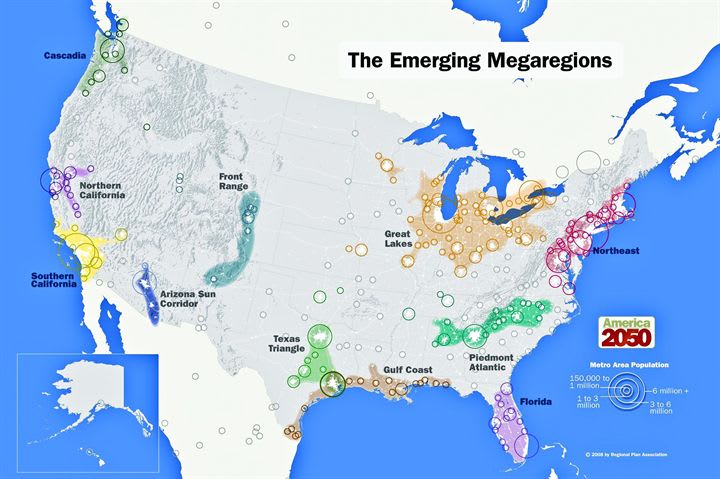
High-speed rail works primarily in corridors of approximately 100-600 miles in length, which exist primarily in the nation's 11 megaregions.
[IMAGE]MET2highspeed-corridormap-2.jpg[/IMAGE]Ridership potential is the number one factor in determining if a corridor is suitable for investment, according to a new study released by America2050 — a national initiative guided by a coalition of regional planners, scholars and policymakers.
The study, "High-Speed Rail in America," identifies the specific conditions that generate ridership demand and scores each corridor according to strength in those areas.
The top performing corridors in each region determined to have the greatest potential demand for high-speed rail ridership include corridors such as: New York-Washington, D.C.; Chicago-Milwaukee; Los Angeles-San Diego; Tampa (via Orlando) to Miami; Dallas-Houston; Atlanta-Birmingham; Portland-Seattle; and Denver-Pueblo.
Scoring was based on factors that have contributed to rail ridership in other systems around the world: Regional and city population size and density, employment concentrations, rail transit accessibility, air travel markets and the composition of job markets by sector.
Based on the analysis, the report proposes that the federal government adopt a similar approach to evaluating where to invest future dollars and calls for prioritizing investments where the potential for ridership demand is greatest. It also calls for a new nationwide study of long-distance travel in America, the majority of which takes place by auto. The last nationwide study of this kind — "The American Travel Survey" — was completed in 1995 and is outdated, according to the report.
The report only examined corridors of up to 600 miles in length - the range of miles at which high-speed rail can compete effectively with automobiles and airplanes - and collected data for every metropolitan region along each corridor. The scoring methodology was designed so that corridors with large central business districts, regional populations, existing transit systems and regional air markets scored highest in the study. Short corridors that concentrate multiple major cities and employment centers tended to score highly in the study (To view the full report, visit america2050.org).
METRO Magazine Executive Editor Janna Starcic spoke with America2050 Director Petra Todorovich to discuss the study and her views on recent criticism of high-speed rail's viability in the U.S.
METRO: What prompted the development of this study?
We did the study because we wanted to provide information on what conditions high-speed rail works in the U.S. This is based on our research of other systems around the world. We have a big country and a limited amount of funding to start the program with, so we feel to spend the money wisely, it makes sense to invest first in places that will have the greatest demand for ridership. For those regions that wish to pursue high-speed rail, it's important for them to have a good understanding of what the ingredients are for success.
The first chapter of the report is devoted to discussing those different factors that contribute to high-speed rail ridership. Basically, we found that population is a driver for high-speed rail ridership. So, these systems that are incredibly capital intensive and require long lead times, planning and construction periods really are most justified connecting very large regions, with large cities at their center to other similarly large cities and regions or medium-sized regions. It seems very basic, but the biggest cities in the nation are probably the biggest generators of ridership of high-speed rail. We did feel it was important to point that out.
After that, the distribution of population across the region is important. We talked about the differences between Philadelphia and Houston, for example, which are two metropolitan statistical areas of about six million people. The way the populations are distributed between those regions is very different. Houston is a much more sprawled region, with its population and jobs more evenly distributed over a wider area, where Philadelphia has a stronger concentration of people and jobs in its center city.
So, on the face of it, it would seem that Philadelphia is more suited in terms of its urban form for high-speed rail, because high-speed rail is a nodal system and has to pick up people at one point. Their people and jobs are already concentrated around a central area that contributes. That means the region is more suited to high-speed rail.
It doesn't mean that Houston should not or could not pursue high-speed rail, it just needs to figure out how it would collect people to that central point of the station. That could be through further investments in rail transit. I know they are moving very aggressively to build out a light rail system. Those are the types of things we want to encourage.
If a region wants to pursue high-speed rail, it needs to be investing in its rail transit system to provide feeder lines to the high-speed rail station.
Who are you trying to reach with this data?
I actually think the transportation industry has a pretty good knowledge of these issues. We also aim to reach the general public and decision makers, including lawmakers in Washington, mayors and governors, and state legislators. We do want to educate a broad audience about the factors that should be in place to make high-speed rail work.
[PAGEBREAK][IMAGE]MET2highspeed-megaregionmap-2.jpg[/IMAGE]You also talk about potential growth in these cities. is high-speed rail success based on that potential?
There's sort of a paradox in that some of the regions that are more densely developed today, places that were built up around rail transit, places like the Northeast or Midwest that have strong city cores, those also tend to be places that are more challenging to acquire rights of way, thus, may be more difficult to build high-speed rail in those places even though we know the demographics and the land-use characteristics are well suited for high-speed rail. So, contrast those regions to some of the faster growing regions in the South or the West, where you may have, with the exception of California, which is pretty densely developed, less densely developed regions and less rail transit, but it may be easier to acquire right of way. And, they have the growth that's anticipated, places like Orlando, where they have 60 percent projected population growth by 2040. If it channels all future growth around high-speed rail and light rail stations, it could certainly create that land development, land-use character that supports high-speed rail.
Every region of the country is different. We are not discouraging rail investment in any particular region; rather, I think it's more interesting in the fast growing regions, the Sunbelt regions that have mostly developed around an auto-oriented mode. Could high-speed rail provide a framework for shifting more toward the center-based development approach in the coming decades? That would also be fueled by demographic trends, oil prices, the environment and so forth. High-speed rail could actually bring about a greater transformation in some of these regions that, today, may not seem as well suited for high-speed rail as the more traditional pre-World War II regions that developed on more of a center-based land-use pattern.
Newsweek columnist Robert Samuelson wrote an article last fall where he basically said high-speed rail is a waste of money. What do you think of this argument?
I think it's inaccurate and shows a real failure of imagination. If we only make the investments that we traditionally have, how do we expect America to change and adapt to the demands of a 21st Century economy?
I think the interstate highway system was a tremendously important investment for the last 50 years of growth in our country and fueled economic growth during that period. For the next 50 years, we have a different set of circumstances we are dealing with - greater globalization, higher energy costs, the need to respond to climate change, changing market demand and demographics in our country where you don't have as much need for single-family homes in the suburbs. You have smaller families and you have people getting married and having children later — all of which point toward more city living and mixed-use development.
To continue to invest in a highway system that was inspired by a 1950s vision of America is foolhardy and is a recipe for us becoming a lesser world power that can't compete.
You recently appeared on a segment of a PBS show called "Fixing America." at the end you mentioned having vision and faith with regard to high-speed rail projects. Can you elaborate on how we can embrace that?
I do recognize that it's very difficult to see past the national deficit, lack of adequate revenues to pay for many of our government obligations and, because of the severe economic challenges, it's hard also for people to look past the next year, two years, when they are struggling with finding a job, or a member of their family is in tough economic times. When you are in the midst of a hard economic crisis, it's hard to look past that.
All the same, our country has traditionally been supported by people who had long, farsighted visions. From the framers of the Constitution to the infrastructure investments made during the new deal to the Eisenhower vision for the interstate highway vision, all of these policies or investments were set in place with a long-term view for America's future. And, I fear that, at this moment in time, we've lost that long-term view because the challenges at hand are so great. But if we neglect that, we really risk losing much of our economic vibrancy.
I think that what we are trying to do with our project, not just this study, but other programs focused on the need to invest in infrastructure, is paint a picture of what the benefits can be and how investments that will put us on the path toward greater economic prosperity and sustainability are needed. We don't need to pay for them all at once; there are different ways to finance capital investments so you stretch out the cost over the length of the project. We're trying to paint a picture of a success story for America that is in part built by high-speed rail.
More Rail
FRA Announces $5.3B in Rail Investments, Including $2B for Amtrak
Funding will support grade-crossing improvements, infrastructure upgrades, and new Amtrak equipment in 23 states.
Read More →
Finding the ‘Happy Medium’: Optimizing Maintenance Without Sacrificing Reliability
The key to maintenance optimization isn’t doing less work—it’s doing the right work at the right time on the right assets.
Read More →
OKC Streetcar Makes Zero-Fare Service Permanent
Ridership increased an average of 71% compared with the same period a year earlier during the fare-free pilot.
Read More →
DART Customer Satisfaction Reaches Six-Year High
Overall satisfaction rose to 74.9%, while the agency’s Net Promoter Score reached a record 33.7.
Read More →
How DART's GoPass Is Redefining Regional Mobility
Serving 14 transit agencies, GoPass simplifies multimodal travel by allowing riders to plan, pay for, and manage an entire trip through one app.
Read More →
Amtrak Board Advances Plan to Restructure Organization, Seeks Public Input
The proposal, developed by Amtrak management and approved by the board for further consideration, is intended to modernize the organization's structure while improving accountability, operational efficiency, and customer service.
Read More →
Biz Briefs: STV teams with Amtrak, Motorcoach Operators Boost Fleet and Land Contracts, and More
From manufacturers and suppliers to transit agencies and motorcoach operators, these updates offer a snapshot of the projects, partnerships and business moves driving the industry forward.
Read More →
Metra Celebrates 100 Years of Electric Rail, Looks to the Future
The event was also a celebration of recent reforms to public transportation in the Chicago area, changes that could be as transformative in the future as the major civic achievement a century ago, said officials.
Read More →
LA Metro Marks Banner Year, Sets Ambitious Goals for New Fiscal Year
Incoming LA Metro Board Chair and Los Angeles Mayor Karen Bass joined outgoing Board Chair Fernando Dutra and LA Metro CEO Stephanie Wiggins to review accomplishments from fiscal year 2026, which included the opening of new rail extensions, advancement of major transit projects, expanded safety programs, and new rider amenities.
Read More →
DART Taps Nathaniel P. Ford Sr. as Next President/CEO
Since 2012, Ford has served as the CEO of the Jacksonville Transportation Authority
Read More →