




RELATED: Addressing sleep apnea in public transit operations
Add 'Cheese' to Ensure Safe Bus Operations
I suspect you may be wondering what cheese has to do with safety? The connection is not so obvious. At least it wasn’t for me, until Steven Dallman of the Transportation Safety Institute introduced me to the work of Dr. James Reason and his Swiss Cheese Model of system failure.
December 27, 2017

5 min to read

I suspect you may be wondering what cheese has to do with safety? The connection is not so obvious. At least it wasn’t for me, until Steven Dallman of the Transportation Safety Institute introduced me to the work of Dr. James Reason and his Swiss Cheese Model of system failure¹ ².
You see, Dr. Reason used Swiss cheese to illustrate the potential for failure in human systems. Each slice of cheese denotes a specific layer of defense (collectively the cheese represents our systems, programs, policies, procedures, etc.). After stacking slices of cheese side-by-side, Dr. Reason demonstrated how it is possible for the holes to align, opening a path for a straight line to be drawn through the entire deck. This represents a breach of our system. The line suggests that despite having many layers of defense — against potential threats and hazards — flaws remain that can allow an unwanted incident to occur.
It is a given that no single layer (slice of cheese) can account for every conceivable risk to an operation. So, it stands that whenever “holes” (in the form of new risks) are discovered, we respond by generating an appropriate mitigation to effectively plug that hole. Hence, we must add another slice o’ cheese to our stack. To spare myself further embarrassment, please refer to the picture provided below. The visual representation is much more effective in conveying the premise of Dr. Reason’s model.
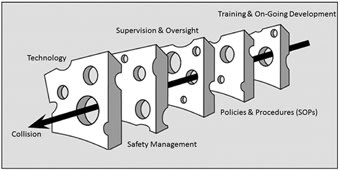
In my opinion, the Swiss Cheese model represents a fair depiction of the daily challenge faced by all safety professionals. The world is constantly changing and doing so in the blink of an eye. For this reason alone, the emergence of a new threat isn’t only likely — it’s totally inevitable.
As a result, transit operators must constantly search for (and recognize) potential gaps in their “stacks o’ cheese.” They must find a way to add that next slice before an emerging threat can exact adverse consequences. But how do we identify threats looming on the horizon?
Fact is, we already have lots of cheese.
Transit organizations invest greatly to promote safe operations. They provide comprehensive training programs for new hires and follow that up with continuous development efforts that take the form of refreshers, annual certifications, corrective actions (remedial), performance audits and feedback, coaching, etc.
They deliver safety programs, craft daily messages, issue bulletins, monitor and measure, recognize, and reinforce exemplary behavior and much more to mitigate risk and promote safe operations. And, they largely succeed. Mass transportation has an admirable record of performance. Data suggests that riding a bus is nearly 60 times safer than driving a car³. Yet, there is no time to stop and celebrate. Risk never sleeps, so safety professionals never rest.
Here are three potential sources for “holes” that may already be on your radar:
1. There are a growing number of cyclists on our roadways.
Unlike old farts like me, Millennials and iGen’rs are more likely to use bikes to get around — and like everything else — bikes are becoming more sophisticated.
I had an experience in October that made me appreciate a new twist to a familiar challenge for bus operators — sharing the road with cyclists. Allow me to explain. I passed a person mid-block that was pedaling their bike somewhere between five to 10 mph. As I approached the intersection, slowing my speed to conduct a right turn, this person whizzed past me at close to 20 mph. I noticed that the bike was equipped with an aftermarket electric motor able to convert a standard bicycle into a full-blown motorbike. Shame on me for letting my guard down. I should have continued to track the cyclist’s progress in my mirrors, especially knowing I would soon be turning.

Navya driverless shuttle.
2. Autonomous Vehicles
The AV Revolution is upon us. There is no escaping it now. The rush to be first to market with a fully autonomous vehicle has resulted in the rapid development (and refinement) of cutting-edge technology. It seems that everyone with a microprocessor has a stake in the game. So again, it’s no longer a matter of IF — it’s simply a matter of WHEN.
Of course, the replacement of human-piloted vehicles will not happen all at once. First, we will go through a series of transitional periods where human bus operators will find themselves interacting with varying degrees of augmented vehicles (human pilot with assist capabilities), mostly autonomous vehicles with imposed restrictions, and then — finally — fully autonomous driving machines. Oh, what fun we will have.
3. Unintended Applications of Technology
Misconceptions and/or gaps in pre-implementation training has resulted in documented cases of misuse or outright abuse of the technology.
For instance, a fleet manager recently discovered that a handful of drivers were relying on their newly adopted “fitness to lane” technology to protect them as they watched videos — while they were driving! Fortunately, the fleet manager was able to address — and eliminate — this practice before it was able to manifest as a regrettable outcome.
Sadly, many of us are familiar with the tragedy that resulted after an owner misinterpreted the level of personal engagement that must be maintained while using the autopilot mode of his Tesla Model S4.
More Tech Means More Training, Not Less
Training is a critical element toward the successful adoption of any new technology. Extreme care must be taken to ensure that each — and every — operator clearly understands the specific role, intended purpose, functional capabilities, and specific limitations associated with each new feature or system. There can be no doubt as to the degree of responsibility the operator must bear after implementation.
By now, you have surely noticed my careful side-stepping of the question posed in the opening paragraphs. That’s because no single person has all the answers.
Protecting an organization against looming threats requires an “all hands on deck” approach. An approach that involves vigilance, constant communication that moves critical information up and down the chain of command, relentless peer-to-peer sharing of best practices and lessons learned, and a willingness to accept insights gleaned from other modes of transportation.
To that end, we only have space here to get this conversation started. Please feel welcome to share those gaps and holes you have recently filled that appeared to be unique to your agency. They will no doubt benefit other properties that may soon find themselves dealing with that same issue for the very first time.
Steve Mentzer is a long-time industry veteran specializing in driver safety and training.
References:
Reason J. Human error: models and management. BMJ. 2000;320:768–70. doi: 10.1136/bmj.320.7237.768. [PMC free article] [PubMed] [Cross Ref]
http://patientsafetyed.duhs.duke.edu/module_e/swiss_cheese.html
https://usa.streetsblog.org/2014/12/19/heres-how-much-safer-transit-is-compared-to-driving/
Subscribe to Our Newsletter
More Blog Posts

Improving Transit Accessibility by Offering Assistive Listening
Did you know that there are literally tens of millions of people worldwide with hearing loss, many of whom will use some form of public transit at some point?
Read More →
35 Years of the ADA, Making Travel Easier for Seniors
Thirty-five years after the passage of the Americans with Disabilities Act of 1990 (ADA), the impact of this landmark piece of civil rights legislation cannot be overstated.
Read More →
Driving Performance with Purpose: How I Lead One of Greyhound’s Top Teams
Safety, on-time performance, and customer experience are critical elements in intercity bus operations. But getting them right doesn’t come down to plans or protocols alone. It comes down to execution. How well your team performs on the ground, in real time, is what defines success.
Read More →
Navigating Emerging Privacy Laws: A Call to Action for Service Providers in Mass Transit
With Data Privacy Day Jan. 28, I want to spotlight a critical challenge faced by service providers in the mass transit sector: managing personal information responsibly in an era of rapidly evolving privacy regulations.
Read More →
Human Trafficking Awareness: What Public Transportation Can Do?
January is National Slavery and Human Trafficking Prevention Month in the U.S., and January 11 is National Human Trafficking Awareness Day.
Read More →
Want to Improve Transit Safety and Operations? Break Down the Silos
Retrieving and reviewing data and video can be a cumbersome process for fleet managers. Each system or tool provides a piece of the puzzle, but seeing the complete picture requires tedious manual synchronization.
Read More →
Ensuring Public Transit Cybersecurity Through Robust Protective Measures
In today’s highly connected world, cybersecurity is of utmost importance, particularly for transportation agencies overseeing transit bus systems that rely increasingly on sophisticated technologies, including the use of data analytics in traffic signal networks, to manage and operate their systems.
Read More →
How Advances in Thermal Management Revolutionize Urban Mobility
In the daily hustle and bustle of city life, transit buses serve as the backbone of urban transportation, allowing millions of city dwellers to get from point A to point B each day reliably.
Read More →
The Evolution of Bus Design
Thirty years ago, drivers not only had to drive the bus and navigate heavy traffic, but they were also responsible for tasks like supervising passenger loading and unloading, selling tickets, and providing passengers with various kinds of information, all while sitting in an often ill-fitting workstation.
Read More →
What 'Transit Safety 101' Really Means
Safety, Safety, Safety. This word is used repeatedly, and in many contexts, without most people understanding what it actually means.
Read More →