



5 Questions: Omnitrans' Milo Victoria
Established in 1976, Omnitrans carries approximately 15 million passengers each year throughout its 480-square-mile service area, covering 15 cities and portions of the unincorporated areas of San Bernardino County.
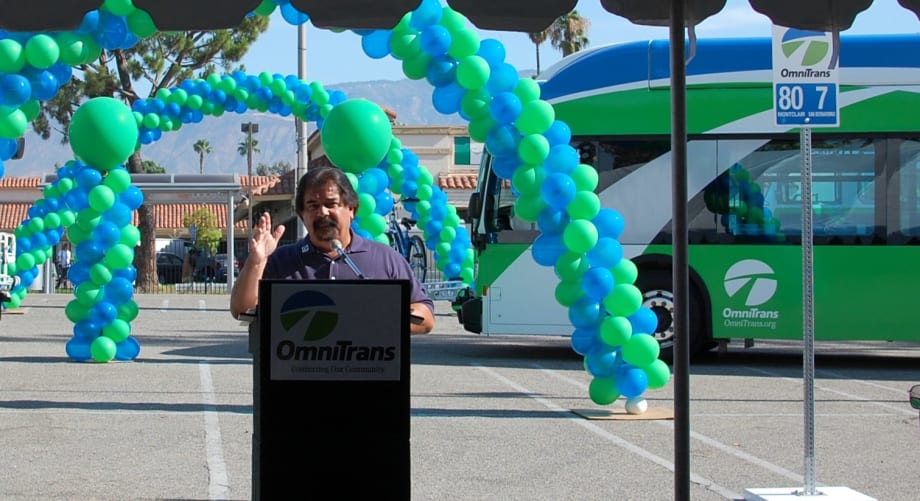
Milo Victoria was named GM/CEO of the San Bernardino, Calif.-based Omnitrans in January 2010. Previously the assistant GM, bus service, for the Washington Metropolitan Area Transit Authority (WMATA) in Washington, D. C., Victoria directed day-to-day operations of its fleet of 1,500 buses, serving more than 360 bus routes and more than 12,000 bus stops across 1,500 square miles. Established in 1976, Omnitrans carries approximately 15 million passengers each year throughout its 480-square-mile service area, covering 15 cities and portions of the unincorporated areas of San Bernardino County.
Omnitrans recently rebranded. Could you discuss a little about what went behind that decision and what the agency hopes to accomplish?
Omnitrans’ new look and logo are a reflection of renewal and growth of our agency. In addition to the fact that our former logo has been in place since 1985, our new logo is simpler, cleaner and contemporary. The circular shape and white T intersection in the logo design represent the ‘O’ and ‘T’ of Omnitrans. The ‘T’ also represents the roadways we follow in delivering our service to the community. The logo colors symbolize our green earth and blue sky, reflecting Omnitrans’ commitment to the environment and air quality in particular with our 100% natural gas-powered fleet.
The rollout of our new logo and fleet graphics illustrates Omnitrans’ dedication to fiscal responsibility. The launch was planned to coincide with the delivery of 20 new buses, so we were able to incorporate the new design at very little extra cost. Further, we have decided go with a simplified color refresh of our existing fleet, rather than completely revamping all of our buses with the new design, to significantly reduce costs. Updates of other agency identity items, including our 2,500 bus stop signs, will be rolled out over the course of this fiscal year.
We hope that our bold new design will generate a new awareness of Omnitrans and, ultimately, attract new riders to our award-winning transit agency. But, I have to say that my favorite part of Omnitrans’ new look is our tagline: ‘Connecting our Community.’ As we went through this process, discussing different options, this immediately resonated with me as the key to what we do. At its essence, this is our function: to connect all members of the community — from students, to mothers, to commuters, to persons with disabilities and senior citizens — with the places they need to go to live their lives as they choose.
Your nearly 16-mile sbX BRT system is set to launch in January 2014. How important will that new line be for the customers you serve?
When the first sbX corridor opens for passenger service in early 2014, not only will it provide a valuable service to our existing customers who rely on Omnitrans local Route 2 to get to businesses, medical facilities and school campuses, we think it will cater to a new group of passengers who realize the new service is sleek, state of the art, comfortable, faster and more frequent than fixed-route service, and more time competitive with automobile commutes. Our initial ridership projection for the sbX E Street line is 5,600 average weekday boardings, which is about 35 percent higher than the current local route delivers. We are confident that number will steadily grow, based on the successes of other BRT projects.
Even with the support of the city and nearby partners, how difficult is it to scrap for funds and complete projects such as sbX as well as projects planned down the road?
In contrast with the old ‘design and defend’ model of project delivery, when good planning comes first, investment and implementation will follow. Anyone who is asked to invest their precious dollars into a project —taxpayers, federal and state agencies, foundations, developers and financiers — will want to know what return they will get on their investment. This includes not only financial return, but the economic, social and environmental benefits to the community. It takes a lot of consensus building amongst all the community stakeholders to decide how to deliver projects in the most cost-effective way to bring the best value for the community.
At Omnitrans, we engage with community stakeholders throughout every step of the process. Each project ultimately is not Omnitrans’ project, but the community’s project. Omnitrans is a partner bringing resources, technical expertise and innovation to the table to meet the community’s goals. We facilitate dialogues between engineers, land use planners, developers, business owners, community advocates and other stakeholders to ensure a project is providing value to the entire community.[PAGEBREAK]
Omnitrans’ ridership continues to grow. Can you please talk about some of the important factors behind that growth?
We are happy to report that Omnitrans is ahead of the national trend for ridership growth. For our fiscal year 2011-12 we were 7.4% above of the previous year. We surpassed 16 million for the first time in eight years.
A key growth factor is the ‘Go Smart’ college program that provides unlimited bus rides to students at participating colleges. A one-year pilot program generated over 1.4 million trips from students, as over 25% of enrolled students hopped on board. Three community colleges approved student fees to continue the program for five years. A trade school also joined the program.
Other growth segments included our OmniGo community shuttle routes, which surged 34 percent year over year. Our freeway express route posted a 17 percent gain. Needless to say we are looking at opportunities to expand both local circulators and express service in the future.
Aside from your work at Omnitrans, you are also involved with Leadership APTA and Toastmasters. How important do you find it to stay involved both in your immediate community and the broader transportation community?
I have always been an advocate for development. The more we know, the better we can be at our jobs and at making decisions. In 2007 while working at WMATA, John Catoe asked me to be part of a panel for the Leadership APTA class. I loved it and decided to get involved in developing the future leaders of the industry. For the past two years, I have been part of the committee and really enjoyed spending time with these bright minds.
As for Toastmasters, when I first came to Omnitrans one of my board members suggested I check them out. I did and really enjoyed the easy, non-threatening manner in which one learns to be a better speaker, listener and leader. Being the advocate for development that I am, and with the help of my Director of Planning Rohan Kuruppu, we decided to start a Toastmasters Club exclusive to Omnitrans. It has been very successful, and we even received a top award from Toastmasters International, but most importantly, we have helped and continue to help our people gain many skills that will help them in their personal as well as their professional life.
More Bus

More Than a Summer Job: Building the Next Generation of Transit Talent
The Delaware River Port Authority and PATCO have transformed their internship program into a hands-on professional development experience that introduces students to the breadth of transportation careers — and creates a pipeline for future employees.
Read More →
LA Metro Board Awards 220 Battery-Electric Bus Contract to ENC
The contract, which is the largest base award of battery-electric buses by a U.S. transit agency, will be built in Southern California, sustaining good jobs as LA prepares to welcome the world in 2028
Read More →
Public Transit Conference Returning to GFX in 2027, Call for Papers Now Open
The Call for Papers is now open, allowing transit agency professionals and industry experts to help shape the PTC educational program by submitting session ideas for consideration.
Read More →
Indian River Transit’s Community-Focused Approach Earns National Recognition
Named APTA’s 2026 Outstanding Public Transportation System in its size category, Florida’s Indian River County transit system continues to grow ridership through fare-free service and a focus on evolving community needs.
Read More →
ENC Lands MATA Contract and More in Biz Briefs
In this edition of Biz Briefs, we spotlight the latest developments shaping the future of mobility.
Read More →
From Surviving to Thriving: Building Stronger Transportation Organizations
Bus Business Consultants founder Brian Dickson shares lessons on leadership, organizational health, and creating options for long-term success in a changing transportation industry.
Read More →
Everett Transit, Community Transit Outline Consolidation Agreement
The proposed agreement calls for a 50% increase in bus service in Everett, a new microtransit zone, continued paratransit service, and the transfer of Everett Transit operations to Community Transit.
Read More →
SEPTA Details Accelerate Vision for Transit System
The plan outlines investments in trolley modernization, new Metro and Regional Rail vehicles, accessible stations, and more frequent bus and rail service.
Read More →
Report: Transit Bus Manufacturing Supports 34,100 Jobs, $5.1B in GDP
The “Buses Mean Business” report examines the transit bus manufacturing industry’s economic footprint, supply chain, and rising demand for vehicle replacements.
Read More →
Biz Briefs: New Flyer Delivers in Columbus, Houston, Beep and Freebee Merge, and More
In this edition of Biz Briefs, we spotlight the latest developments shaping the future of mobility.
Read More →